Citizens United 2.0

The Supreme Court heard oral arguments on a GOP-led case that could repeal campaign finance limits on how much money parties can redirect to individual candidates. Here are the standout moments.
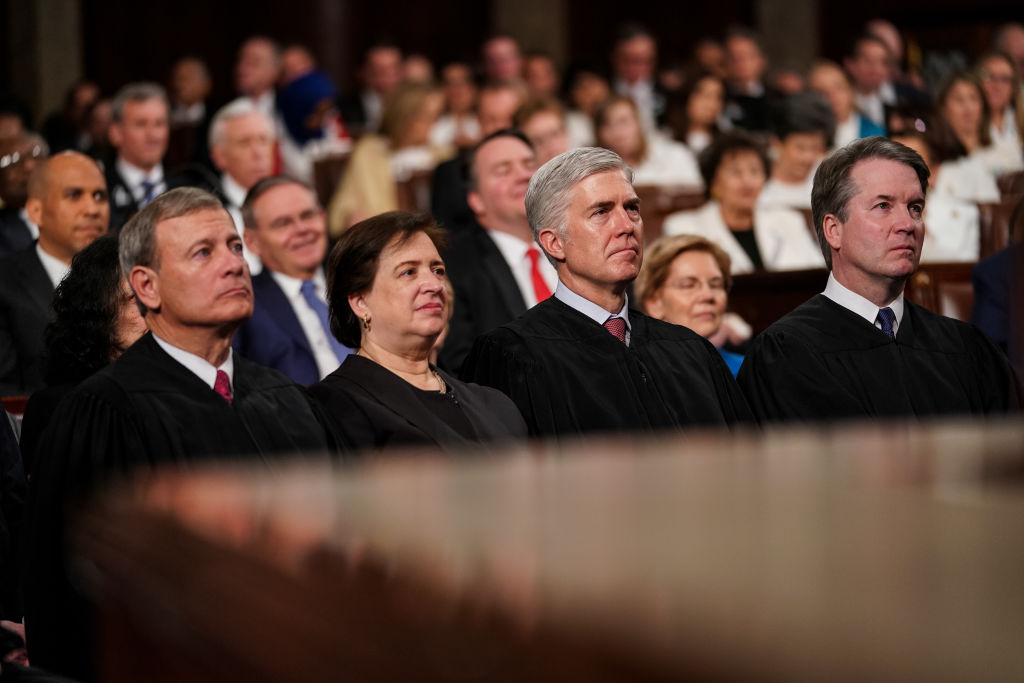
A new Supreme Court case could become Citizens United 2.0. (Doug Mills / Getty Images)

Last week, the US Supreme Court heard oral arguments in a GOP-backed effort to repeal campaign finance limits on how much money parties can redirect to individual candidates.

This case could expand the court’s 2010 Citizens United decision, which overturned generations of anti-corruption campaign finance regulation and opened the floodgates of corporate and billionaire political giving.

The Citizens United decision still kept intact decades-old limits on party-coordinated campaign spending, which the Supreme Court upheld in 2001 in the face of another Republican-led effort against campaign finance limits, in part, because they stop donors from simply circumventing individual giving caps by funneling money through parties.

But now, the National Republican Senatorial Committee and other GOP interests want even these threadbare rules abolished — they claim spending limits “are at war” with the high court’s recent rulings on the First Amendment.

Here are the top standout moments during arguments of a case that could become Citizens United 2.0.

1. Republicans said the quiet part out loud about super PACs.

According to those aiming to kill the spending limits, their opponents’ anti-corruption arguments are based on “Rube Goldberg” theories of crime — referencing the famous cartoonist whose machine drawings solved basic problems in the most comedically complex manner possible.

There are, they argue, much easier ways to deliver a bribe through existing campaign finance law.

“A would-be briber would be better off just giving a massive donation to the candidate’s favorite super PAC,” Noel Francisco, a lawyer representing the plaintiffs, argued. “Why [donate to party committees] rather than just cutting a million-dollar check directly to the candidate’s favorite super PAC?”

2. Justice Sotomayor almost dropped an “M” bomb.

After liberal Justice Sonia Sotomayor pointed out that recent presidential campaigns have used party-coordinated spending to solicit individual donations far exceeding the $3,500 limit enforced by the Federal Elections Commission, Francisco argued that “more speech is always better than less speech” and that high-dollar donations aren’t linked to corruption or the appearance thereof.

To which Sotomayor pointed out the Cybertruck-shaped elephant in the room: “You mean to suggest that the fact that one major donor to the current president, the most major donor to the current president, got a very lucrative job immediately upon election from the new administration does not give the appearance of a quid pro quo?”

Sotomayor was, of course, referencing billionaire tech mogul Elon Musk, who used his America PAC to give a record $277 million to support President Donald Trump and the Republican Party in the 2024 election, and was subsequently made head of the Department of Government Efficiency (DOGE).

In response, Francisco (rather obtusely) suggested that Musk, as one of the world’s richest men, couldn’t be bribed with a government job — a point which Sotomayor quickly shut down on account of the billions of dollars in taxpayer money Musk enjoys at his technology and space ventures through federal contracts issued by agencies he oversaw as part of the now-defunct DOGE.

3. Justice Alito “um, actually’d” Citizens United.

All that super PAC talk apparently ruffled the feathers of conservative justice Samuel Alito, who took time to defend “our much maligned, I think unfairly maligned, decision in Citizens United,” which he argued “helped level the playing field.”

Alito then asked the plaintiffs who they think would most benefit from repealing party-coordinated spending limits — and their answer was . . . America herself.

By eliminating campaign finance limits on parties, Francisco argued, “you start to restore the political parties to the relative political power that they’ve ultimately had [in the past], which I think is ultimately to the benefit of democracy itself.”

Francisco is referring to the political machines of the nineteenth and early twentieth centuries, when parties served as iron-fisted gatekeepers and kingmakers of the political process. That was undone over the course of decades of electoral reform and regulation, including in response to Watergate.

4. The “milk money” scandal got a mention.

Throughout the arguments, the GOP’s lawyers maintained there is absolutely no evidence to prove that corrupt actors have used party-coordinated spending to circumvent campaign finance rules and execute a quid pro quo bribe.

But as Sotomayor pointed out, the campaign finance laws in question were created, at least partially, in response to a documented quid pro quo scandal involving party-coordinated giving. The 1971 “milk money” scandal saw the dairy industry channel $90,000 a month to President Richard Nixon’s campaign coffers, laundered through the Republican Party and its committees, in exchange for Nixon’s backing of milk subsidies, among other favors for Big Dairy.

“I don’t understand how you can say there’s a lack of evidence [of quid pro quo]. It’s replete in all of our cases and in the history. And if there’s not direct evidence, it’s because our [regulatory] umbrella is working,” Sotomayor said.

5. J. D. Vance’s political ambitions were hotly debated.

Meanwhile, defense lawyers defending party-coordinated limits argued that the GOP’s suit should be dropped by the Supreme Court, because it no longer involves “live controversy.” That’s because the case was cofiled by then-senator J. D. Vance (R-OH), who ostensibly had a stake in the game when he was seeking reelection to the Senate.

Vance, they argue, is clearly no longer an active candidate, rendering the case moot.

However, the Republican Party’s attorneys insist Vance is still a potential candidate for 2028, citing his active Senate election committee — as well as the likelihood that he’ll run for president.

“We also know that virtually every vice president goes on to run for the presidency, particularly young ones like Vice President Vance,” lawyers for the GOP argued.

That might be unwelcome news to Vance’s boss, who’s said “there are methods” to bypass the 22nd Amendment and get a third term in office.