Oasis’s Working-Class Image Is Seductive but Empty
English rock group Oasis has always been a populist contradiction, rooted both in working-class culture and the individualism of post-Thatcherite Britain. But while other bands become more political, Oasis’s comeback tour offers only escapist nostalgia.
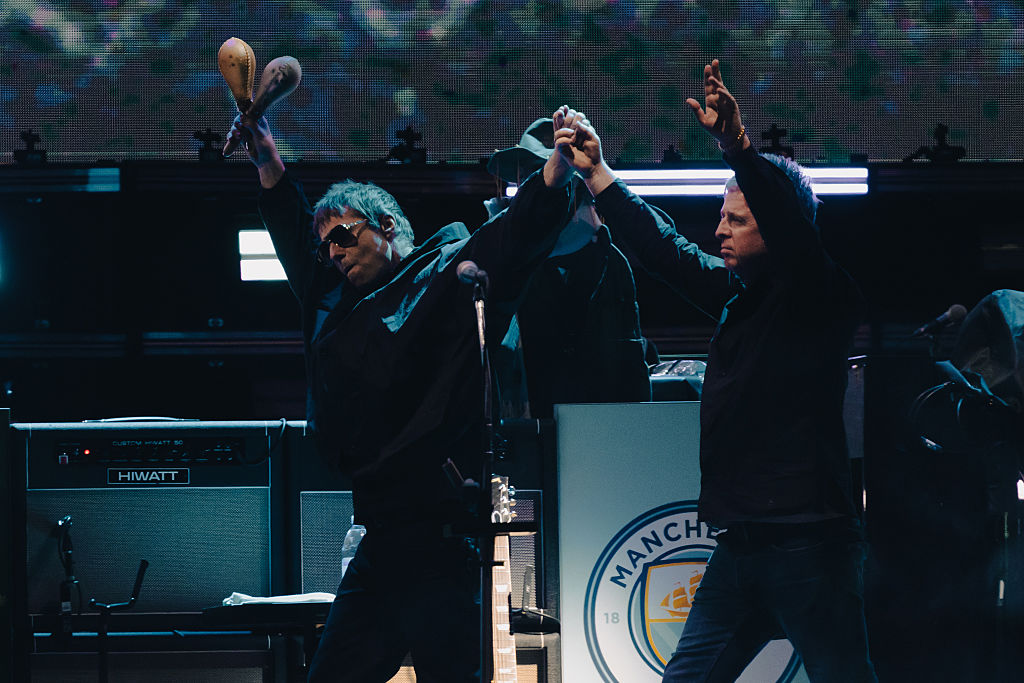
Audiences have not simply learned to tolerate the Gallagher brothers’ preening self-admiration; they have become enamored by it. (Chris Putnam / Future Publishing via Getty Images)
“What a stadium, man,” Liam Gallagher shouted at the audience, just over thirty-seven minutes into Oasis’s first of two sold-out shows at MetLife Stadium in East Rutherford, New Jersey — an 82,500-seater venue. “Nearly as big as my house.”
If there’d been any doubt, Oasis’s unmitigated swagger and trademark self-regard were clearly back. With recent stops in South Korea, Japan, and Australia, plus several more coming up in South America, their Live ’25 tour — the band’s first since breaking up in 2009 — has been a euphoric success. Leaving little to chance, it has also resulted in few surprises, whether capacity crowds (despite costly dynamic ticket pricing), visible onstage warmth between the oft-tempestuous Gallagher brothers, or charismatic setlists that have dwelled on the band’s canonical first two albums, Definitely Maybe (1994) and (What’s the Story) Morning Glory? (1995).
What has been surprising is the ecstatic reception the band has received, especially in the United States. While British listeners briskly institutionalized Oasis, reflected by their historic shows at the Knebworth Festival in 1996 only two years after its debut LP, they had a more polarizing effect on American audiences during the 1990s. Their brash self-proclamation about being bigger than the Beatles caused distaste at a time when crass commercialism proved divisive among musicians and audiences on the independent music scene.