From Socialism to “Capitalism for All”
Bolivia’s election of the center-right Rodrigo Paz Pereira marks the end of the MAS’s nearly 20-year rule. As MAS self-destructed, Paz appealed to an urban middle class that expanded as the Left achieved historic reductions in poverty and social inequality.
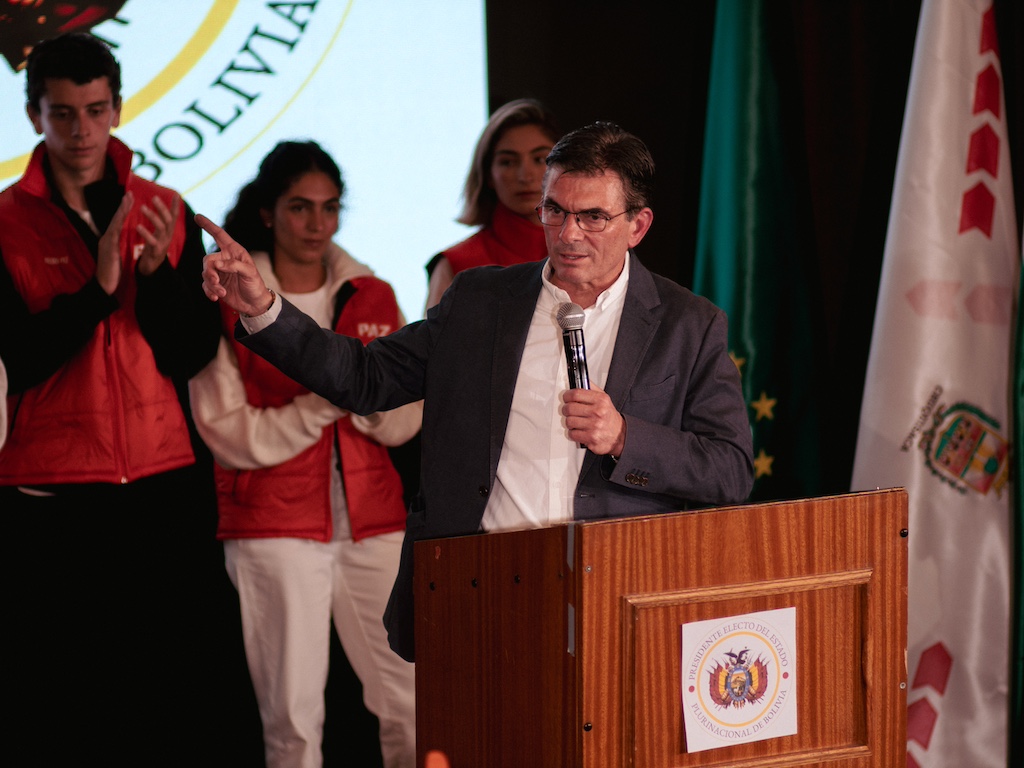
Rodrigo Paz Pereira addresses supporters in La Paz, Bolivia, after winning the election. (Benjamin Swift / Jacobin)
Bolivia’s October 19 runoff vote not only elected the center-right Rodrigo Paz Pereira as the next president but put the final nail in the coffin of the nearly twenty-year rule of an indigenous left-wing coalition. The Christian Democrat Paz, propelled into prominence by his popular running mate, former policeman Edman Lara, beat far-right candidate Jorge “Tuto” Quiroga by a resounding 9 points.
Paz’s promotion of “capitalism for all” resonated in a country dominated by the world’s largest informal economy. Even during the indigenous working-class leader Evo Morales’s fourteen years in office, there was rarely a debate about socialism per se. Committed Marxist vice president Álvaro García Linera promoted what he called “Andean-Amazonian capitalism,” adapted in his view to the reality of a country without a strongly developed working class and industrial economy. Instead, their party, the Movement Toward Socialism (MAS), focused on developing a strong state capable of effectively negotiating with private capital on behalf of Bolivia’s people.
“When Evo Morales came into office, indigenous people sought recognition from the state, but now they are more interested in getting help for their business endeavors,” explains Quya Reyna, a thirty-year-old Aymara writer. “Their interests have shifted from being social to economic, which means they now have found more of a home on the Right.” In the context of the increasing social and economic mobility created under the MAS government, voting for Paz represented a strategic choice, designed to avoid losing the gains made under the MAS government.