“Bolivia Is Not for Sale”
Bolivia’s new right-wing government was forced to abandon its neoliberal reform package, pushed by executive decree, following the largest mobilization of the nation’s labor movement in at least five years.
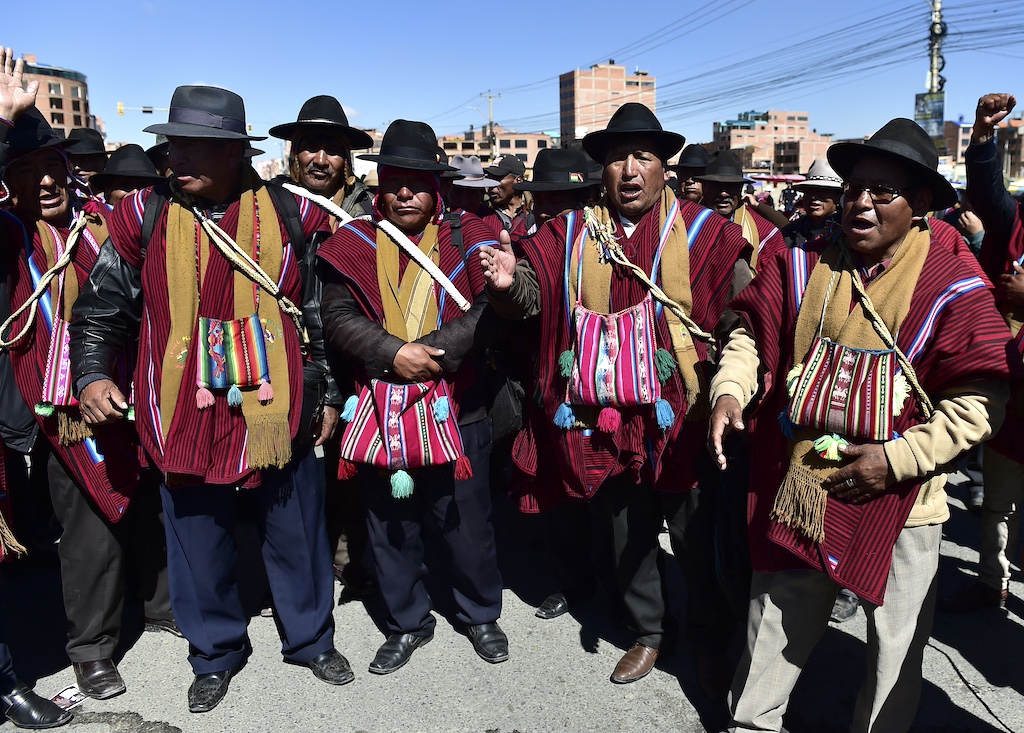
The victory of the COB shows that while the MAS may have been crushed as an electoral force last year, its social movements have recalibrated. (Jorge Bernal / AFP via Getty Images)
“Fuerza, fuerza, fuerza! Fuerza, compañeros!” bellowed a man in a miner’s helmet into a megaphone. Marching through the sun-drenched streets in the haze of noisy firecrackers, thousands of miners, workers, peasants, civil society associations, and indigenous organizations in Bolivia descended on the city of La Paz earlier this month in the biggest social mobilization in at least five years. Beyond the city, road blockades led by union locals brought transport to a near standstill across the country. In the streets, the mantra was “Bolivia no se vende” (Bolivia is not for sale).
The mass protests against the executive decree of newly elected Rodrigo Paz’s conservative government lasted nearly a month. While presented as the elimination of the fuel subsidy, which keeps gasoline prices artificially low, Decree 5503 would have also privatized key natural resources and implemented a wide range of austerity measures.
The impressive display of workers’ might, combined with an effective negotiation strategy by the trade union confederation, the Central Obrera Boliviana (COB), forced the government to back down. It announced it would draft a new decree as per an agreement with the unions that opposed the original decree. The fuel subsidy will not return, but the range of other neoliberal policies will be abandoned.
“We can proudly say: ‘Duty fulfilled, Bolivian people. The objective has been achieved, my comrades,’” COB leader Mario Argollo declared after the negotiations.
The victory of the COB shows that while the Movement Toward Socialism (MAS) may have been crushed as an electoral force last year after two decades in power, its social movements have recalibrated in defiance of right-wing domination.
Decree 5503
It’s telling that the fuel subsidy, a power-keg issue of Bolivian politics, proved to be one of the least contentious in Paz’s decree. Given the country’s deepening economic crisis, actors across the political spectrum seemed to agree that its time had passed.
The history of the fuel subsidy is long and controversial. It was first introduced in 1997 by former dictator Hugo Banzer, during his second democratic presidency, as a tool to curb inflation. Evo Morales attempted unsuccessfully to cut the subsidy in 2010, an effort also met with mass protest, and Luis Arce attempted again in 2024 by proposing a referendum that ultimately never took place.
Prior to Decree 5503, issued in late December, a liter of diesel and gasoline in Bolivia was sold at a subsidized price of $0.53, a policy that cost the state $2 billion a year. Removing the subsidy is part of a range of austerity measures designed to address Bolivia’s fiscal deficit and the economic turmoil of dollar and gas shortages and rising inflation over the past two years. Fuel prices will now increase by 86 percent for gasoline and 162 percent for diesel.
When the announcement was made just before Christmas, unions representing the choferes (minibus drivers) and transportista sector were initially up in arms. However, after the government reached a backdoor deal with the transport sector unions, this left only the COB and later the peasant union, the Confederación Sindical Única de Trabajadores Campesinos de Bolivia (CSUTCB), to oppose the decree.
Printed booklets of the decree were being sold on every street corner in La Paz. A look at its fine print reveals the devil is truly in the details. As the COB argued, the fuel subsidy was just the tip of the iceberg. With 121 articles, the decree would in fact have ushered in a range of radical neoliberal reforms, from allowing the Central Bank of Bolivia to approve potentially high-risk financial programs to a fast-track process for approving extractive projects by foreign companies outside customary checks and balances. To sugarcoat the decree, Paz also raised the minimum wage to 3,300 bolivianos per month (US$480), although it only benefits those laboring in the formal economy, around 17 percent of workers according to the International Labour Organization.
While the press presented the issue as limited to fuel subsidies, the COB argued that the decree would champion private interests over the public good and was nothing less than a threat to Bolivian democracy itself.
Kawi Kastaya, a veteran union leader from El Alto, explained to Jacobin:
If the political constitution of the state stipulates that the legislative assembly is responsible for making laws, then they are the ones who must draft them to address the issue of subsidies or to allow any institution to exploit natural resources. So, regarding the decree, the president has decided to violate that part of the state’s political constitution. That’s why many representatives of social organizations have spoken out.
Indeed, in a Facebook post, economist Gonzalo Colque from the NGO Fundación Tierra notes that the decree was designed to enable the capture of the state by “opportunistic minorities.”
Former peasant union leader and Aymara community activist Roberto Pacosillo Hilari, speaking to Jacobin, concurred that the decree represented a disturbing overreach of executive power: “It is not democratic. . . . No government is authorized to rule by decrees.” He expressed particular concern about the risk to Bolivia’s natural resources through exploitation by foreign companies, which could have been expanded through the decree. “All activity, such as mining, has an environmental impact,” he warned.
The COB — an umbrella labor organization dominated by the miners’ union, the Federación Sindical de Trabajadores Mineros de Bolivia, and currently led by Mario Argollo — has long been a powerful force in Bolivia, playing a pivotal role in the 1952 National Revolution, for example. But many doubted that it still had the political clout to mount an effective challenge to neoliberal reform. Bruised from the collapse of the MAS in the recent election, and plagued by protracted infighting and corruption allegations, could the COB assemble its unions on the streets?
The vigor of the COB’s response clearly took Paz by surprise. According to Kastaya, “If there hadn’t been the agreement [earlier this month], Bolivia would have been practically paralyzed, given the fact that more organizations were joining, transportation and others. So that’s why, out of fear, [Paz] stepped back.”
Both the COB and peasant union, the CSUTCB, have a long history of struggling for human rights, including from the dictatorships of the 1970s until the return to democracy in 1982. In 2020, the COB and CSUTCB mobilized to successfully demand that Jeanine Áñez hold elections after a year of unelected far-right rule following the coup against former president Morales.
Neoliberalism Returns to Bolivia
Decree 5503 reflects the neoliberal mission of the Paz government and a commitment to deepening the extractive model at the expense of workers, peasants, and indigenous peoples — a commitment that won’t disappear with the defeat of the decree.
The Paz government has also expressed its intentions to deepen its relations with the United States following the MAS’s expulsion of the United States Agency for International Development (USAID) and the Drug Enforcement Administration (DEA) following its meddling in Bolivia’s affairs. As the United States expands his imperialist assault on Latin America, Paz’s government has bent over backward to accommodate Donald Trump’s new imperial world order. Earlier this month, the Inter-American Development Bank (IDB) arrived in Bolivia and announced it would offer the country a $4.5 billion support package, six times larger than the bank’s previous allocation. The money will support agribusiness and mining, among other sectors, according to the bank.
Local footage also suggests the DEA is flying drones and helicopters over the Chapare region, where former president Morales is under the protection of his coca-growing supporters.
At the same time, the Paz government has reneged on its commitment to protect the Tariquía National Reserve of Flora and Fauna, a biodiverse reserve in the east of the country where local indigenous and peasant groups have long resisted oil-drilling initiatives. Amid the protests, the police forcibly penetrated a checkpoint in the Quebrada Las Vacas area to allow the Brazilian petrol giant Petrobras to access the site of the planned Domo Oso X-3 (DMO-X3) exploratory well.
Environmental defender and peasant Nelly Coca told the local press:
We thought that with this government there would be a change for us; we had hope that they would respect Tariquía. When he was a senator, [Rodrigo Paz] came to my house, and we signed an agreement stating that he would not allow the oil companies to enter, that he would defend the reserve. However, he is the first to send the security forces to detain us and trample all over us.
Vengeance in a Post-MAS Bolivia
Since Paz took power in November 2025, he has been committed to quashing the MAS and the social movements that brought it to power back in 2005. The indigenous wiphala flag was swiftly removed from the official presidential sash as soon as Paz took power.
Former president Arce currently languishes in jail alongside ex-MAS politician Lidia Patty, from the indigenous Kallawaya nation, facing charges of corruption relating to the Fondo Indígena, a Morales-era expenditure program that redistributed funds to Bolivia’s poorest indigenous communities. Although the program had long been plagued by accusations of improper expenditure, the fact that the majority-white government has focused its attention on a program that redistributed funds to indigenous groups, overseen by indigenous peoples themselves, is a clear message.
Meanwhile, Áñez, the short-lived dictator who seized power in 2019 during the coup against former president Morales, was immediately released from prison along with twelve others accused of involvement in the massacre of unarmed civilian protesters in Senkata and Sacaba during the coup. Over thirty-five people died in the violence that followed her seizure of power in 2019, according to Amnesty International. The charge against Áñez was annulled based on supposed violations of due process during her trial. As it stands, no one has been held accountable for these acts of state violence, a worrying indication of impunity.
The recent mobilization by popular sectors, however, exposes Paz’s shaky hold on power. “The Paz government surely thought it had power, legitimacy obtained from the elections,” says Kastaya. “But the majority of the population voted for his vice president, Mr Lara.”
A bizarre political dynamic has emerged in Bolivia in which Vice President Edmand Lara, elected on the same ticket as Paz last year, has mounted an increasingly vocal opposition to Paz. An ex-police officer from Cochabamba with a loyal Tik Tok following and a salt-of-the-earth demeanor, Lara is favored by the rural peasant sector and the urban working class. His popular persona contrasts with Paz’s urbane background in the white elite. Paz comes from a long line of politicians, with his father, Jaime Paz Zamora, serving as president between 1989 and 1993.
In response, Paz has sidelined Lara and issued another decree, weakening the vice president’s authority by ensuring he cannot wield executive power when the president is abroad.
A Backlash Brewing?
During the protests, the right-wing-controlled media in Bolivia began drip-feeding a stream of anti-COB stories, alluding to the inflated salaries of COB officials and their involvement in alleged MAS-era corruption. Paz has issued warnings against the use of dynamite in protests, despite no evidence of dynamite being used in the recent marches.
Although this did little to dent support for the COB in resisting the decree, an authoritarian right-wing discourse around blockades has gained traction among the urban middle classes. Paz’s government is seeking to introduce a law regulating blockades, a time-honored form of Bolivian protest and a cornerstone of campesino mobilization in the landlocked country. A proposed bill includes penalties of up to twenty years in prison for those who organize or participate in blockades, which would deal a major blow to the right to protest.
The CSUTCB has said it will resist efforts by representatives in the right-wing dominated legislature to outlaw blockades.
Recent weeks have seen, in the post-MAS climate, a reenergized COB emerge as an emboldened instrument of workers’ power in defiance of the authoritarian government. Paz knows that he is now on the back foot, with the COB winning an important victory for democracy and workers’ rights in Bolivia by overturning Decree 5503. But whether this heralds a new cycle of class struggle in one of Latin America’s poorest countries remains to be seen.