France’s Secret War in Cameroon Is Still Choking Its People
The world’s oldest president, Cameroon’s Paul Biya, is running for yet another term. Biya’s autocratic rule stems directly from a brutal colonial war France waged in the 1950s and ’60s while keeping it virtually hidden from the outside world.
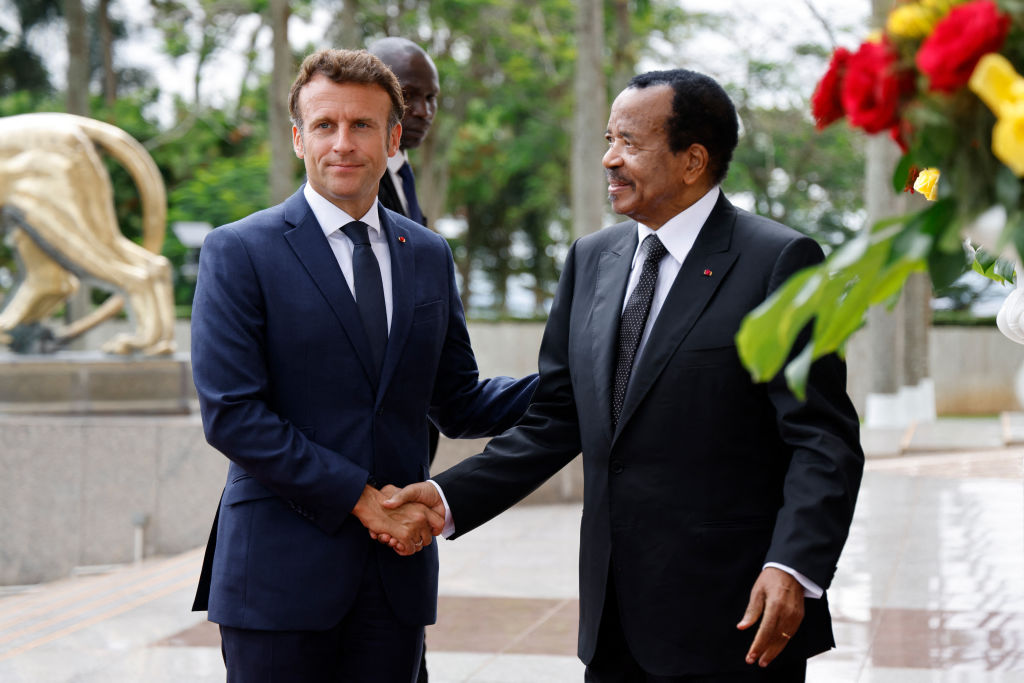
French president Emmanuel Macron shakes hands with Cameroon’s president, Paul Biya, as he arrives for talks at the presidential palace in Yaoundé, on July 26, 2022. (Ludovic Marin / AFP via Getty Images)
During the 1950s and ’60s, France waged a brutal colonial war in Cameroon while managing to keep it largely shielded from scrutiny. The American historian Caroline Elkins refers to the silence that followed the British repression of the Mau Mau in Kenya as an instance of “state-imposed amnesia.” The line likewise applies to Cameroon: everything was done so that this invisible war would never return to haunt official French memory.
This organized amnesia has led to some surprising, or at least telling, episodes. When French prime minister François Fillon visited Yaoundé in May 2009, a journalist asked him about the French responsibility for the assassination of Cameroonian nationalist leaders. He astonishingly replied, in a mixture of ignorance and contempt: “I totally deny that [the] French participated in any way in assassinations in Cameroon. All that is pure invention!”
But ghosts are in the habit of coming back to haunt us. For some years now, a new generation of Cameroonian historians has been leafing through the archives and traveling up and down Cameroon to interview the last survivors. This is a race against the clock, as the archives, poorly preserved, rot quickly in the country’s tropical climate. As for eyewitnesses, there are ever fewer of them in a country where the average life expectancy is just fifty-five.