My Grandfather Resisted the Nakba. It Still Isn’t Over.
Palestinians mark May 15 as Nakba Day, anniversary of the foundation of Israel. That state was born amid mass displacement and ethnic cleansing — and it’s getting even worse today.
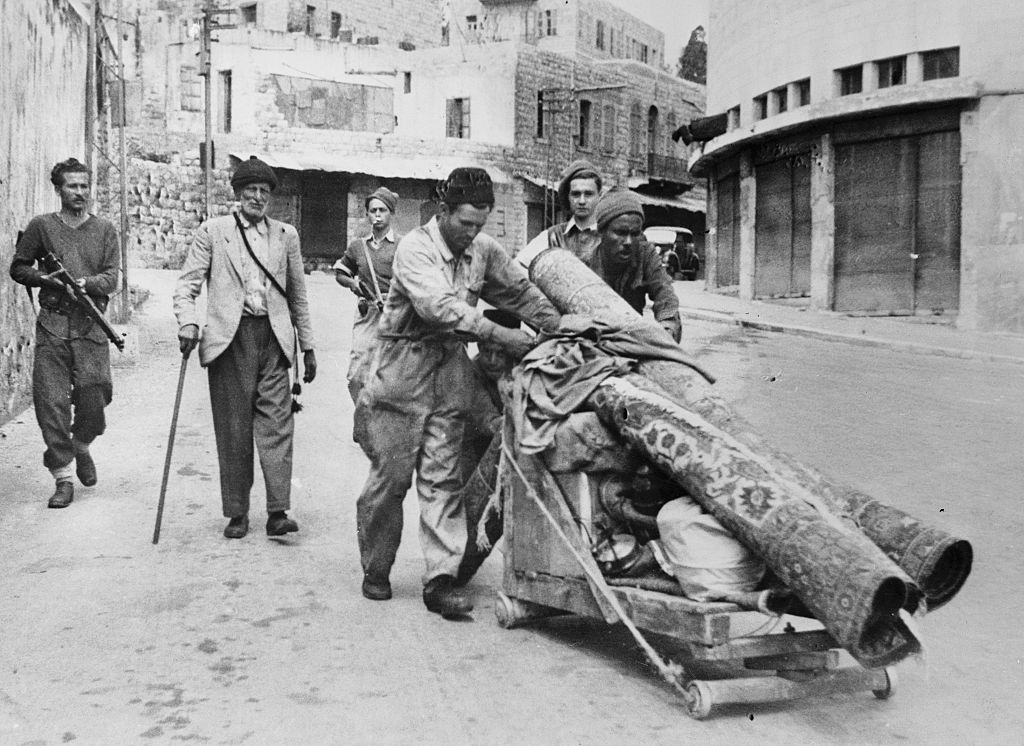
Members of the Zionist paramilitary group Haganah lead Arabs out of the Jewish-captured city of Haifa during the Nakba on May 12, 1948. (Bettmann / Getty Images)
It’s seventy-seven years since the Palestinian Nakba — the catastrophe. Rather than a single point in time, we might think about it as a disaster whose legacies and possible outcomes are still unfolding. In its lifespan, a new geological time period has been anointed, the number of sovereign nation-states has jumped from seventy to almost two hundred, and communication has been revolutionized by IT. Amid this dizzying kaleidoscope, the Palestinians have fought desperately — often in vain — to control the tide and meaning of their national cataclysm. In one direction lies survival. In the other, the way of the dodo. The Nakba’s ultimate legacy has never been predetermined. But the starkness of that binary choice has always been obvious to Palestinians.
May 15 is chosen as “Nakba Day” because it is the day that Israel declared itself independent. But just as Rome wasn’t built in a day, neither was historical Palestine reduced to rubble overnight. My paternal grandfather, Ahmed, was a young man of twenty-four when the ethnic cleansing of Palestine broke out in 1948. An East Jerusalemite from the Mount of Olives neighborhood, he immediately volunteered to fight against the destruction of his homeland. But Ahmed’s childhood and teenage years had also been overcast by the last years of the British Mandate, the exponential growth of Zionist Yishuv (“settlement”) populations, and the rise of terror gangs like the Irgun and Lehi. By the late 1930s and early 1940s, Palestinian marketplaces and cafés were being routinely booby-trapped and bombed, public buses commonly ambushed with guns and grenades. Just as the violence meted out to African Americans under Jim Crow was not “sporadic” or “mindless” intercommunal violence but carefully orchestrated terror designed to buttress white supremacy, so too the violence of the Zionist paramilitaries was the function of something much larger and deadlier.
The Nameless
That “something” began formally in November 1947. Within a year, approximately 80 percent of the inhabitants of today’s Israel had been forcibly displaced — 750,000 Palestinians driven from their homes. “Jewish villages were built in the place of Arab villages,” Israeli defense minister Moshe Dayan would later boast to a lecture hall full of Israeli students. “You do not even know the names of these Arab villages. . . . There is not one single place built in this country that did not have a former Arab population.”