The Trouble With the Free Press’s Olivia Reingold

For Olivia Reingold, one of the most prominent and prolific contributors to Bari Weiss’s Free Press, defending Israel seems to be a far greater priority than the facts.
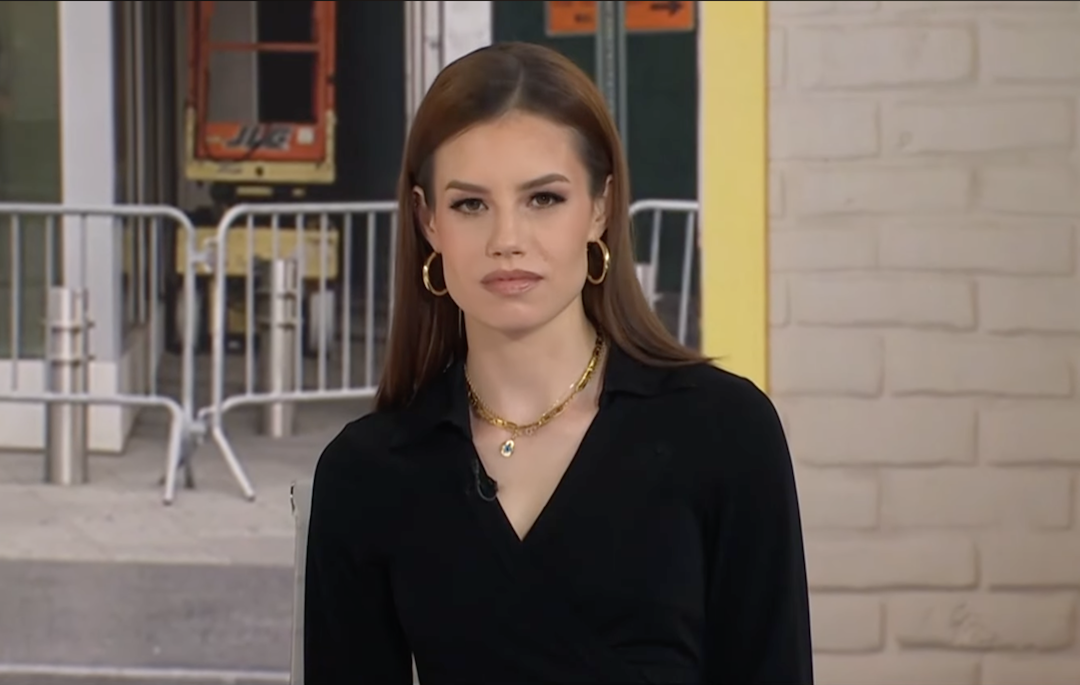
Olivia Reingold speaks on CBS News.

You almost feel sorry for reporters and influencers like the Free Press’s Olivia Reingold, who genuinely seems to believe that antisemitic animus, rather than anger at Israel’s war crimes, is lurking around every corner. (CBS News / YouTube)


On September 8, 2025, a tweet, soundtracked by Antonio Vivaldi’s “Spring,” went viral. In it, we’re shown a seemingly random collection of titles from Columbia University’s bookstore: Frantz Fanon’s Black Skin, White Masks; a kids’ book about the late Supreme Court Justice Ruth Bader Ginsburg; Richard Rothstein’s The Color of Law; Robert A. Dahl’s How Democratic Is the American Constitution?; and, among others, the Quran. The caption reads, “Went to the Columbia University bookstore — these are some of the books students are reading this semester. A bookstore employee told me the Qur’an is required reading for all freshman [sic].” That tweet’s author is the Free Press’s Olivia Reingold, a staff writer who is among the masthead’s most prolific. If you don’t frequently visit the Free Press website, you may have come across Reingold in her influencer-style Instagram reels, often delivered in a tone mixed of scorn, trepidation, and rage. These clips are mostly in defense of Israel and the GOP and screeds against New York City Mayor Zohran Mamdani and critics of Israel.

After October 7, Israel’s massacre of Gaza, and ensuing record negative views of Israel among the US public, new influencer opportunities have emerged for those who seek to do hasbara. Literally translated from Hebrew as “explanation,” hasbara basically entails doing pro-Israel public relations in the public sphere, no matter how horrific Israel’s crimes and often with a less-than-complete regard for the full truth. In this respect, Reingold has joined the ranks of other stateside, right-of-center, pro-Israel influencers: Fox News frequents Debra Lea and Emily Austin, Upper East Side cringe mom Lizzy Savetsky, and PragerU personalities like Xavier DuRousseau and Shabbos Kestenbaum, to name a few. Reingold, however, calls herself a “truth teller” on her personal website, who believes that “there is nothing more valuable than integrity.”

Indeed, unlike these other purveyors of hasbara, Reingold claims to be a journalist and a reporter. Looking at her work, far from seeing “integrity,” it’s hard to tell where the hasbara ends and the reporting begins.

Many valid criticisms have been leveled against Bari Weiss’s Free Press, as well as more recently the David Ellison–owned, Donald Trump–friendly, revamped CBS News division under her control. Earlier this month, veteran 60 Minutes journalist Scott Pelley was fired for apparently failing to get on board with the Weiss agenda; he proceeded to deliver a scathing interview to the New York Times decrying Weiss.

But Reingold says the quiet part especially loud in delivering shoddy propaganda, beyond the norm even for Weiss’s hires.

Reingold’s “Journalism”

Start with Reingold’s aforementioned visit to Columbia’s bookstore. In that post, her contempt for Islam as a whole is clearly suggested. Her implication is left purposely vague but seems to be that the Quran — assigned to second-year students (not freshmen, as she falsely stated) in the required course Contemporary Civilization — is unacceptable as an object of study.

Never mind that the Quran is just one of many texts assigned, taught in a secular and scholarly manner, as a major piece of world literature. Excerpts from the Old and New Testaments are also assigned throughout Columbia’s Core Curriculum. As a Columbia undergraduate myself, I just took Contemporary Civilization this past academic year and can happily report no instructor pushing me to adopt radical Islam.

Her seeming implication that Fanon, Rothstein, and Dahl are anathema to some sort of proper university education is even more absurd. All three are serious authors whose works have had real impact on the world. Should such authors not be studied in a university context?

Reingold was fearmongering about texts that are sold at a bookstore, using individual titles — whose “problematic” nature she seems to assume needs little explanation, whether or not they are key texts in anti-colonial movements worldwide, like Fanon’s, or influential works of constitutional scholarship, like Dahl’s — to paint a picture of a hellscape of radicalism in Morningside Heights. In this sense, she appears no better than the Right’s favorite “ultrawoke” caricatures, taking things out of context and maintaining a constantly offended, constantly shocked posture — a mirror image of the narrative that the Right, and the supposedly anti-identitarian and pro-free-speech Free Press, has gotten so much mileage out of in recent years.

Still, if this were just one incident, perhaps it could be seen as just an unfortunate faux pas and not indicative of Reingold’s work as a whole. But the month prior to her visit to the Columbia bookstore, Reingold cowrote an “exposé” alleging that twelve Gazan kids featured in the New York Times as evidence of Israeli-induced starvation “lacked important context.” Her reasoning: those kids all had underlying medical conditions.

This point ignores the obvious fact that children with underlying conditions are more likely to die first in a famine. Reingold wasn’t attempting to prove that these children weren’t starving, or that there wasn’t a humanitarian crisis in Gaza — only to shift the blame from Israel.

And her actual defense of Israel was rather odd. Reingold reached out to Yannay Spitzer, at the time an economist at the Hebrew University of Jerusalem, whose comment she paraphrased as, “Hunger in Gaza is largely declining since Israel resumed aid deliveries in late May after its nearly 80-day blockade.” For Reingold to include that hunger is decreasing in Gaza after Israel lifted the aid blockade means that Gaza was experiencing hunger because of Israel prior to lifting the blockade.

In a subsequent Instagram reel explaining her reporting, Reingold said that the fact that the same children ill “not just with malnutrition” were being photographed by different people somehow indicated some degree of “coordination.” She said she did “something so simple, it’s shocking no other journalist bothered to do it” and translated the names of starving Gazan kids from English to Arabic, then searched for those names in Arabic, where local news sources had covered underlying conditions more than their anglophone counterparts, according to Reingold (though she concedes the New York Times indeed had reported on some of it) — proving, apparently, “a more nuanced story.”

That is, according to Reingold, Israel doesn’t want these kids dead and isn’t responsible for famine, and that “the average Gazan doesn’t look like that.” None other than Benjamin Netanyahu would proceed to post that reel to his own Instagram account. Caption: “Facts matter>>” 

For Reingold, it is Israel, and not the facts, that matters more than images of skeletal children — with or without the supposedly important underlying conditions — that would disgust any normal human being. The pushback to all of this, she claims on her website, was “a global cancelation campaign.”

What Reingold’s Religion Really Is

Reingold-style Zionism appears as a religion. That religion is not Judaism, nor is it just about believing in the Jewish national project; it is an incessant deference to the unflagging righteousness of a modern nation-state with a sophisticated military, nuclear weapons, a powerful American lobby, near-total control over Palestinians in the occupied territories, and a foreign policy that seems to necessitate always killing innocents in the region. 

That may be why Reingold, again using the language of wokeness, decided to call the images of the starving kids across mainstream media “problematic” in her monologue. “Problematic,” because they make her feel uncomfortable and put into direct question her absolute certainty of the all-good, always-good of Israel and Zionism.

Interestingly, it seems Reingold wasn’t always this way. In a March essay about being an “October 8 Jew” — Reingold is part-Jewish, on her father’s side — she explained, “I came into the Arab-Israeli conflict as a nearly blank slate. I was open to the claims that my friends were making on social media — that Israel is an apartheid state, a colonial entity, and even guilty of genocide.” At a time when many American Jews saw the horrors unleashed upon Gaza and began to question their support for Israel’s warmaking and its current right-wing extremist government, even their Zionism altogether, Reingold went in exactly the opposite direction.

After apparently engaging critically with a broad swath of Americans skeptical of Israel, Reingold reached the conclusion: “What I saw wasn’t a civil rights movement. . . .  This was about Jews.” Seeing widespread outcry about Israel’s atrocities as sure evidence of a revival of ancient antisemitism, Reingold went on to embrace what she described as her “link” to Judaism, but that in actuality is hasbara: a “journalistic” project constantly reinforcing the State of Israel’s, the American supporters of Israel’s, and pro-Israel establishmentarian conservatism’s bottom line instead.

She tweeted earlier this month that a Jewish Voice for Peace activist she interviewed for a recent piece wasn’t really a Jew, since the individual in question did not grow up Jewish. Far from me to determine this, but by Reingold’s own standard here, she herself is not really Jewish either.

What she’s saying is clear: to be a “real Jew,” you must be an avid supporter of Israel today. Again, it is an ideological orthodoxy in defense of the actions of a modern state, not Judaism or even Zionism in the strict sense of the word, that is her religion.

However, I have no reason to doubt Reingold’s explanation of her evolution to where she finds herself today. If you take a look at Reingold’s previous stints in media — Georgia Public Radio (news reporter); Yellowstone Public Radio (tribal issues correspondent); Politico (editor-producer for audio); Matthew Yglesias’s Bad Takes, which in a LinkedIn post she claimed she launched and was her concept — she wasn’t exactly ranting in defense of Israel the whole time as she is now. In fact, she wasn’t doing so at all.

This is where I feel sorry for Reingold. She appears to genuinely believe that the election of Mamdani, declining support for Israel, and sympathy for the plight of Palestinians is all a harrowing step in ushering in twenty-first-century hatred of Jews. In her own words, “Anti-Zionism is antisemitism,” and an editorialized report she coauthored on the night of the Democratic Socialists of America’s sweeping 2026 New York City primary victories featured the scary subtitle: “On Tuesday, radical House candidates won big in the city. ‘It doesn’t feel safe to be Jewish anymore.’”

Previously, in a December 2024 piece on “How to ‘Make Your Campus Palestinian,’”Reingold framed the recruiting of Jewish students into the pro-Palestinian movement as a cynical move to legitimize antisemitism. It is true that antisemitism is on the rise in some respects — as anyone who spends a significant amount of time online can tell you, and with anti-Jewish hate crimes having peaked in October and November 2023 (though since much declined) — and that campus activism has occasionally veered into territory broadly alienating to Jewish students and even, rarely, downright violent, America’s public outcry ultimately was and is about the violent actions of a foreign government we’re financing, not “the Jews.” In explicitly tying the protection of Jews to support for Israel, Reingold is insisting on the actions of Israel as the will of all Jews — much like the antisemites justifying the hatred of Jewish individuals based on their group identity and the decision-making of the nation-state claiming to represent them.

The Next Bari Weiss Carries On

Why would someone with such clouded judgement become one of the most public-facing figures at the Free Press? And what does that tell us about the Free Press’s and Weiss’s tech right — and now Ellison-backed broader aims for journalism? Maybe the point was never to inform or widen minds — in other words, to forge a “free press” — but to induce fear and normatively make excuses for a nation-state with a long history of brutal war crimes 6,000 miles away from ours.

There is much more to list about Reingold. Just a few more examples: Her weirdly fearful description of Michigan senatorial hopeful Abdul El-Sayed, whom she branded as Michigan’s “Own Mamdani” (a slur for her and the Free Press readership) as having “retorted, narrowing his eyes” when Reingold asked him whether he believed in Israel’s right to exist as a Jewish state — and then she could not proceed to define what she meant by “Jewish state.” Or her piece on Jewish parents with Mamdani-voting children, clearly taking the side of the parents who were horrified and guilt-ridden; one even sought to supervise her daughter’s absentee ballot to make sure she wouldn’t vote for Mamdani, which is coercion (a violation of federal law).

And more than this, like the good influencer she is, she sensationally placed herself at the center of a reported article; in another instance, facing the camera at herself and not at what was happening at the White House Correspondents’ Dinner shooting earlier this year. Consider also her May investigation into Mamdani’s wife, Rama Duwaji, chastising her for a Spotify playlist that’s apparently hers (in full-cancel-culture litigious tone) and for liking a clip of Tucker Carlson grilling Ted Cruz on the American Israel Public Affairs Committee (AIPAC) and why it isn’t registered as a foreign lobby.

It’s easy to criticize Reingold as a bad journalist and an unflinching Israel apologist, facts be damned. But her boss, Weiss, rode similar transparent biases to heading CBS News — and soon, it seems, CNN. Reingold is the most obvious purveyor of hasbara at an outlet itself clearly committed to doing hasbara, of which, now that Weiss is less involved, Reingold’s arguably become the most visible personal.

In Reingold, we have a younger version of Weiss tweeting and Instagramming in defense of institutional conservatism and Israel’s interests as they try and fail to bring themselves into the populist, digital age. Except Reingold doesn’t even have the more composed and elevated and at least occasionally believable journalistic posture of her boss.