Thomas Müntzer Struck the Fear of God Into Germany’s Rulers
Today marks the 500th anniversary of Thomas Müntzer’s execution after he led a mass revolt that was both religious and social in its content. Müntzer’s complex, contradictory career has long been a source of fascination for historians of class conflict.
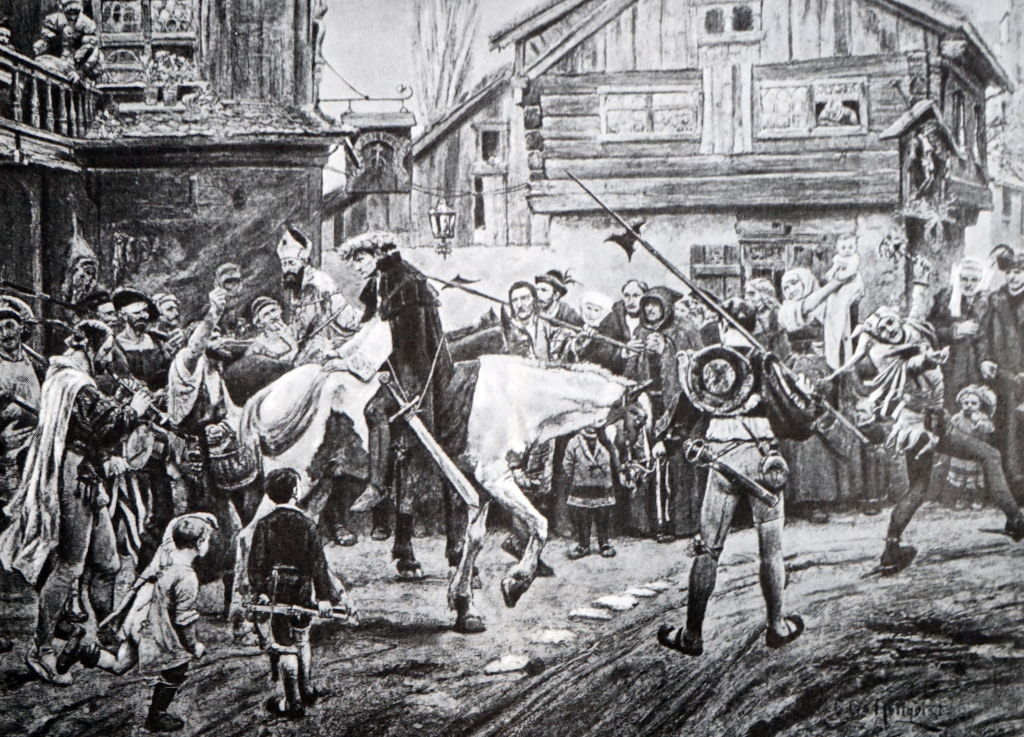
A depiction of Thomas Müntzer, the German preacher and theologian of the early Reformation whose opposition to both Martin Luther and the Roman Catholic Church led to his open defiance of feudal authority in central Germany. (Universal History Archive / Universal Images Group via Getty Images)
A saga that ended with the rebel preacher Thomas Müntzer beneath an executioner’s axe in Mühlhausen on May 27, 1525, began not with his radical Protestant preaching or his apocalyptic visions, but rather a year before with snails.
Helix pomatia, better known as the Burgundy snail, is common throughout Europe and found in the town of Stühlingen just below the Black Forest. Among other uses, it is prized for its large, brownish-cream-colored spiral shell that can be useful as a thread spool.
During the notoriously difficult harvest of 1524, when inclement weather had caused disastrous crop failures throughout the Holy Roman Empire, the countess of Lupfen ordered over a thousand of her serfs to cease working their fields so as to collect snail shells to be used as spools in her estate.