How the Constitution’s Framers Got It Wrong
James Madison argued that politicians' ambition would lead them to uphold the separation of powers. Today congressmembers’ ambition seems to lead them to do the exact opposite: submitting to Trump and completely bargaining away their own power.
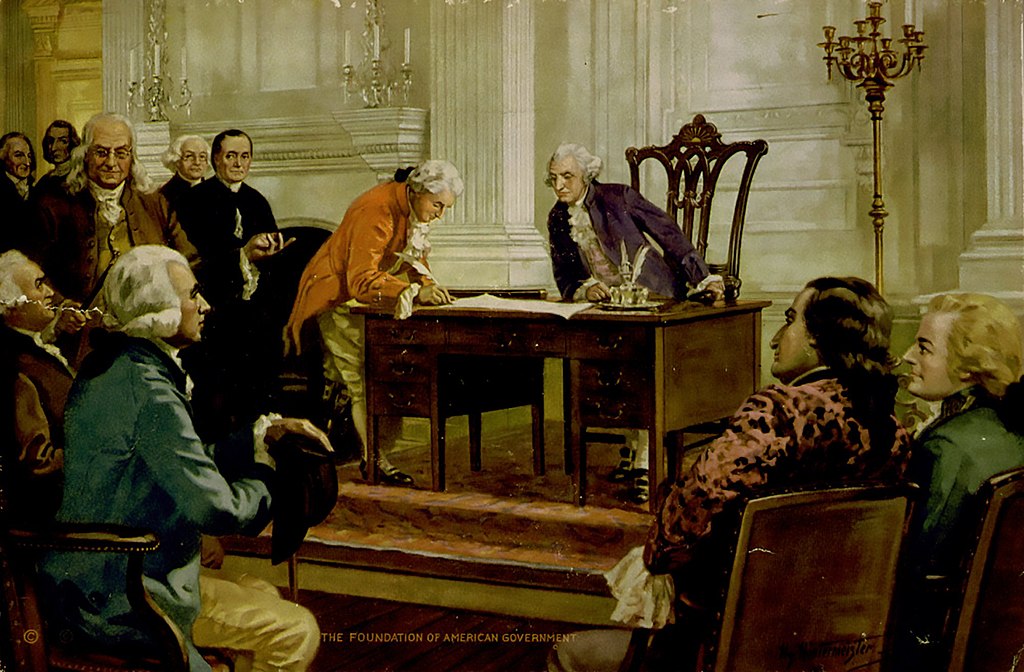
George Washington watches Gouverneur Morris sign the US Constition in a 1925 illustration by John Henry Hintermeister. (Wikimedia Commons)
One of the continuing puzzles I come back to is the separation of powers: Where did the framers go wrong?
Political scientists often claim that it is norms that undergird the US Constitution, but this is not at all the view of the framers. If anything, the idea that norms underpin the Constitution, maintaining its delicate balance of separated and limited powers, is an almost pre-founders, naive view of things.
If you read James Madison — whom nobody would accuse of having a rosy view of human nature — in the Federalist Papers, he makes it clear that what preserves liberty and constitutionalism more generally is the separation of powers, and what preserves the separation of powers is . . . the ambition of individual politicians. Madison makes constant, and fairly smirking, references to moralists who would rely on the “better motives” of men to constrain power. “If men were angels,” he famously writes of such moralists, “no government would be necessary.”