Ukraine’s Forbidden Frescoes
Ukrainian painter Mykhailo Boichuk and his circle of socialist artists perished in Stalin’s 1930s repression, destroying much of the movement’s beautiful public murals in the process. Today what remains of their work is a symbol of hope in dark times.
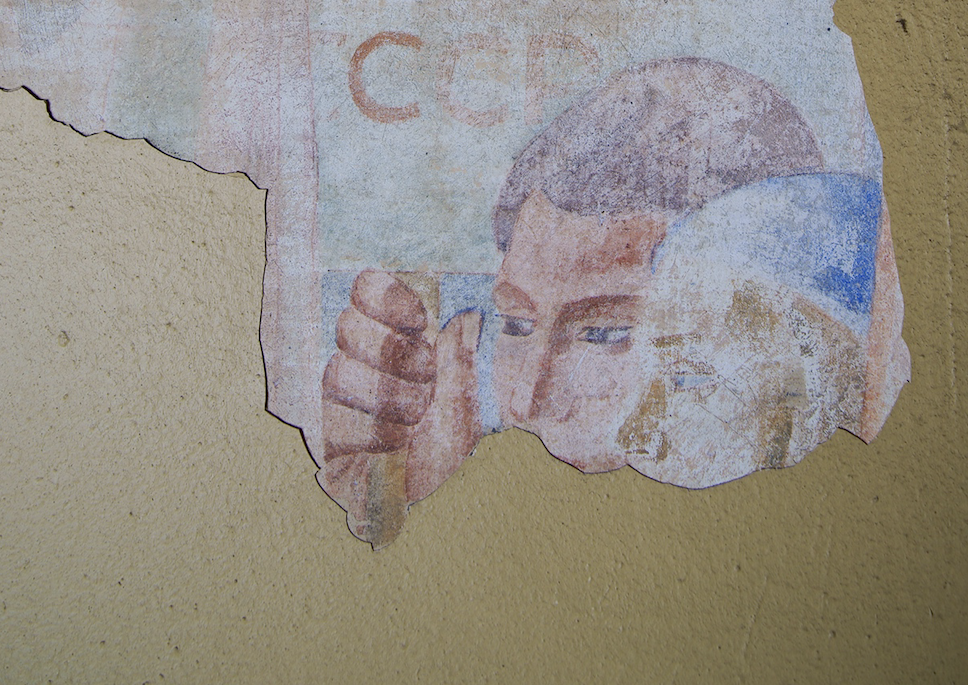
Fresco in Ukraine, ca. 1920s–’30s.
A woman’s face emerges from the many exposed layers of plaster. The cheeks have lost their glow. The crack that cuts through the fine contours and has claimed one eye is only scarcely closed with mortar. This fragment of a once much larger — but destroyed — mural today adorns a wall inside the National Academy of Fine Arts and Architecture in Kyiv.
Despite the regular screeching of air raid sirens over the city and the roar of explosions, the woman’s disfigured face — and the fresco’s destruction in general — is not due to the Kremlin’s current war of aggression against Ukraine. Rather, it stems from similar campaigns of violence at the hands of Moscow in the 1930s, nearly a century ago.
The wave of repression at that time swept away the Boichukists — the circle of artists behind murals like this one. As the leading figure in monumental art in Soviet Ukraine in the 1920s and 1930s, Mykhailo Boichuk had kickstarted an entire movement by this time while teaching at the National Academy of Fine Arts and Architecture, which he cofounded in 1917.