Rediscovering Vkhutemas, the Soviet Union’s Revolutionary Art School
Sometimes referred to as the “Soviet Bauhaus,” Vkhutemas featured a radical experiment in student democracy and design that went even further than its German counterpart.
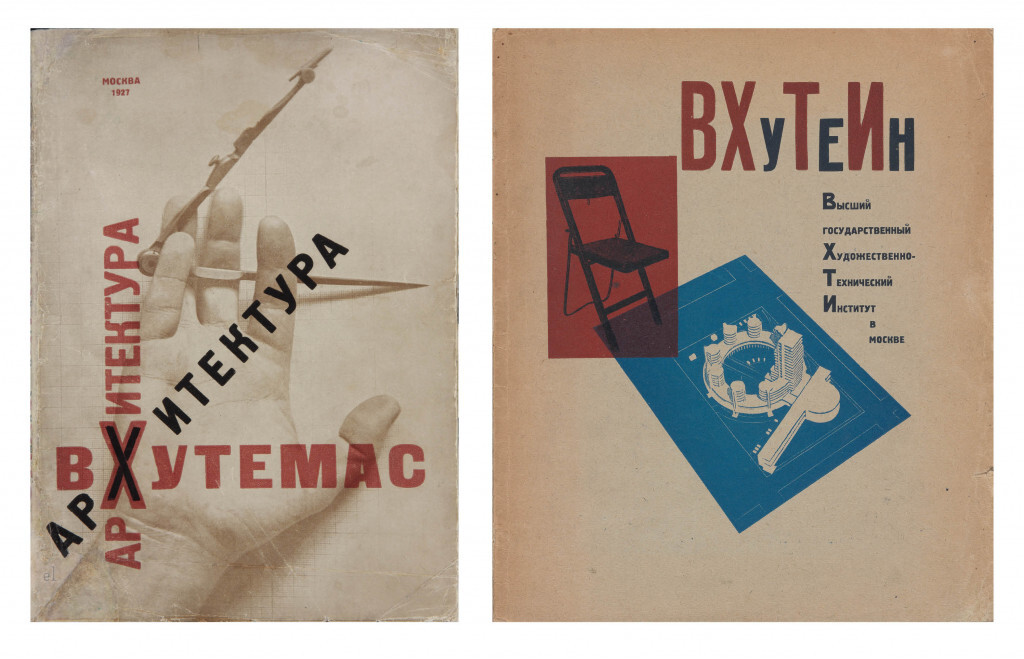
Left: Arkhitektura: Raboty arkhitekturnogo fakul’teta Vkhutemasa, 1920–1927 (Architecture: Works of the Architecture De-partment of VKhutemas, 1920–1927). Dust jacket by El Lissitzky. Right: Vkhutein: Vysshee Khudozhestvenno Tekhnicheskiy Institut v Moskve (Vkhutein: Higher Art and Technical Institute in Moscow), Moscow, 1929. (Images courtesy of Beinecke Rare Book and Manuscript Library, Yale University)
The last episode of the four-part Soviet Central Television series about Lenin’s life has an unusual setting. Made in the late 1960s and shelved until 1987, the stark black-and-white film shows Lenin against the backdrop of avant-garde paintings and futuristic architectural models. A series of striking point-of-view shots convey a heated debate between a group of turtleneck-wearing, leather-clad art students and the premier.
Despite the anachronistic fashion choices, the film is based on a real episode from 1921. Vladimir Lenin and Nadezhda Krupskaya paid a surprise visit to their friend and fellow Bolshevik Inessa Armand’s daughter who was a student at the young state’s newly established art school. According to the student recollections of the visit, Lenin made snarky remarks about the abstract compositions he saw and questioned the choice of the clunky abbreviation, Vkhutemas, for the institution he had helped create.
In response, the students passionately defended their new objective approach to art and the utilitarian quality of the school’s name. They showed Lenin around their dormitory, organized as a co-op, and complained that their professors weren’t willing enough to learn from them as students. The film ends with Lenin placing a phone call to the minister of education, Anatoly Lunacharsky. He expresses concerns with the star Futurist faculty at Vkhutemas, but remains optimistic about the student governance and the younger generation of artists’ commitment to shaping the emerging socialist culture.