The Quiet Decline of Belgian Social Democracy
Strong unions, a labyrinthine state, and political deadlock prevented Belgian neoliberals from implementing reforms in the 1970s. But as the economy spun into crisis, the Catholic Party convinced its labor union to accept austerity and wage cuts.
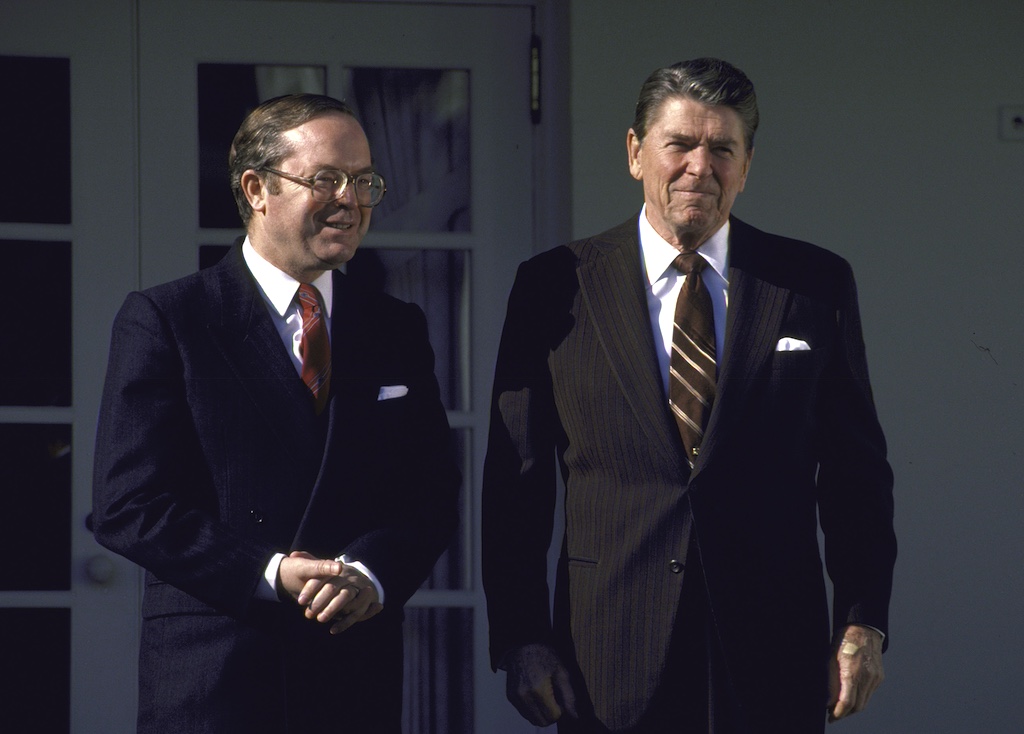
Wilfried Martens and Ronald Reagan at the White House in 1985. (Diana Walker / Getty Images)
Many would frown at the notion that Belgium could accurately be described as “neoliberal,” Belgians themselves included. There is good reason for such skepticism. Belgium’s welfare system is famously generous, relatively speaking. In 2022, it was ranked second by the Comparative Welfare Entitlements Project, just after Norway. Organisation for Economic Co-operation and Development data from 2022 ranks Belgium joint fourth in public social expenditure as a percentage of GDP (29 percent, tied with Finland), outmatched only by France (31.6 percent), Italy (30.1 percent), and Austria (29.4 percent).
Belgium is also one of the last remaining European countries where automated wage indexation is still in place, insulating most workers from recent inflation shocks. To argue, therefore, that Belgium had its own “neoliberal” turn might come as a shock.
Moreover, Belgium lacks clearly “neoliberal” politicians. True, Guy Verhofstadt — who came to prominence in the Anglophone world as a cheerleader for the EU during Britain’s Brexit referendum — has been nicknamed “Baby Thatcher.” As the young, fresh-faced chairman of the Flemish liberal party (Partij voor Vrijheid en Vooruitgang, PVV) in 1982, he brought the party in line with Reaganite orthodoxies. Still, this was a gradual process; his four Burgermanifesten (“Citizen Manifestoes”) between 1989 and 2006 outlined the ideological transitions of the party over a longer period. Only in 1999 did Verhofstadt snatch the office of prime minister away from the Catholic party — after more than five decades of uninterrupted rule — to form a historically unprecedented anti-Catholic majority. However, by that time, most of the privatization and economic discipline he aimed to implement had already become the norm.