Germany’s Green Transition Is Faltering
A decade ago, Germany’s renewable energy transition was seen as a model for the rest of the world. Today much of the working class has turned against all things green. What happened?
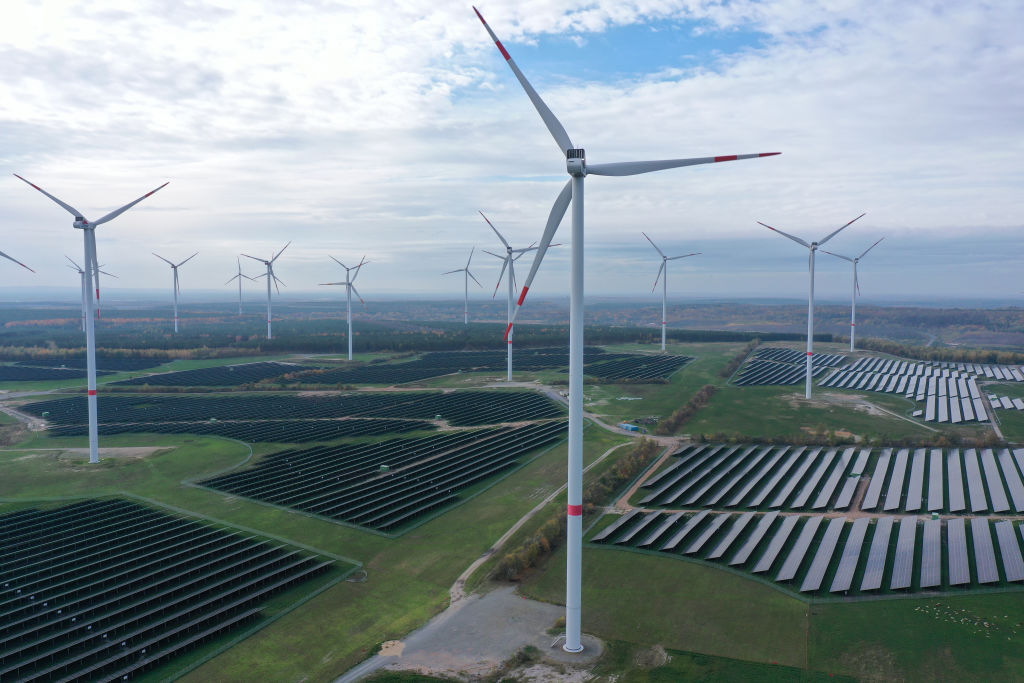
In this aerial view, wind turbines producing electricity spin over a solar park on November 1, 2022, near Klettwitz, Germany. (Sean Gallup / Getty Images)
In recent years, the term dunkelflaute (“dark doldrums”) has entered the political discourse in Germany. It refers to a period of consecutive days or weeks during which renewable energy sources generate low or minimal energy. It can occur during late fall and early winter due to a decrease in wind, cloudy skies, or both.
In 2023, weather-dependent wind and solar power accounted for 43 percent of Germany’s electricity supply, the highest in the world. Olaf Scholz (a Social Democrat), along with the ruling “traffic light coalition” of Greens, Social Democrats (SPD), and Free Democrats, wants to accelerate the deployment of wind and solar, pointing to the fact that, coupled with the need to address climate change, Russia’s decision to invade Ukraine and the gas supply crisis that followed vividly illustrate the need to end the country’s dependence on gas (95 percent of which is imported). In its 2022 “Easter Package,” the government introduced a series of legislative amendments designed to expand renewables’ share to 80 percent of electricity supply by 2030 — a massive increase — on the way to almost 100 percent renewables by 2035.
Pedaling Forward, and Back
When the dunkelflaute strikes, Germany relies on gas or coal for its electricity, or it must import nuclear power and/or hydroelectric power from France and the Scandinavian countries, respectively. Does replacing coal and gas (which currently provide, respectively, 23 and 15.5 percent of Germany’s electricity) with intermittent wind and solar mean that dunkelflaute periods will become more frequent and their impact more severe? And what if other EU countries also pursue a high renewables future? Over the past few years, several dunkelflaute events have been reported in the Netherlands, Belgium, and Denmark, during periods of extremely weak wind, persistent high-pressure systems, and overcast conditions that have a tendency to darken several countries simultaneously.