In Germany, Trade Unions Are Waking Up To the Climate Crisis
- Nathan French
Rooted in Germany's metalworks industries, IG Metall is one of the world's strongest trade unions. But the need for climate action is forcing it to take a more critical approach to the industries where its members work — and fight for a green transition that creates new kinds of high-paid, fulfilling jobs.
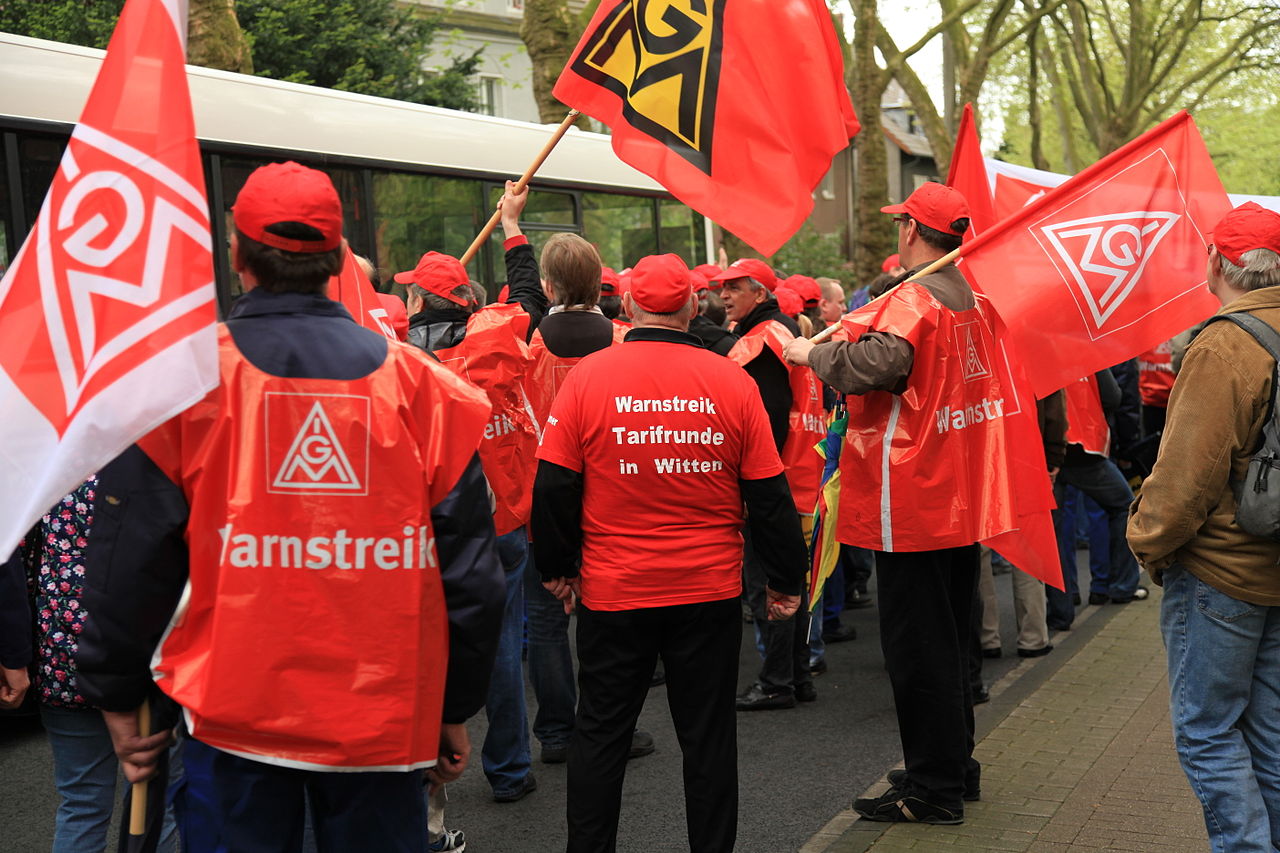
An IG Metall strike. (Wikimedia Commons).
With its over two million members, the Industriegewerkschaft Metall (“IG Metall”) is Germany’s biggest trade union and the largest industrial union in Europe. Since its founding in 1949, it has expanded to cover a number of industries, including automotive manufacturing, printing, steel, and machine building, and today sets standards in terms of working hours, conditions, and pay levels for millions of workers.
IG Metall has won a number of major victories to improve members’ conditions in both the workplace and beyond, relying on its ability to halt production in Germany’s crucial export industries. The union engaged in a hard-fought battle for a thirty-five-hour workweek in 1984; this campaign was defeated, but it finally achieved this for its members in the metal industry in 1995. More recently, in 2018 a major strike won its members the right to opt into a twenty-eight-hour workweek for up to two years for childcare or other care responsibilities. Given IG Metall’s unparalleled ability to force companies to strike extensive compromises with their employees, it is arguably the world’s most powerful trade union.
Hans-Jürgen Urban has served on IG Metall’s executive board since 2007. He is known as a strong advocate for the union’s political independence and the need for a “socio-ecological transformation” away from fossil fuels and the capitalist mode of production. In 2019, he was reelected with the support of over 98 percent of delegates at the union’s national convention. He spoke with Jacobin’s Loren Balhorn about the German labor movement’s tasks during the coronavirus crisis, the state of class struggle in Germany today, and how industrial unions can contribute to the climate justice movement.