Who’s Afraid of Mexican Democracy?
Mexico’s judiciary is infamous for favoring oligarchs and other unsavory interests. MORENA’s judicial reforms aim to fix this by introducing democratic elections for judges — a move that has the US and global business elites in a panic.
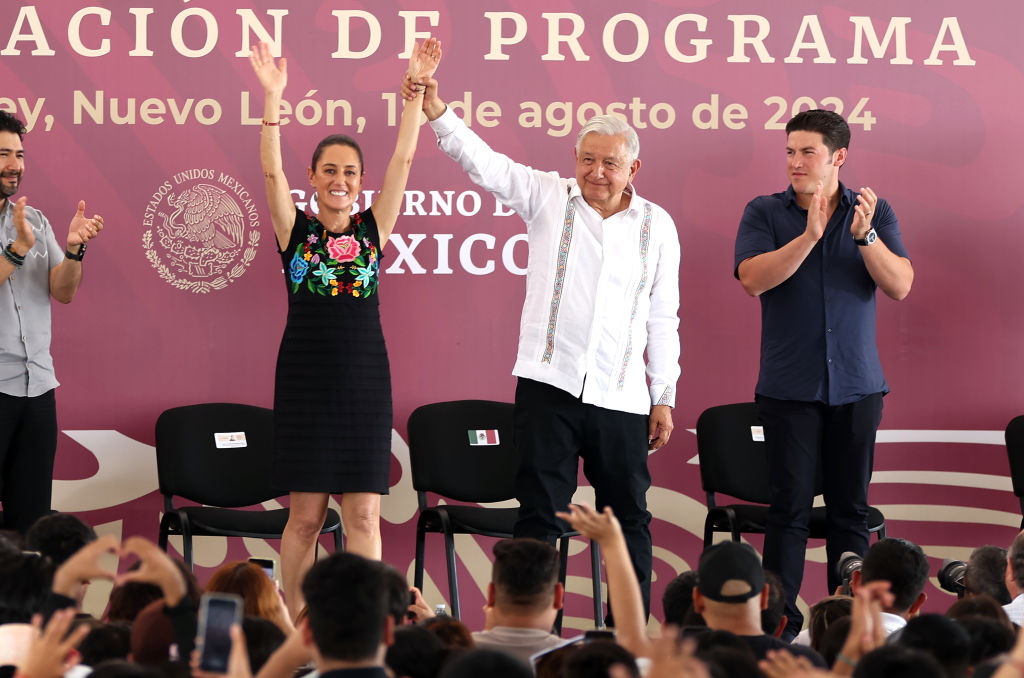
Mexican president Andrés Manuel López Obrador appears with president-elect Claudia Sheumbaum on August 18, 2024, in Monterrey, Mexico. (Medios y Media / Getty Images)
Following its landslide victory in Mexico’s presidential elections, the MORENA coalition is wasting no time in getting to work. Even before president-elect Claudia Sheinbaum takes office on October 1, the new Congress is taking up a package of constitutional amendments proposed by outgoing president Andrés Manuel López Obrador (AMLO), flexing the muscle of a two-thirds qualified majority that allows the president’s party to pass such measures virtually on its own. And the first one up is already drawing the ire of corporate media and foreign powers alike: a judicial reform requiring direct, democratic elections for the entire federal judiciary.
On August 22, US Ambassador to Mexico Ken Salazar released a statement opposing the reforms. It was, to say the least, a curious one. After mentioning Iraq and Afghanistan — two countries the United States has recently invaded and occupied — as examples of countries that lack independent judiciaries, he proceeded to aver that “popular direct election of judges is a major risk to the functioning of Mexico’s democracy.” Following the exposition came the threat: “I also think that the debate . . . will threaten the historic trade relationship we have built, which relies on investors’ confidence in Mexico’s legal framework.” If you know what’s good for you, in so many words, lay off.
AMLO, in fact, did not know what was “good for him.” “How are we going to allow the US ambassador, with all due respect . . . to opine that what we are doing is wrong?” he asked at his press conference the following Tuesday. While denying that the ambassador would be expelled, he explained that the relationship with the embassy was “on pause.” The same, he added, for the Canadian embassy, whose attitude in seconding the United States had been “pitiful . . . like a vassal state.” Both countries, he concluded, “would like to interfere in matters that only concern Mexicans. As long as I am here, I will not allow any violation of our sovereignty.” The battle lines had been drawn.