Sahra Wagenknecht’s Party Is Here to Stay
- Julia Damphouse
Sahra Wagenknecht’s new party has followed rather than resisted Germany’s shift to the right. But its perceived antiestablishment stance has likely carved it out a niche — especially on foreign policy.
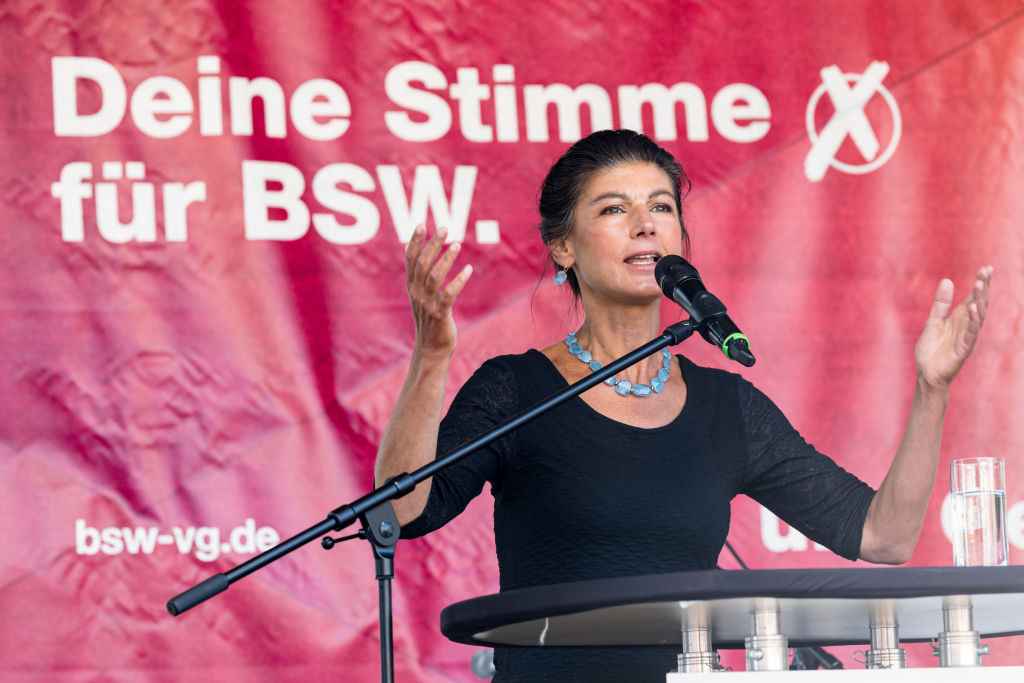
Sahra Wagenknecht, leader of BSW, speaks to supporters in Eisenach, Germany, on August 19, 2024. (Jens Schlueter / Getty Images)
The creation of the Sahra Wagenknecht Alliance (BSW) prompted debate over whether her new party would help or hinder the rise of the far-right Alternative für Deutschland (AfD). Even before the BSW was officially founded, we, too, expressed the hope that a Wagenknecht party could slow the rise of the Right and redirect the German political debate more toward socioeconomic issues, where the Left is traditionally strongest. Wagenknecht’s party has been around since late January, and has now participated in three electoral contests, namely the European parliamentary elections, and two state elections in former East Germany. So, have these hopes been fulfilled? Has the BSW helped in the fight against the Right, or is it contributing to a right-wing shift.
A look at voter shifts in June’s EU elections suggests that the BSW is primarily hurting the left-wing Die Linke and the ruling Social Democrats (SPD). According to Infratest Dimap, most BSW voters previously voted for the SPD and Die Linke: 580,000 former SPD voters and 470,000 former Die Linke voters switched to the BSW. Only 160,000 of the BSW voters had voted for the AfD in the 2021 federal election. According to this same pollster, most BSW voters in Thuringia and Saxony this September 1 also came from the broad left and only a small portion from the AfD.
At first glance, it seems clear that the BSW is mainly taking votes from left-wing parties and hardly touching the AfD vote. Yet, it can be assumed that due to the relative newness of the party, many of those who voted for the AfD in the 2021 federal elections and particularly the 2019 state elections are now part of the far-right party’s core electorate. It is hardly surprising that this largely radical right-wing constituency hardly ever switches to the BSW. The same cannot be said of those who have turned to the AfD in the past two years. At the beginning of the year, the AfD had a nationwide polling share of 22 percent, but then “only” achieved 16 percent in the European elections. Perhaps most tellingly, the proportion of voters who stated in post-election surveys that they voted for the party not out of conviction but out of disappointment with the other parties is relatively high — just under half.