Germany’s Far Right Is Exploiting a Broken Economic Model
In Thuringia, former East Germany, the far-right AfD has won a state election for the first time. Its success is the product of a low-wage economic model that has itself fed anti-migrant backlash.
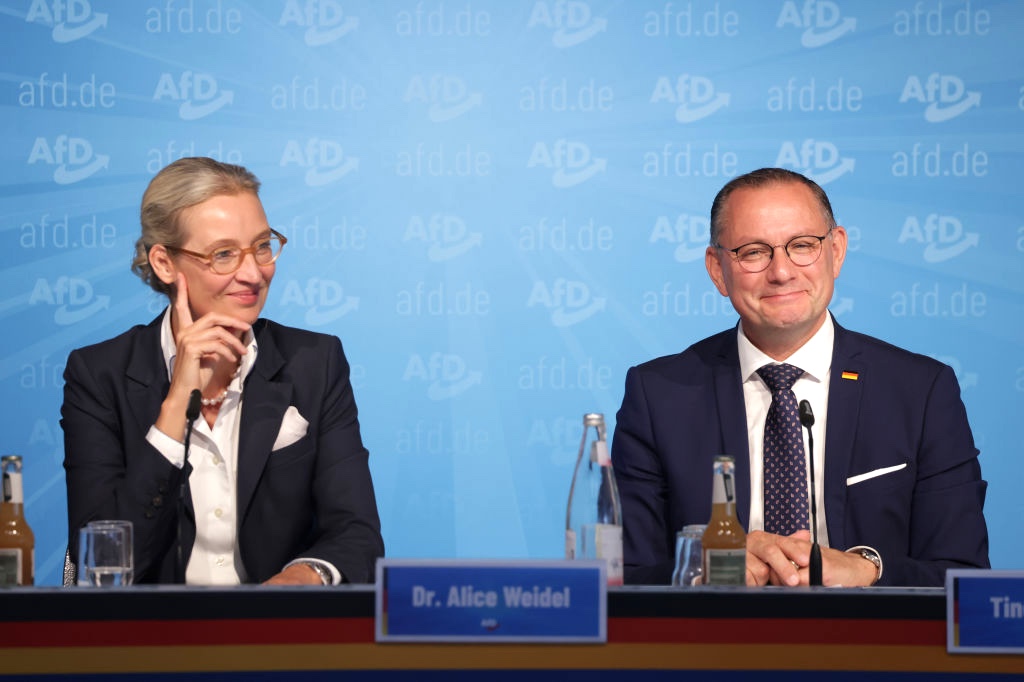
Coleaders of the Alternative für Deutschland Alice Weidel and Tino Chrupalla speak to the media after state elections in Saxony and Thuringia on September 2, 2024, in Berlin, Germany. (Sean Gallup / Getty Images)
Sunday saw state elections in the eastern German states of Thuringia and Saxony — with the far right doing just as well as expected. The Alternative für Deutschland (AfD) scored 32.8 and 30.6 percent in each state, respectively, becoming the most popular party in Thuringia and just being edged into second place in Saxony. It is expected that when another eastern state, Brandenburg, votes on September 22, the result will be similar.
Media explanations largely blame this on “exceptional” conditions in the East: most people were socialized by life under the German Democratic Republic (GDR) that collapsed in 1989–90, and as such do not fully support democracy. Instead, authoritarian parties like the AfD are said to appeal to such a socialization. The fact that the AfD is leading among young voters belies this notion entirely. The AfD’s success is, rather, the result of a failing economic model that has simply affected eastern Germany more significantly so far.
Made in Germany
Germany, 2000s: a country in crisis, internationally known as the “sick man of Europe.” The economy was stagnating, while unemployment was climbing beyond 10 percent. Amid this situation, the government led by a coalition of Social Democrats (SPD) and Greens formulated a series of policies known as “Agenda 2010” to restore economic “competitiveness.” Seeking to restrict “excessive” aspects of the welfare state, it instituted a series of neoliberal reforms: pension levels were lowered, a large low-wage sector was introduced, and employment rights were restricted. At the same time, a growing export market emerged through the mid-2000s through the expansion of the European Union into Eastern and Southern Europe.