Why Venezuela’s Coup Plotters Came Up Short
In 2019, a coalition of conservative forces responded to Nicolás Maduro’s authoritarian turn and Venezuela’s ongoing economic crisis by launching a coup. Despite backing from the US and Venezuelan capital, the conspirators failed. A new book explains why.
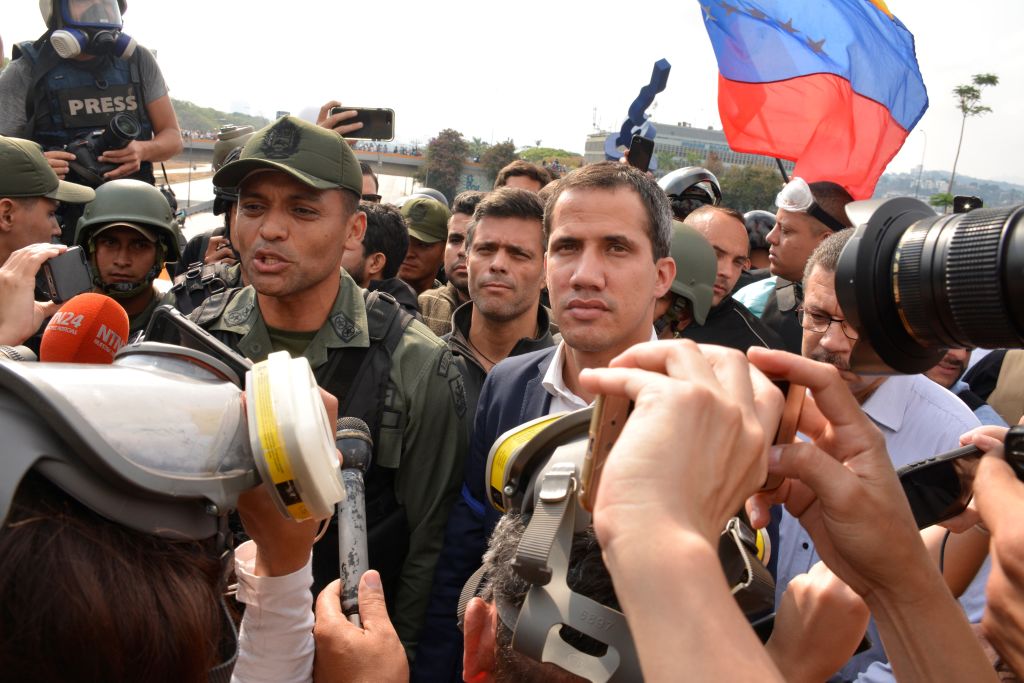
Venezuelan opposition leader Juan Guaido (R) makes a statement to press members near the Altamira distributor road in Caracas, Venezuela, April 30, 2019. (Rafael Briceno / Anadolu Agency / Getty Images)
The political project of neoliberalism in Latin America is dead. Peddling austerity, privatization, and deregulation is no longer a straightforward task for political elites. In response, politicians like Luis Abinader, the recently reelected president of the Dominican Republic, have successfully employed a strategy centered on culture wars, crime, and anti-immigrant sentiments. Meanwhile, a new wave of young politicians has emerged, touting “post-ideology” narratives that span from anarcho-libertarian fantasies to crypto-bro outsiderism, both sharing an authoritarian core with fascist undertones. These politicians have managed to steal from the Left the sentiment of “anti-elite” populism and channel the discontent of the informal working class toward market-oriented solutions. Nonetheless, neoliberalism has lost its stride, and the nations that defy it continue facing pressure.
Latin America’s Pink Tide populist revolt emerged in response to the Washington Consensus, which had privatized extractive commodities, deindustrialized and fragmented industrial workers, gutted social services, and perpetuated stark economic and social disparities across the hemisphere. The birthplace of the resistance against neoliberalism was in the mass uprisings in Venezuela in 1989 against then president Carlos Andrés Pérez’s paquetazo, a neoliberal economic package that included cuts on government salaries and spending, eliminating subsidies for farmers, removal of price controls and liberalization of the price of petroleum, elimination of tariffs and liberalization of imports, and the easing of foreign capital into and out of the country. The results were disastrous, with poverty increasing by 44 percent and extreme poverty by 20 percent.
The Caracazo, or Sacudón, was a massive urban uprising that shook Venezuela in 1989, driven by the urban poor, informal workers, students, and ex–guerrilla fighters. The brutal government crackdown, which targeted leaders and militants in their homes, left a trail of blood and deepened the polarization between the wealthy oligarchs and the general population. The rebellion and its aftermath also split the armed forces, with some soldiers refusing to continue slaughtering Venezuelans fighting for national sovereignty. This pivotal moment, as argued in the modern classic We Created Chavez: A People’s History of the Venezuelan Revolution by George Ciccariello-Maher, gave rise to grassroots movements and neighborhood assemblies that would play a crucial role in the rise of Hugo Chávez and the cementing of the Bolivarian Revolution.