Mario Vargas Llosa’s Bizarre Turn to the Right
Peruvian novelist Mario Vargas Llosa’s turn to authoritarian neoliberalism has puzzled many. A new book traces his journey to right-wing punditry back to a beef with Fidel Castro.
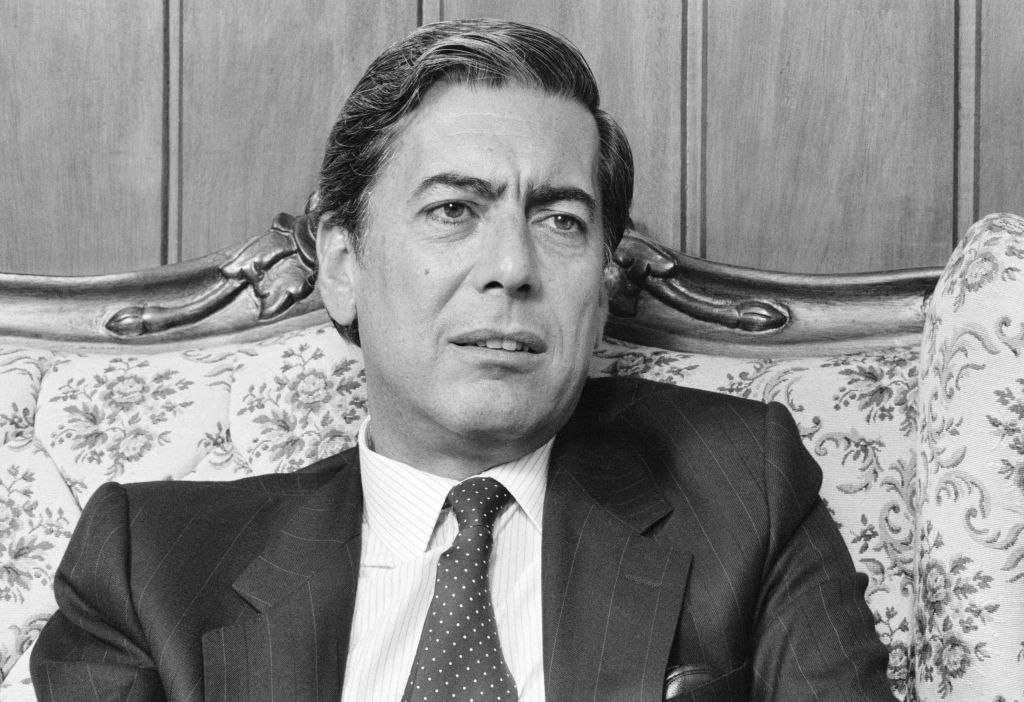
Mario Vargas Llosa at the Presidential Palace, San Salvador, El Salvador, March 8, 1984. (Robert Nickelsberg / Getty Images)
Peruvian author Mario Vargas Llosa has been one of the leading writers and intellectuals of the twentieth century in Latin America. He was part of the so-called Latin American boom, a group of novelists that achieved international fame together with Carlos Fuentes from Mexico, Julio Cortázar from Argentina, and Colombia’s Gabriel García Márquez. Since his youth in Lima, Vargas Llosa tried to place himself in the literary avant-garde under the legacy of Rubén Darío’s modernism, French literary narrative, and the tradition of US writers, in a quest to diagram a “Latin American realism” attentive to capturing the dynamics and changes that affected the societies of the region. Although in political-ideological terms he is currently associated with liberalism and the right wing, in the 1960s and 1970s Vargas Llosa fervently supported the Cuban Revolution, processes of decolonization and, with nuances, the socialist experiments.
Latin American studies professor Carlos Aguirre and Russian international relations scholar Kristina Buynova’s new book explores a portion of Vargas Llosa’s career and his early relationship with the political and cultural processes that interpellated much of the Latin American intelligentsia of that time. Aguirre and Buynova’s work, published in Spanish, allows us to accurately gauge, on the one hand, Vargas Llosa’s political-ideological path during the period, and, on the other hand, its link with the Cuban and Soviet cultural world. As a result of the access that both scholars had to archives and materials found in the United States, Russia, and Latin America, the book tries to explain the reasons that led the Peruvian novelist from a position of identification with Cuba, in particular, and socialisms in general, to a deep disenchantment that facilitated the enunciation of a general and resounding criticism to all these experiences. Access to his personal correspondence, newspaper publications, and various letters allow the authors to compose in detail the circumstances surrounding the significant moment in his life in which Vargas Llosa traveled to the Soviet Union in 1968.
Trips to revolutionary Russia were commonplace throughout the twentieth century for intellectuals, writers, politicians, activists, and even workers. Visiting Moscow and other Russian cities became essential for those interested in “seeing” and “touching” the new future of humanity. Historiography has long been examining the features of these trips, their protagonists, the networks used, the places traveled, and the subsequent return to the country of origin where opinions on what was experienced were presented.