The ANC’s Double Bind
After losing its parliamentary majority for the first time, South Africa’s African National Congress is scrambling to form a coalition government. Its options are bleak.
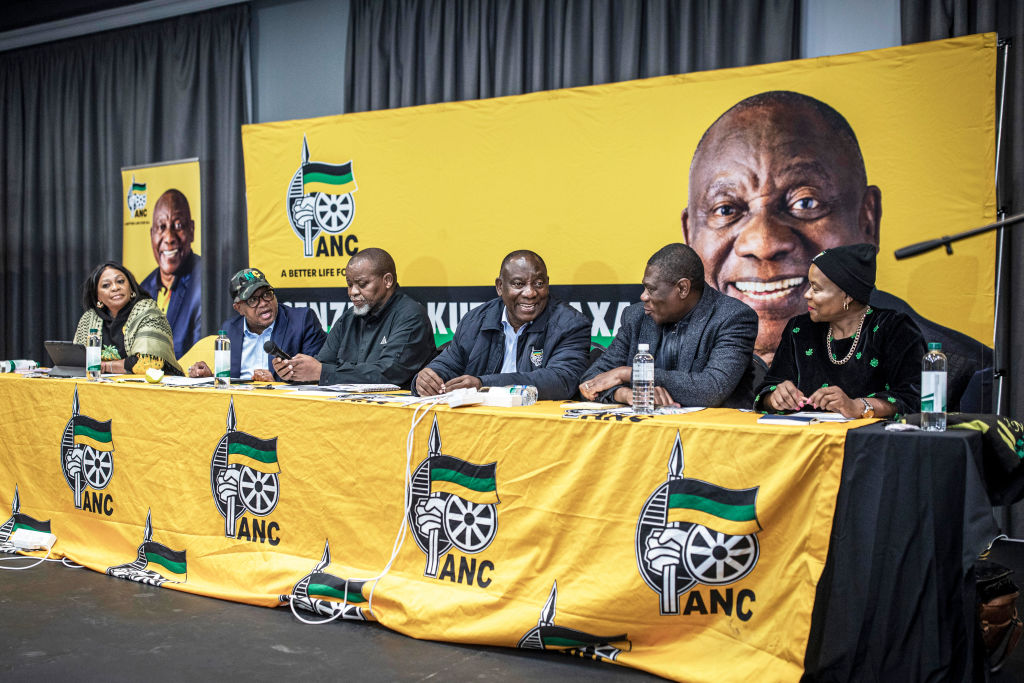
African National Congress president Cyril Ramaphosa sits at a table with fellow National Executive Committee members at a special meeting on June 6, 2024, Boksburg, South Africa. (Per-Anders Pettersson / Getty Images)
Politics during apartheid had a certain straight-line simplicity. It was always pretty clear who the main enemy was. Things got scrambled with democratization. But a measure of simplicity was soon returned — at least for the outsider left. A neoliberal hegemonic bloc merged at the summit of power, binding old white business elites to an emergent “corporate black bourgeoisie” as Roger Southall put it. The battle lines were clear once again.
That era ended somewhere around 2014, during the reign of Jacob Zuma. Nurtured in the interstices of the corporate economy, a new rivalrous elite made its presence fully felt in that period. It assumed the helm of a wider assemblage of forces born out of the “informal economies” of the African National Congress’s (ANC) patronage state and committed to a more muscular form of racial redistribution without the progressive pretenses.
With Zuma’s defeat at the ANC’s national congress in 2017 the forces of “radical economic transformation” (RET) were briefly repulsed. But they came roaring back to life last month when Zuma’s new uMkhonto weSizwe (MK) party captured 14.6 percent of the vote in national elections, denying the ANC its electoral majority for the first time since democracy. Combined with the Economic Freedom Fighters (EFF), parties dedicated to RET will hold around a quarter of the seats in the new parliament.