South Africa Has Not Been Immune to Right-Wing Populism
Since the end of apartheid, South Africa's ANC has held a firm grip on power. In recent years, the party, plagued by accusations of clientelism and corruption, has been met with opposition from populist forces seeking to advance an ethno-nationalist agenda.
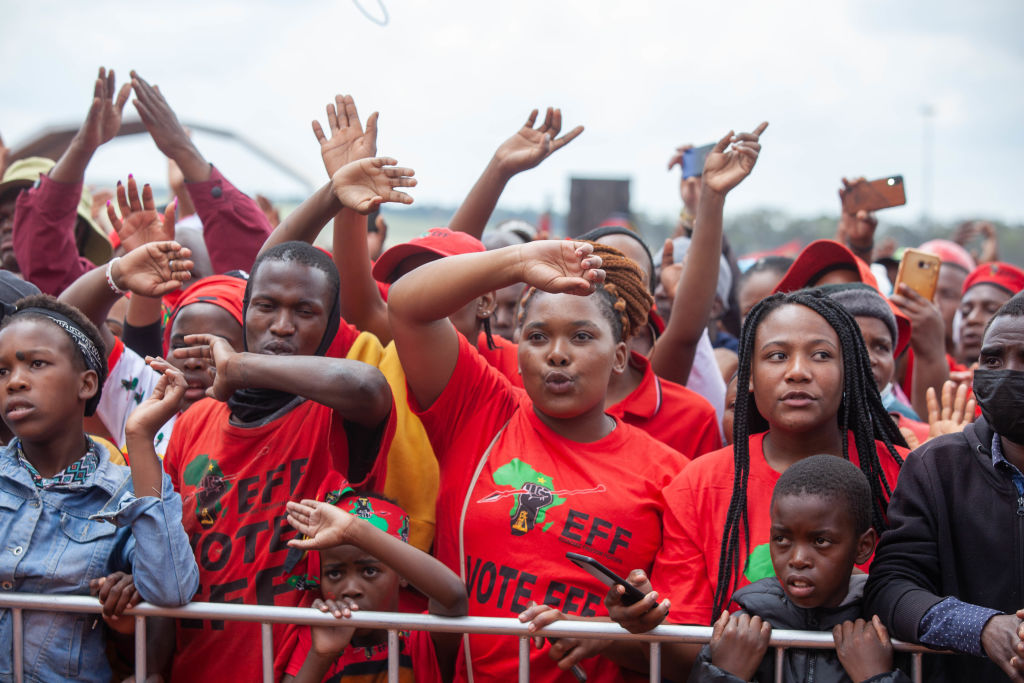
Economic Freedom Fighters (EFF) supporters at the Siyabonga Rally in Tembisa, South Africa, 2021. (Papi Morake / Gallo Images via Getty Images)
Twenty-eight years in, South Africa’s democratic order is in a bad place. Warning signs are to be found everywhere one looks. Several years after Jacob Zuma’s kleptocratic presidency, the state remains mired in corruption and mismanagement and is failing to reverse a catastrophic decline in basic services and infrastructure. Its security apparatus, deeply penetrated by criminal and seditious elements, seems powerless in the face of growing political violence and gangsterism. Populist parties are gaining ground, while demagogic, anti-constitutional voices increasingly dominate social media and fuel a new wave of xenophobic violence. Polls show collapsing support for democracy and growing receptiveness to authoritarian forms of government.
All of these morbid symptoms are well chronicled in a now daily stream of commentary issuing earnest warnings and dire prognostications about the fate of our democracy. These concerns are made far more acute by the gloomy international backdrop against which they are set. According to a growing consensus among political scientists, the world is in the midst of a “third wave of autocratization” ushered in by the 2008 financial crisis. That crisis definitively concluded the long expansive phase of democratization that had begun in the 1970s. Since then, fewer and fewer countries have seen any improvement in the health of their democratic institutions, while the number of places experiencing democratic “backsliding” has shot up.
Democracy’s retreat is conterminous with the globe-spanning rise of right-wing populism. Populists now control the government in numerous countries of the Global South, including major economies such as Brazil, India, the Philippines, and Turkey. In most cases, they assumed power through free and fair elections. But they’ve wasted little time in turning on and undermining those democratic freedoms once in office. Coups and full-blown dictatorships have been rare in the current authoritarian wave — its modal form has been the hollowing out of democratic institutions from the inside by incumbent governments. Populists have also claimed power in a handful of Organization for Economic Co-operation and Development (OECD) countries, and have become a major electoral force in most others, often ending decades of duopolistic control by centrist parties.