The US Plan to Outsource Its Imperialism in Haiti to Kenya
The US has long outsourced meddling in Haiti to Global South countries. Recently Kenya has agreed to take over leading a US-backed multinational police intervention there — justifying its own “stabilization” mission with Pan-Africanist rhetoric.
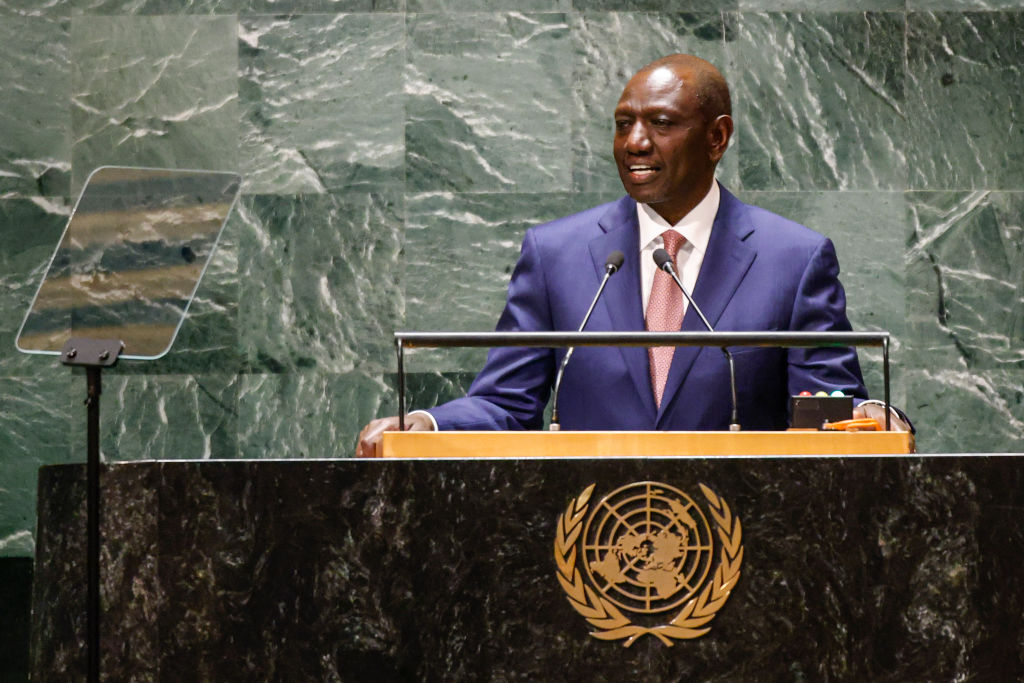
President of Kenya William Ruto speaks at the United Nations headquarters on September 21, 2023 in New York City. (Kena Betancur / Getty Images)
On May 23, President Joe Biden will host Kenyan president William Ruto at the White House for a state visit that marks the sixtieth anniversary of US-Kenyan diplomatic relations. This gathering (the first such visit by an African head of state since 2008) is expected to coincide with the formal launch of the US-backed, Kenyan-led multinational police intervention in Haiti, signaling — in the words of White House press secretary Karine Jeanne-Pierre — that “African leadership is essential to addressing global priorities.”
As far as the plan to “stabilize” Haiti is concerned, the US-Kenya alliance represents a convergence of strategic interests between the United States as an imperial power and Kenya as an increasingly assertive player in the Global South. Given the widely criticized history of imperial meddling in Haiti, the Biden administration has sought to avoid being seen to play a direct role in the most recent plan to intervene in the country (a plan that is dominated by US concerns about migration rather than the well-being of Haiti’s people).
By outsourcing the mission to Kenya, the Biden administration hopes to convince the American public that the United States is not committing itself in yet another foreign military occupation, and to persuade Haitian citizens — much as it did in 2004 when Brazil agreed to lead the UN stabilization mission known as MINUSTAH — that the interveners are comrades rather than colonizers. Strategically downplayed is the fact that (along with at least $300 million in financial backing) the United States will be providing logistical support to the mission in Haiti, including intelligence sharing, communications, and air power — meaning that this is as much a US-led mission as it is a Kenyan-led one.