Assassination Attempt Prompts Soul-Searching in Slovakia
Last week's shooting of Slovakia’s prime minister, Robert Fico, is the product of a long intensification of political conflict. But beneath Slovakia’s overheated politics is a fundamental hollowness — and an impasse in the neoliberal order built in the 2000s.
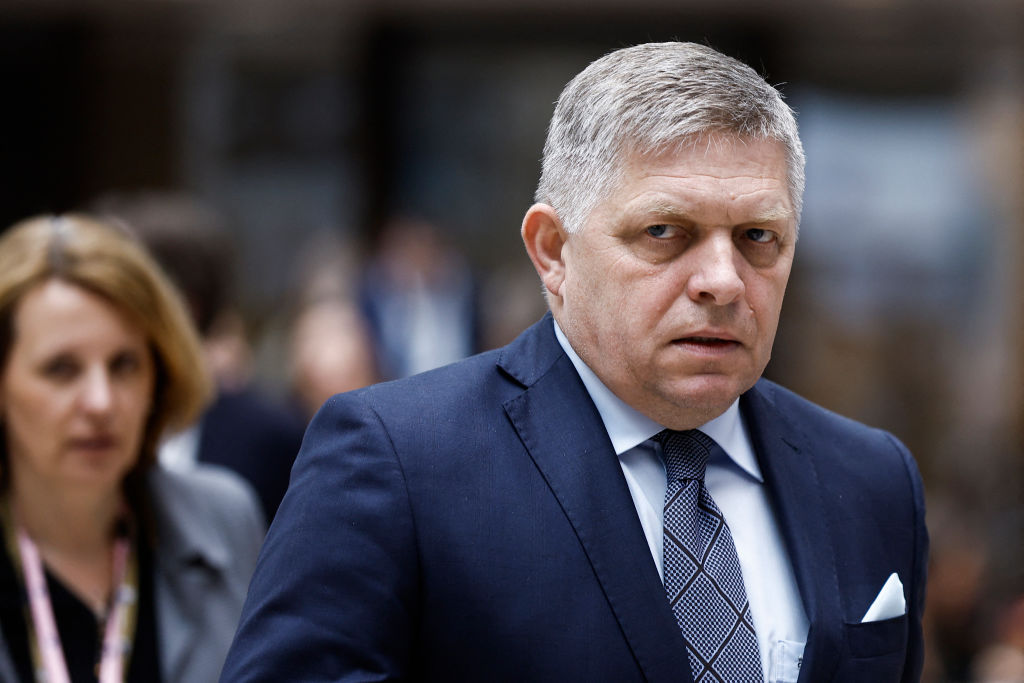
Slovakia’s prime minister Robert Fico at the European Council summit at the EU headquarters in Brussels, on April 18, 2024. (Kenzo Ribouillard / AFP via Getty Images)
How does a political community delineate the boundaries of legitimate political debate? For the twentieth-century German jurist Carl Schmitt, politics was defined by the distinction between friend and enemy. Conceptions of the common good — and conflicts about these conceptions — were, for Schmitt, so at odds that no rational dialogue could resolve them. These were existential questions that could only be resolved by force and, if necessary, violence.
Schmitt’s claim, though radical, raises an important question for any liberal democracy. Where is the boundary between permissible (even if disagreeable) political opinion, and what is an existential fight for the definition of a political community?
These questions came in to view last week after an assassination attempt left Slovakia’s prime minister Robert Fico fighting for his life. Politicians across the spectrum united in unequivocally condemning the attack against Fico, who leads the left-wing nationalist Smer (Direction) party. But this seeming show of unity concealed much deeper problems at the heart of Slovakia’s political community which has, for more than three decades, struggled to constructively accommodate various forms of dissent against the post-socialist status quo.