The Grim High-Tech Dystopia on the US-Mexico Border
To police the US-Mexico border, the US government is implementing an array of ever more sophisticated military tech — now including AI-powered robo-dogs. It promises to worsen an already severe humanitarian crisis.
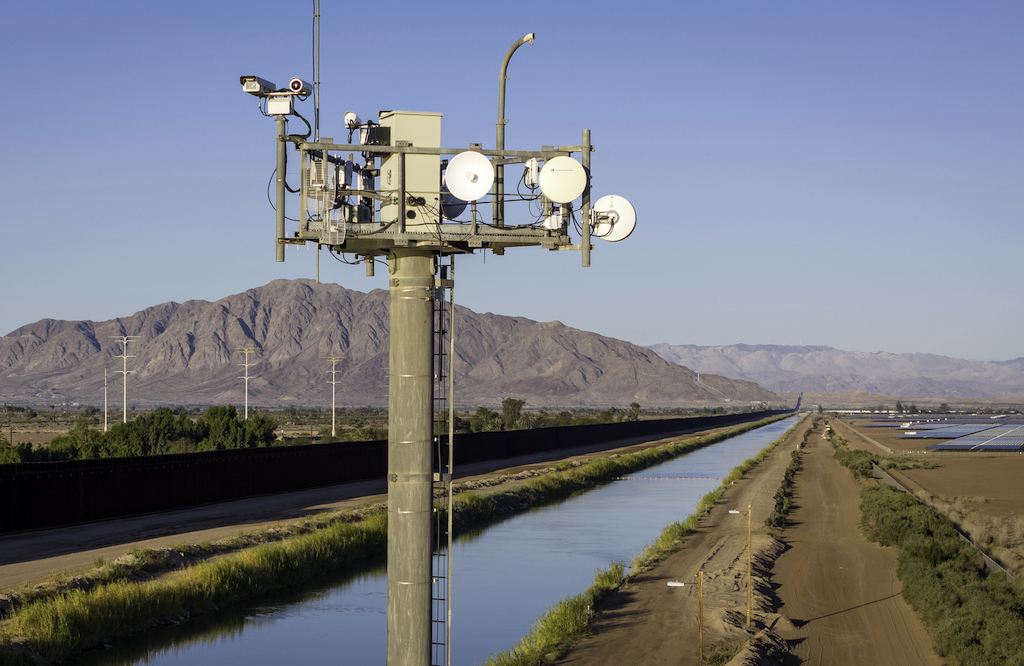
Cameras on a US Customs and Border Protection surveillance tower monitor activity along the US-Mexico border on March 8, 2024 in Calexico, California. (John Moore / Getty Images)
The wall bleeds rust. As I put my palm on the vast stretch of metal bisecting the Sonoran Desert, the wall seems to pulsate as it stretches into the horizon, painted black in parts to make it extra hot in the sun. And yet, for all its spectacular length and ability to dominate the news, at a particular point along El Camino del Diablo, or “the Devil’s Highway,” on the US-Mexico border, the rusted metal arbitrarily ends in the middle of the desert.
This is one of the longest stretches of the wall, but many smaller walls — some as short as a few meters — litter the Sonora, a vast area in the state of Arizona and a frequent crossing point for refugees and people on the move from Central and South America. Late one night in February 2022, we are driving along the perimeter in probably the biggest truck I’ve ever been in, and at the wheel, James Holeman is talking nonstop. A tall, white former marine with a neon orange cap emblazoned with a green cross, James is the founder of Battalion Search and Rescue, a volunteer organization that combs the Sonora for bodies and survivors. After a mandatory stop at an ice cream shop in Dateland, Arizona, for “the best — and probably only — date shake you’ve ever had,” he is taking us along the sections of the border where people have been crossing for years, entering military territory where rusted tanks and helicopters have been planted for target practice, competing with cholla cacti for space.
Speaking a mile a minute, James may be the most energetic person I have ever met. After leaving the military, the lifelong Arizonan could not bear to, in his own words, “just sit at home and do nothing.” He and his group of volunteers go into the desert at least twice a month, sometimes overnight, donning reflective orange vests and carrying walking sticks and short-wave radios.