Some Portuguese Still Haven’t Accepted the Revolution
Fifty years since Portugal’s democratic revolution, the far-right Chega party is on the rise. It’s exploiting disaffection with mainstream parties — but also nostalgia for the days when dictator António de Oliveira Salazar ruled a Portuguese empire.
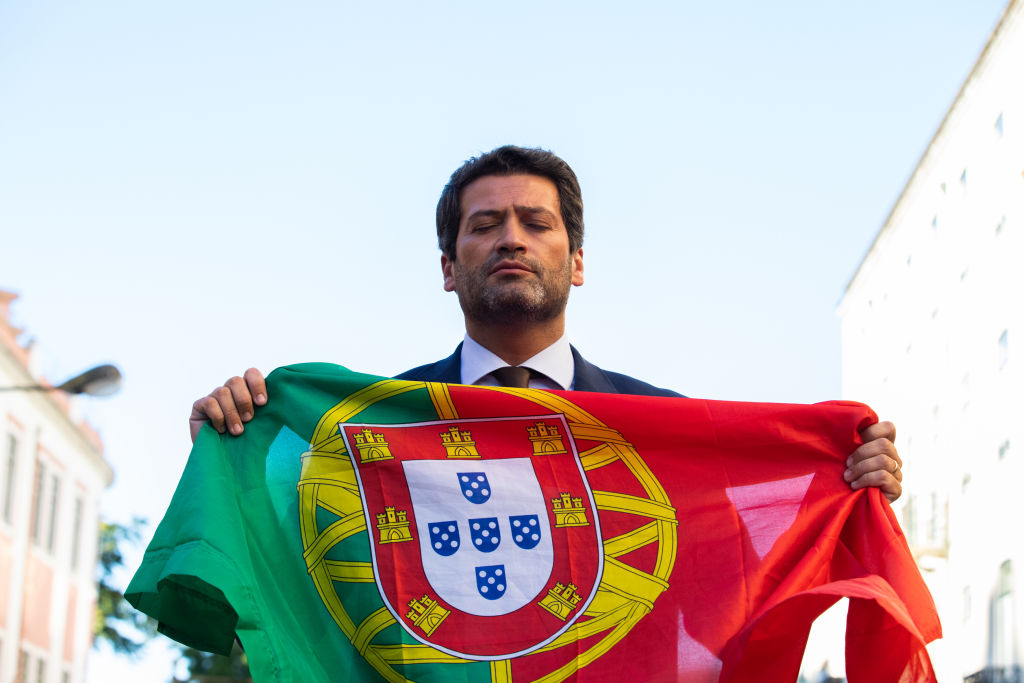
André Ventura, leader of the Chega party, sings the Portuguese national anthem with the Portuguese flag on July 1, 2021 in Lisbon, Portugal. (Nuno Cruz / NurPhoto via Getty Images)
In 1965, a statue of António de Oliveira Salazar was erected at the heart of Santa Comba Dão. This is a pleasant rural town in central Portugal — and the place where Europe’s longest-ruling twentieth-century dictator grew up. The statue depicted a stern figure seated with manspread legs upon a granite plinth, beyond the reach of his inferiors. His hands grasped the sides of a throne of stone.
Salazar’s persona united the holy trinity of Portugal’s fascist regime, the “Estado Novo” (“New State”). From 1932 to 1968, he ruled over an empire backed by the Catholic church and institutionalized repression.
When the statue was put up, Salazar was still alive — having been prime minister and de facto dictator for thirty-three years already. In that moment, Portugal was also fighting three colonial wars in Africa — in Angola, Guinea and Cape Verde, and Mozambique — despite being the poorest country in Western Europe. It could only fund its warfare thanks to its NATO membership — and Salazar’s ability to ideologically defend the struggle as a matter of preventing the spread of “Communism in Africa.”