Farming Under Israeli Occupation Is Brutal
Israel’s attacks on Palestinians aren’t only carried out through guns and bombs. They also come through its vice grip on agriculture, including its system of “water apartheid.” We spoke to a Palestinian farmer and union leader about his labor under occupation.
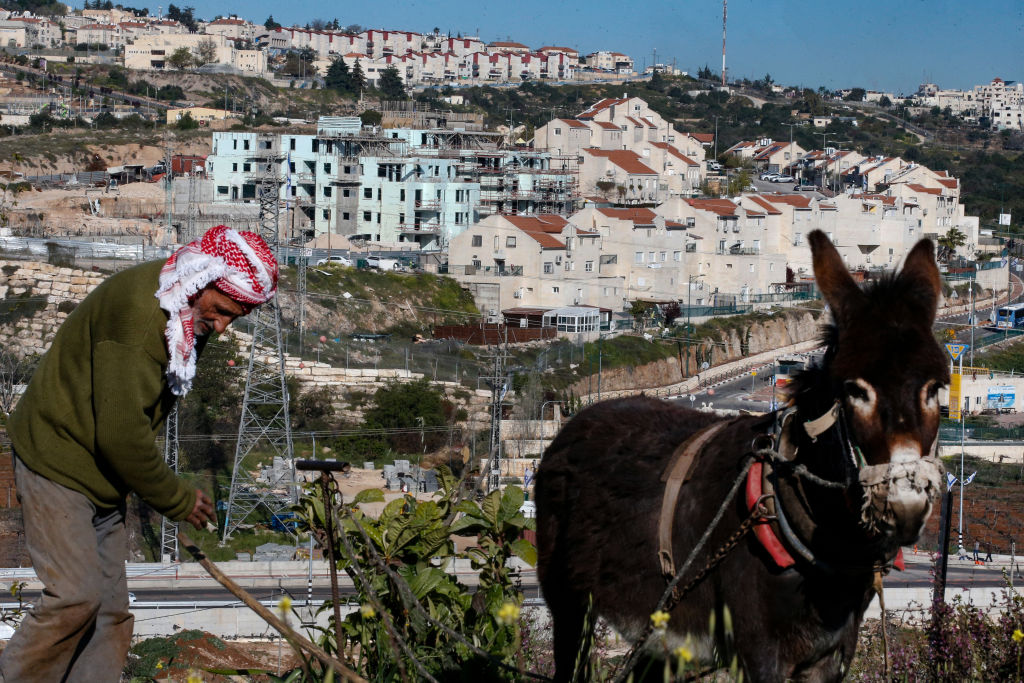
Palestinian farmer Atta Jaber ploughs his land in the West Bank on April 4, 2021, with the Israeli settlement of Kiryat Arba’a in the background. (Hazem Bader / AFP via Getty Images)
The town of Bardala in the north of the Jordan Valley doesn’t lack water. Springs and reservoirs attracted the village’s earliest residents, and before Israel’s occupation of the West Bank in 1967, residents had plenty of water to sustain themselves and the agricultural activity that is their main source of livelihood. But today, Israel leverages its military control over the village, as it does in the rest of the Jordan Valley, to hoard the resource. It’s a system of “water apartheid,” one that leaves the area’s residents in a state of perpetual uncertainty, always at risk of running out of water.
In 1973, Israelis built a water well in the center of Bardala and began restricting Palestinians’ access to their own water. Instead, the Israelis diverted the land’s water to nearby settlements, a practice facilitated by the Oslo II Accords. To this day, Israeli occupation forces control the vast majority of Bardala’s water.
When Palestinian residents, left with no other choice, connect their own water pipeline to that of the Israelis to access water, the Israelis waste little time in trying to stop them. Accompanied by employees of Mekorot, an Israeli water company that has a virtual monopoly on the resource in the West Bank, they enter the village, dig up the Palestinians’ water pipeline, and disconnect it. If they find holes in the Israeli pipes, which Palestinians use to divert some of the water, they seal them.