Itamar Moses’s The Ally Is an Exercise in Liberal Ambivalence
Itamar Moses’s new play The Ally, about free speech and Israel, boldly broaches the topic of Palestine activism on US college campuses. But the play ultimately stays on the safe side, endorsing agnosticism and inaction in a time of massacres.
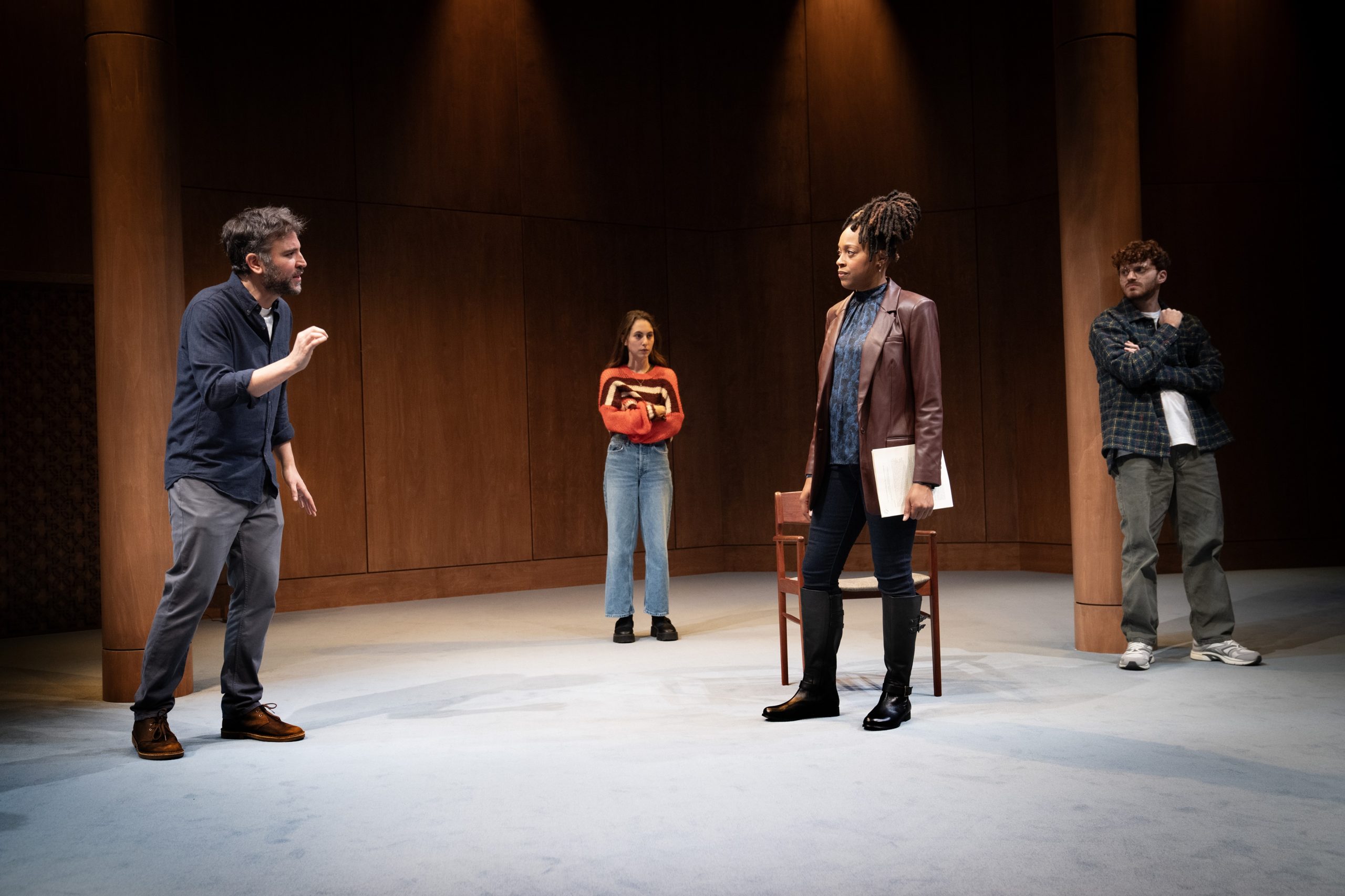
Josh Radnor, Madeline Weinstein, Cherise Boothe, and Michael Khalid Karadsheh in the world premiere production of The Ally, written by Itamar Moses and directed by Lila Neugebauer. (Joan Marcus / Public Theater)
Itamar Moses’s The Ally opened at the Public Theater in lower Manhattan on February 27. The venue is a nonprofit theater, the original home of Hamilton, and a prestigious sanctuary for progressive liberalism in the dramatic arts. The Ally is a play about Israel-Palestine and American campus activism. Moses is an excellent mimic of the speech patterns and thought processes of the archetypes on parade: the Zionist; the undergraduate Boycott, Divestment, and Sanctions (BDS) organizers; the fiery community organizer; the soft-progressive university administrator. He is an excellent writer, and the play is thoughtful and engaging, not to mention searingly topical. But however daring it is to put on a play on this controversial subject matter right in the heat of the moment, The Ally still manages to play it safe. Despite its many merits, The Ally is a more or less pure expression of anxious liberal agnosticism, spotted in the wild in one of that political tradition’s most natural habitats.
The Ally tells the story of Asaf Sternheim, an Israeli-American playwright who finds himself caught between his purported left-wing politics and his Jewish-Israeli heritage after getting embroiled in a political controversy at the college where he teaches as an adjunct professor. There is also a Palestinian student at the center of the play. Moses is a Tony Award–winning playwright, and the fact that such an accomplished figure has elected to put a Palestinian voice on stage in such a prestigious Manhattan theater is a testament to how far progressive liberals have come on this issue. In the recent past, it was uncommon to acknowledge the Palestinian perspective at all.
However, the play itself does little more than represent the voices of the powerless, showcasing but not seriously engaging with the Palestinian viewpoint. Some tensions are irresolvable: one can’t actually retain faith in Zionism while watching the fruits of that ideology play out in real time, in the form of mass slaughter and displacement. Moses takes a big leap forward by exposing theatergoers to a sympathetic campus Palestine activist. But in the end, he undermines that same viewpoint with a play that asserts the equal validity of all perspectives, and leaves it at that.