Christianity Was Always for the Poor
From the Sermon on the Mount through the Apostolic Age, the first Christians preached against wealth.
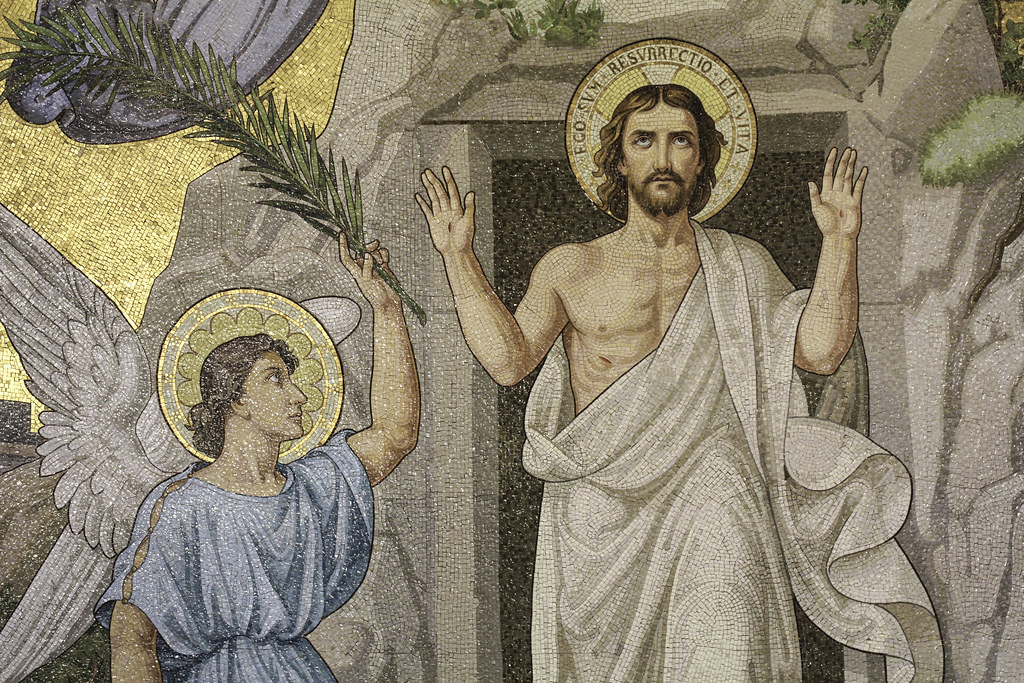
A detail from a mosaic of Christ’s resurrection in the Rosary Basilica of Lourdes, in France. (Lawrence OP / Flickr)
In evolutionary biology, one of those mysterious thresholds of which at present we have only the vaguest conceptual grasp is that moment in the ramification of any phylogenic series at which an irrevocable taxonomic divergence occurs, and a genuinely new species emerges. Traces of the event linger on in the paleontological record and the sequences of the genome, of course, but only in a fragmentary way. Only at the end of the process can we say with some assurance that a cow is most definitely not a whale, and that neither (to its credit) is a corporate attorney. But, of course, we expect nature to be capricious, and since the time of Darwin especially we have learned to find it unsurprising that horses and snails should have arisen out of precursors that did not even dimly adumbrate what horses and snails would eventually be.
Our expectations of human history, however, tend to be somewhat more “essentialist” than that, principally because our institutions and orders of power constantly rewrite the past to establish their own pedigrees. Most of us are able to inhabit and find shelter in cultural, social, political, and religious structures precisely because we trust in their unity, stability, and constancy over time. And even those of us who are anything but Hegelians are likely to believe that there is some kind of rational consistency to history’s disclosure of human possibilities, and that we can explain how the Renaissance sprang from the late Middle Ages with something like the same precision with which we can explain the course of a river reaching the sea. The result of thinking that way, though, can be fairly fantastic, rather like working on the assumption that whales, cows, and corporate attorneys constitute a single species.
All of which is a very circuitous way of saying that there is not, and has never been, a single identifiable thing that we can call “Christianity” except with excruciating generality. From the very first, “the Way” (as it was originally known among its adherents) was like a kind of pluripotential genetic code waiting to be developed by epigenetic forces; and down the centuries, its expressions continuously evolved and diverged into countless unanticipated and ultimately incommiscible breeds. This is not to say that the original “genetic” impulse was random, incidentally; I happen to believe, for instance, that the first followers of Jesus of Nazareth truly did have real experiences of him as alive again after his crucifixion, and that that is why their movement did not dissolve upon his death (though this is not the place to argue the point). It is only to say that there are many religious phenomena out there — such as the great mainstream of American white Evangelicalism — to which we apply the word “Christianity” about as meaningfully as we might apply the word “dinosaur” to a sparrow (there have, you see, been a few developments since those days).