Kissinger in South Africa
With US policy in war-torn southern Africa perpetually on the verge of capsizing, Henry Kissinger’s desire for stability put him in conflict with the ascendant New Right, which was firmly committed to white minority rule.
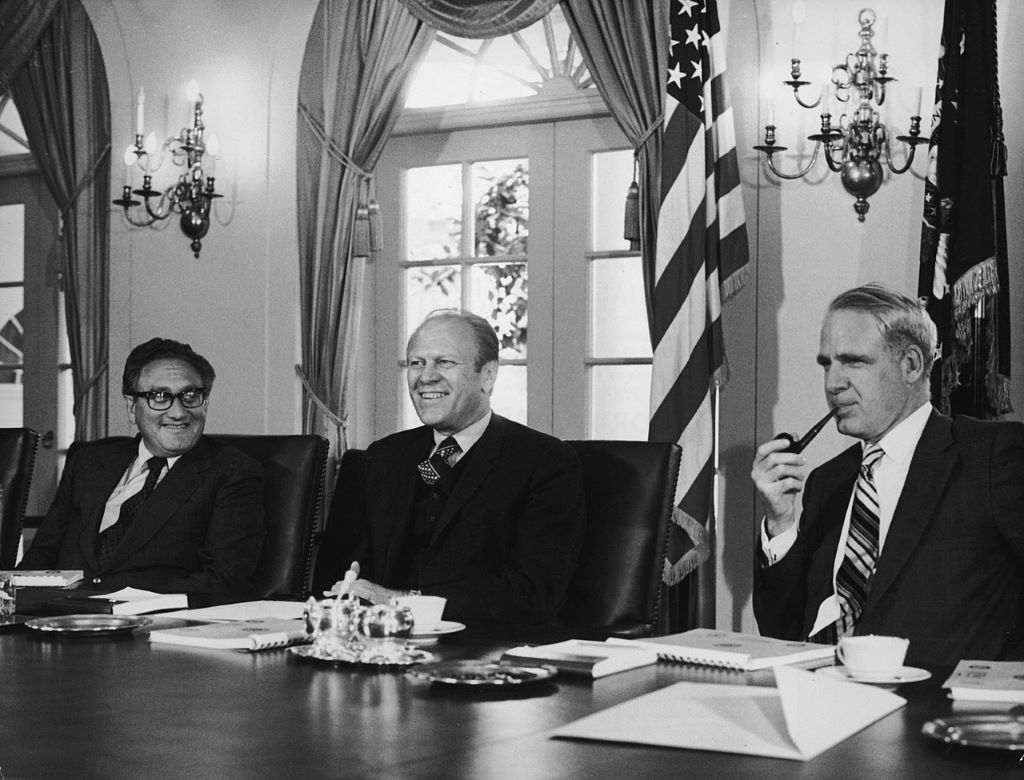
Henry Kissinger (left) with then president Gerald Ford and his secretary of defense, James R. Schlesinger, in November 1974. (White House Archive / Wikimedia Commons)
Henry Kissinger almost drowned.
It was 1976. Scrambling to avoid being overtaken by events in the wake of Cuba’s earth-shattering intervention in Angola, he had decamped to southern Africa, where his immediate goal was to assess whether the illegal white minority regime in Rhodesia might endure. (Rhodesia, fearing that London was beginning to favor African majority rule in the colony, had recently issued its “Unilateral Declaration of Independence,” or UDI.) However, he had taken a tourist detour to the natural wonder European colonizers had earlier termed Victoria Falls — twice the height of its cousin, Niagara Falls. There, his overloaded boat almost capsized.
Kissinger and his navigator were able to right themselves in the nick of time. But US policy in the war-torn region seemed perpetually on the verge of capsizing, particularly when the Rhodesian minority regime was overthrown and replaced by the independent Zimbabwean government in 1980. Later, in 1994, Washington’s client in neighboring apartheid South Africa was finally dislodged in that nation’s first democratic election, which led to the swearing into office of President Nelson Mandela.