The German Army Toppled a Pioneering Radical Government and Opened the Way for Nazism
- Loren Balhorn
In 1923, with Germany gripped by hyperinflation and far-right insurgents, Social Democrats and Communists formed a joint government in Saxony. It was a pioneering experiment in working-class democracy — before the military overthrew it.
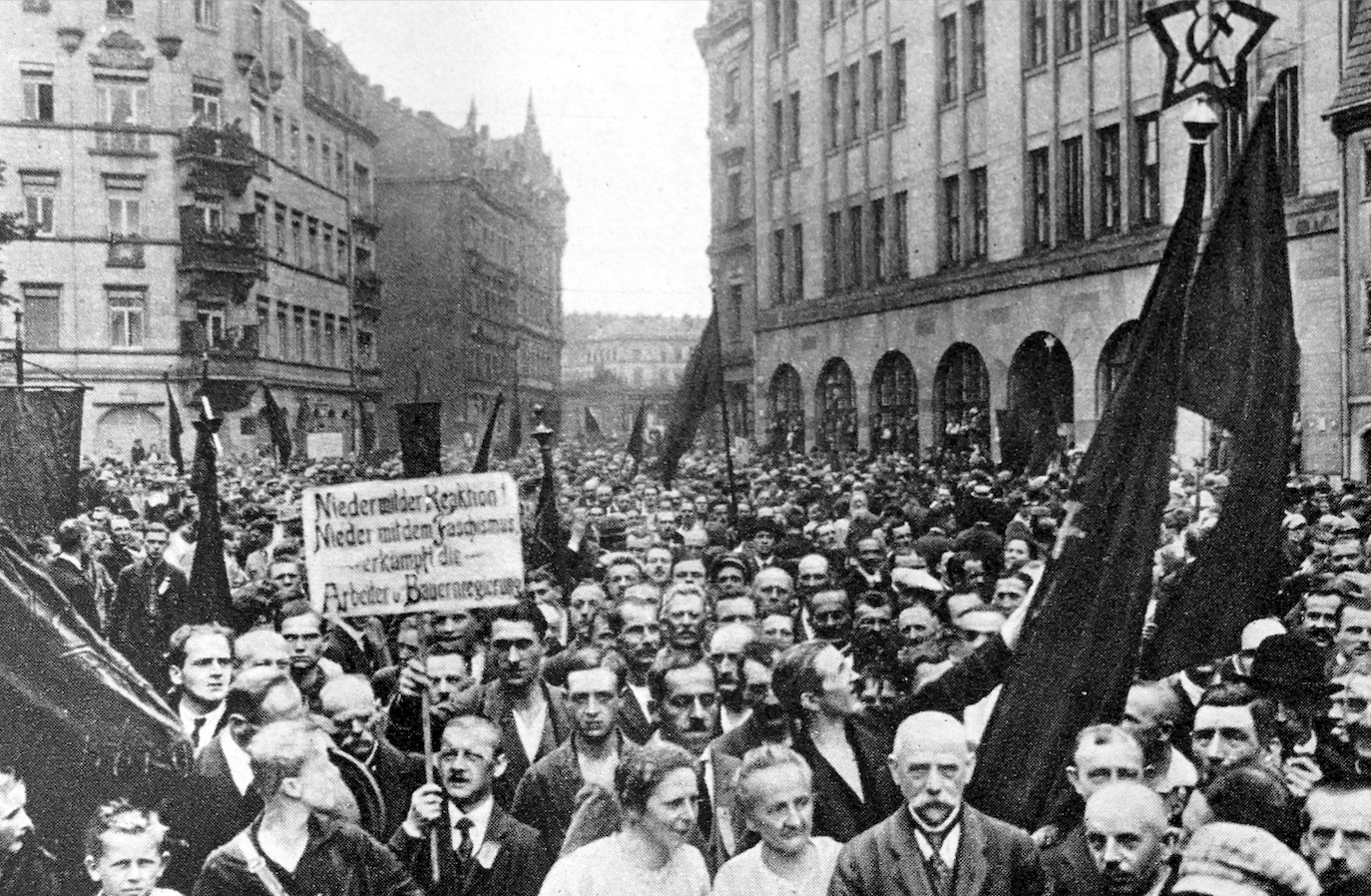
An anti-Fascism protest in Dresden, Saxony, in late summer 1923. (Universal History Archive/ Universal Images Group via Getty Images)
For a century, the year 1923 has stood for a serious crisis in Germany’s political self-understanding. It is a year known for runaway inflation, the French–Belgian occupation of the Rhine and Ruhr, and finally Adolf Hitler’s so-called “beer hall putsch” in Munich. After this year of crisis, so the standard narrative goes, things began moving forward again in Germany. Stabilization was soon followed by the “Roaring Twenties,” the happy era under liberal chancellor Gustav Stresemann.
Much less attention is paid to the events in the German state of Saxony. But here, too, the opinion among mainstream historians is almost unanimous. The policies of Saxony’s left-wing governments under Social Democratic (SPD) minister-president Erich Zeigner, supported by the Communist Party (KPD), are said to have destabilized Saxony and the Weimar Republic as a whole, encouraged a Communist coup attempt, and opened the door to “Moscow” influence.
It was therefore necessary for the German Army, or Reichswehr, to march into the state and depose the government. The army’s so-called Sachsenschlag, or “Saxony strike,” they claim, is all that preserved the republic. A 2021 school textbook, Edition Geschichte, Gesellschaft konkret, summarizes this interpretation succinctly: “In Thuringia and Saxony, the KPD and left-wing Social Democrats formed workers’ governments in an attempt to establish a communist state. These attempts at revolution were put down by the army.”