“A Communist Doesn’t Whine — He Shows His Teeth”
- Loren Balhorn
Theodor Bergmann, the last surviving member of the pre–World War II German Communist movement, spoke to Jacobin.
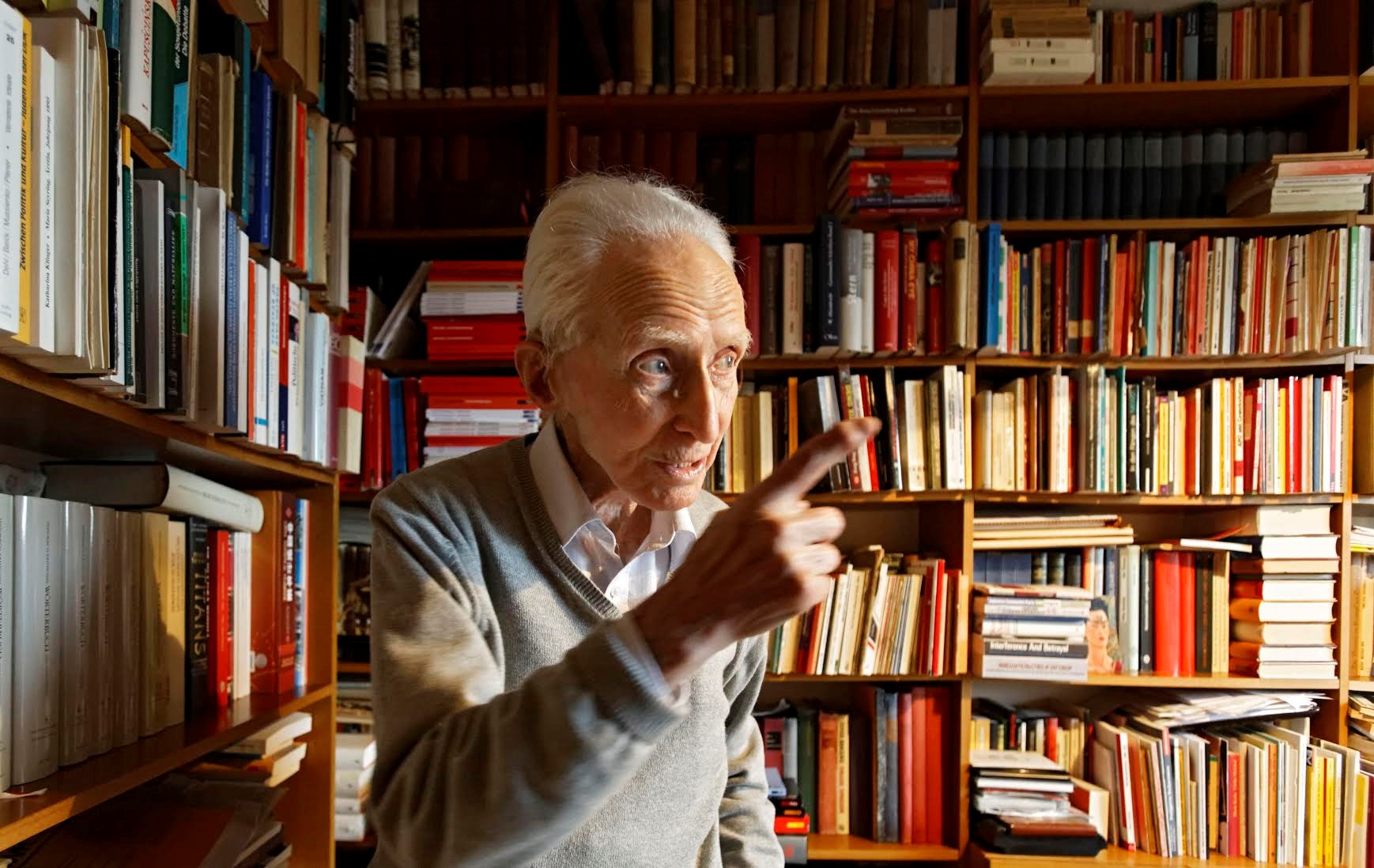
Theodor Bergmann at his home in Stuttgart, Germany. Photo: Joachim E. Röttgers.
Theodor Bergmann, who passed away in 2017 at the age of 101, was the last of his kind. Born to a middle-class Jewish family in Berlin in 1916, he gravitated to Germany’s explicitly socialist workers’ movement as a young boy and remained what he called a “critical Communist” for the rest of his life. Known among friends and comrades as “Young Theo,” he was, as Mario Kessler wrote, “the last participant and eyewitness to the German labor movement of the Weimar era.”
Influenced by his brothers, Bergmann joined the youth wing of the Communist Party (KPD) at age twelve. As political infighting in the party intensified, he sided with the “Right” current that was expelled from the KPD soon thereafter and formed the Communist Party (Opposition), or KPO, in 1929. He spent his school days helping out at the Junius Verlag, a KPO-aligned publishing house that produced a number of serious Marxist scholarly works and became the headquarters of many former KPD functionaries. Here, he came into close contact with deposed party leaders August Thalheimer and Heinrich Brandler, the latter of whom remained friends with Bergmann until his death in 1967.
After fleeing Germany for a kibbutz in British Palestine in 1933, Bergmann returned to Czechoslovakia’s German-speaking Sudetenland region in 1936 to engage in resistance work along the border to Nazi Germany. After the Sudetenland was itself annexed by Hitler, Bergmann escaped to neutral Sweden, where he spent most of World War II working on a farm. After the war, he returned to Germany and spent five years trying to unite the scattered networks of communist oppositionists in East and West into a small organization called Gruppe Arbeiterpolitik.