China and Israel Have a Long History of Cooperating in Repression
Overshadowed by its relationship with the US, Israel has also long enjoyed fruitful ties with China, now its second-largest trading partner — including a military-tech exchange that has helped the Chinese state repress its own population.
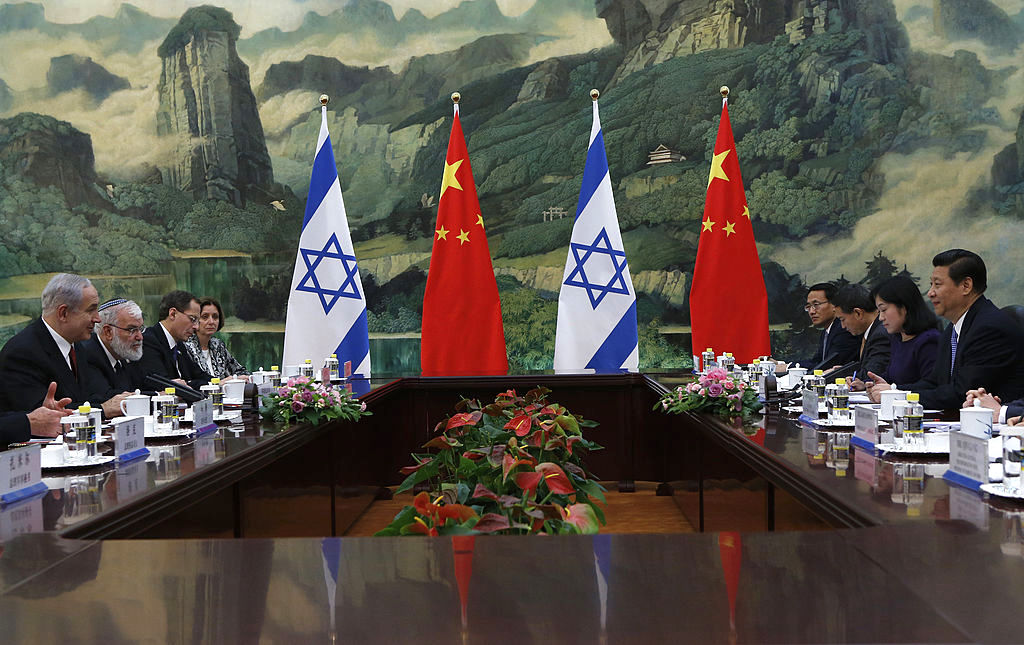
Chinese president Xi Jinping (R) meets with Israeli prime minister Benjamin Netanyahu (L) at the Great Hall of the People in Beijing on May 9, 2013. (Kim Kyung-Hoon / AFP via Getty Images)
As Israel carries out a massacre of Palestinians in Gaza, many have rightly focused on the United States’ support for the Israeli state’s war crimes. But as Tariq Kenney-Shawa points out, “The case that Israel simply no longer needs US aid in order to sustain its healthy economy or its monstrous qualitative military edge over all regional threats is clear.” While US military support to Israel remains decisive, the country receives plenty of support from other quarters — including the United States’ main global rival, China.
Though China is sometimes portrayed as an “anti-imperialist” bulwark, it is no ally to Palestinians. It is true that Chinese state media, unlike its Western counterparts, has been more willing to criticize Israel’s treatment of Palestinians. But the Chinese state has not offered meaningful support for the cause of Palestinian liberation: the significant economic links between China and Israel mean that China has a vested interest in defending Israel. China’s long history of triangulating between Israel and Palestine has involved endorsing a strategy of “peacemaking” and “nonalignment” that allows it to maintain friendly relations with Arab countries while deepening ties with Israel. China has in turn drawn on Israeli technology and counterinsurgency methods to repress its own population.
Between Israel and Palestine
Israel was one of the first and only non-Communist states to officially recognize the People’s Republic of China (PRC), doing so just a year after the latter’s founding, in 1950. Prospects for diplomacy were cut short with the rise of the Cold War, as China strengthened political and military ties with Palestinian political leaders. Chinese premier Zhou Enlai promised to support the Palestinian cause to Arab delegates at the Bandung Conference in 1955. And in the mid-1960s, Fatah and leaders of the newly established Palestinian Liberation Organization (PLO) visited China, which even offered some military training to the Palestinians.