In Latin America, Economic Equality Is a Precondition for Democracy
A new comparative study of left-wing governments in Latin America shows that left governance can create strong local participatory democracy, even in hotbeds of opposition.
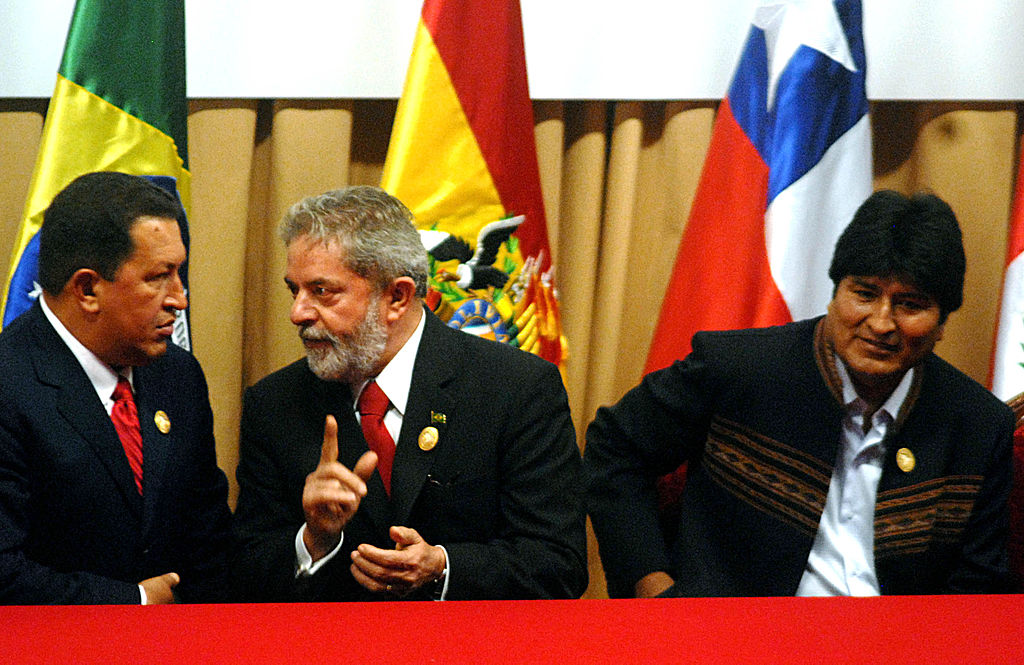
From left to right, former president of Venezuela Hugo Chávez, president of Brazil Luiz Inácio Lula da Silva, and former president of Bolivia Evo Morales, on December 9, 2006. (Ricardo Stuckert / Wikimedia Commons)
Across Latin America at the turn of the twenty-first century, mass protests and popular discontent with the failures of neoliberalism upended decades of elite rule. Progressive governments were elected across the hemisphere, spanning the spectrum from modest reformers to incendiary radicals.
In a new book, political sociologist Gabriel Hetland assesses the strength of participatory democracy in the two leftmost countries at the height of the so-called Pink Tide: Bolivia and Venezuela. His unexpected findings raise important questions for leftists anywhere hoping to one day exercise state power.
The Pink Tide’s Red Crest
The left governments that rose to power across the continent were as diverse as the populations they governed. Venezuela and Bolivia may have boasted the reddest of South America’s Pink Tide governments, but the Hugo Chávez and the Evo Morales administrations had decidedly different characters, each shaped by distinct historical contexts and social forces.