Azerbaijan’s Ethnic Cleansing of Nagorno-Karabakh Is Fueled by Regional Power Struggles
The Soviet Union’s collapse created opportunities for nationalist elites. Azerbaijan's current campaign of ethnic cleansing in Nagorno-Karabakh has been enabled by both this instability and regional jostling for influence by Russia, Turkey, and others.
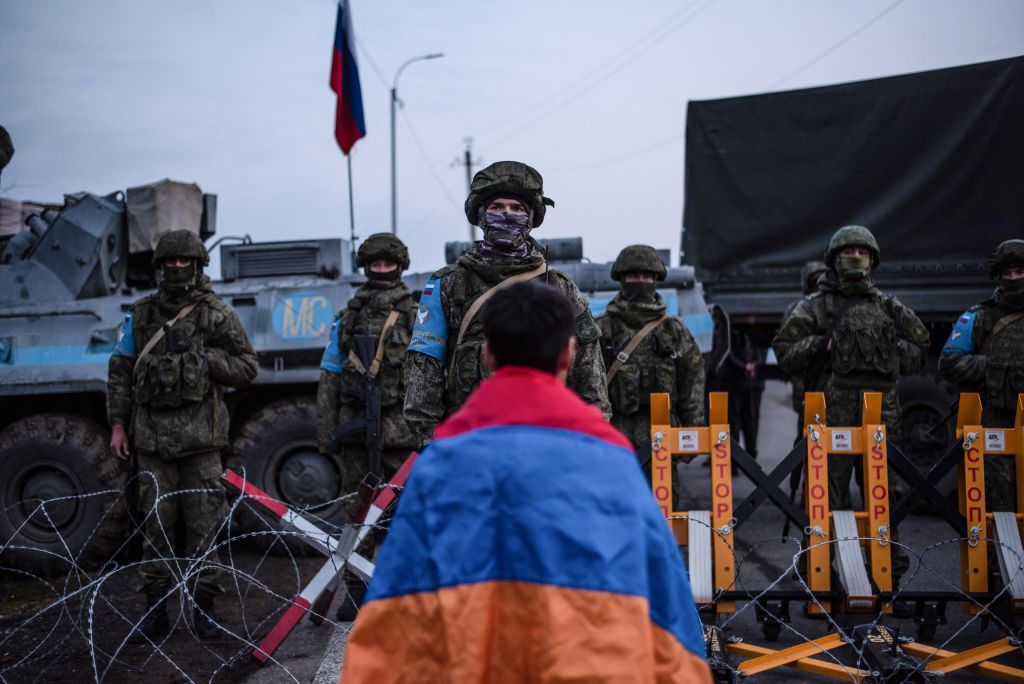
A protester wearing the Armenian national flag stands in front of Russian peacekeepers blocking the road outside Stepanakert, Nagorno-Karabakh, December 24, 2022. (Davit Ghahramanyan / AFP via Getty Images)
Following at least a month of very public military buildup — including numerous weapons transfers from Israel — Azerbaijan launched a massive offensive on September 19 against Nagorno-Karabakh, an ethnic Armenian enclave located within its internationally recognized borders. The assault, and the brutal nine-month blockade of the territory that preceded it, were both gross violations of a Russian-brokered cease-fire agreed to by Armenia and Azerbaijan in November 2020 that concluded forty-four days of hostilities. Those hostilities, or the Second Karabakh War, reversed most of the gains that Armenia won during the First Karabakh War that took place between 1988 and 1994, culminating in the de facto independence of Nagorno-Karabakh.
Today the Armenian population, which has had a continual presence in the region for more than two millennia, is in the midst of fleeing to Armenia proper, seeking refuge from both the humanitarian crisis engineered by Azerbaijan over the last several months and the near certainty of collective violence that awaited them at the hands of Azeri forces. This most recent round of fighting followed a familiar script: Azerbaijan targeted civilian infrastructure, attacked soldiers with drone strikes, and left evidence of atrocities against civilians and military personnel alike, gleefully posted on social media platforms that have, much like they did in 2016 and 2020, allowed these images and videos to circulate freely. The result of this barrage has been the disbandment of Nagorno-Karabakh’s political structures and the disarmament of its defense army, effectively ending Armenian political authority in Karabakh (or Artsakh, as Armenians refer to it), which has existed in some form or another since antiquity.