What Does Revolution Mean in the 21st Century?
We live in an era of major mass protest in nearly every single region in the world. Yet social revolutions as we knew them in the twentieth century are nowhere to be found. Why?
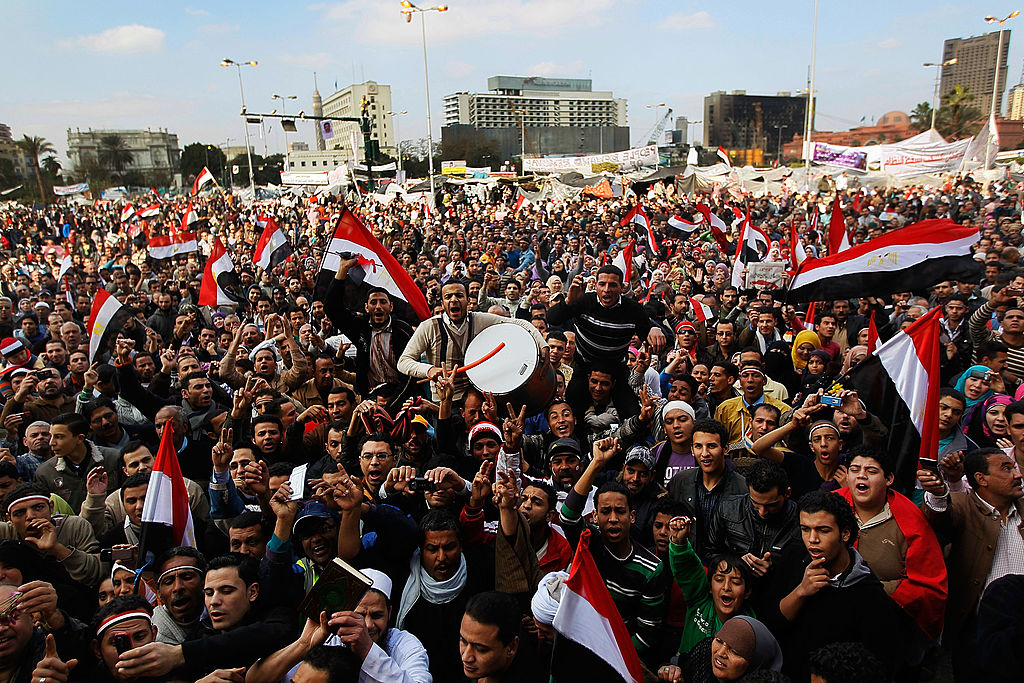
Egyptians gather to celebrate the resignation of Egyptian president Hosni Mubarak in Tahrir Square, February 12, 2011, in Cairo, Egypt. ( Chris Hondros / Getty Images)
There is a curious contradiction at the heart of world politics in the twenty-first century. The dream of social revolution seems further out of reach now than at any moment since its emergence in the eighteenth century. At the same time, however, mass protests aimed at toppling governments have swept the planet like a prairie fire. Even a partial list of countries that have experienced major convulsions in the streets is formidable: Algeria, Brazil, Chile, Czechia, Ecuador, Egypt, France, Hong Kong, Iraq, Kazakhstan, Kyrgyzstan, Lebanon, Puerto Rico, Russia, Serbia, South Africa, Sudan, and Ukraine, among many others. When the world history of the 2010s is written, the Arab Spring, Black Lives Matter, and Occupy Wall Street will all find an important place in its pages.
Each of these protest movements brought masses of people into the streets. Sometimes they even brought down a government or drove an aged dictator into exile. But their record is mixed, at best. The most successful cases have had limited success in bringing more democracy or equality, while the least successful have been subjected to harsh counterrevolutionary repression.
Mark Beissinger’s recent book The Revolutionary City: Urbanization and the Global Transformation Rebellion helps us understand these “urban civic revolutions,” and why they tend to leave the stage of history just as quickly as they take to it.