With Victory in Ukraine Out of Reach, Putin Is Stepping Up His War on Domestic Enemies
Vladimir Putin promised to “denazify Ukraine,” but this week he suppressed Russia’s own watchdog monitoring the far right. Unable to crush Ukraine, his government has turned its fire on domestic critics of war and nationalism.
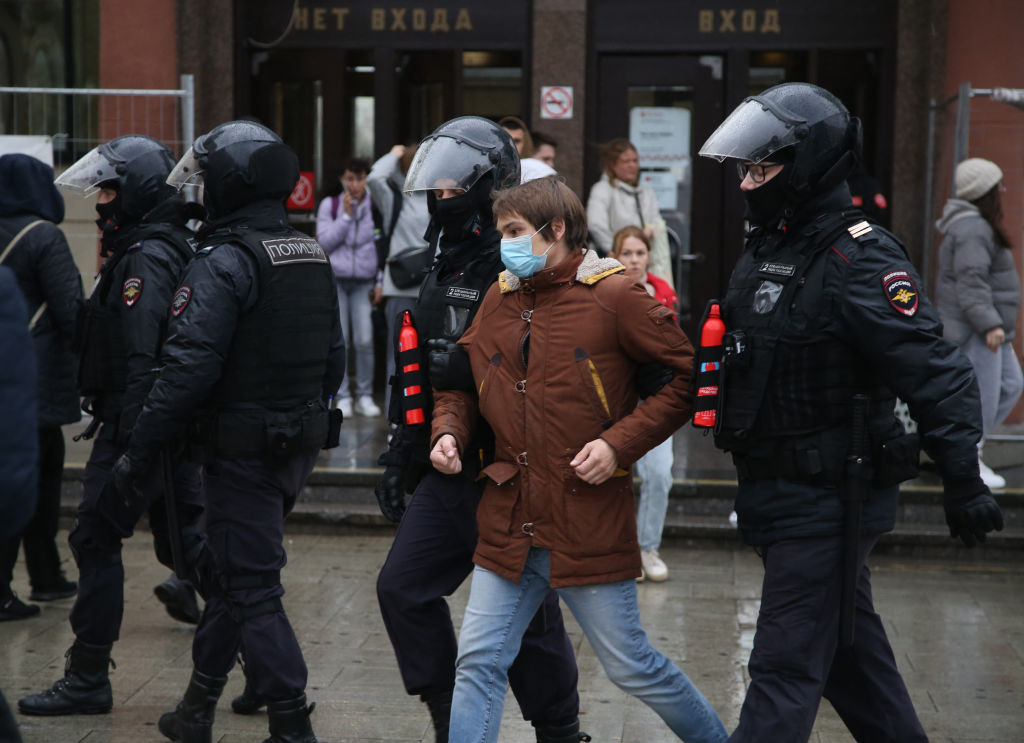
Police officers detain a protester during an unsanctioned rally in protest against the military invasion of Ukraine on September 24, 2022, in Moscow, Russia. (Contributor / Getty Images)
“How are things going for the Russian left? Really poorly,” says the young woman we’ll call Masha, smiling incredulously at what she clearly considers a bit of a stupid question. She’s standing in a Moscow basement, amid the overflowing bookshelves of the small, activist-run Cipollino Library. The collection covers the typical range of leftist literature, from the revolution in Rojava to feminist struggle and the history of the anarchist movement. The library’s name comes from a children’s story by Italian author Gianni Rodari that was popular in the Soviet Union. In Rodari’s tale, a revolutionary onion named Cipollino struggles against the unjust reign of fruits over vegetables. It’s a story of repression and resistance — one that’s become more relevant in today’s Russia than at any other time in Masha’s life.
Since Vladimir Putin launched his full-scale invasion of Ukraine in February 2022, persecution of oppositional organizing, especially from the Left, has escalated dramatically. Given the central role Putin has played in the run-up to and since the invasion — acting the part of decisive commander in chief in several martial speeches to the nation — his government’s future is now intimately tied to the outcomes of his military misadventure in Ukraine. For him, failure in Ukraine is not an option. The genuine popularity Putin had enjoyed since the beginning of his tenure was largely thanks to the fact that he was seen as having returned a degree of stability and economic development to a country reeling from the chaos of the wild, post-socialist 1990s. Now that both stability and economic growth have been sacrificed to foreign-policy goals, the war must somehow be cast as a national triumph, and no criticism of it can be tolerated at home.
This was made clear from day one, as spontaneous antiwar protests were met with violence and mass arrests. Since then, the Russian antiwar movement has been subdued with draconian new laws, introduced swiftly last spring, that criminalize criticism of the invasion as “discreditation of the military” and “spreading of false information.” But despite all official jingoist propaganda, there is not much popular enthusiasm for the war. Although some polls have suggested that large segments of the population condone it, experts have cautioned that response rates are low, and respondents are likely reluctant to answer in ways they fear might be punishable by the newly passed laws. Anecdotal evidence confirms this skeptical interpretation: a year into the war, voluntary displays of pro-war zeal, in the form of Z-patches on clothes or stickers on cars, are so rare in Moscow’s bustling streets, that days can go by without any sightings.