Putin’s War Is Exposing the Cracks in Russia’s Communist Party
For two decades, the Communist Party has been part of Vladimir Putin’s power system, while also integrating many protest movements from within Russian society. But since the invasion of Ukraine, the party’s balancing act has become ever more precarious.
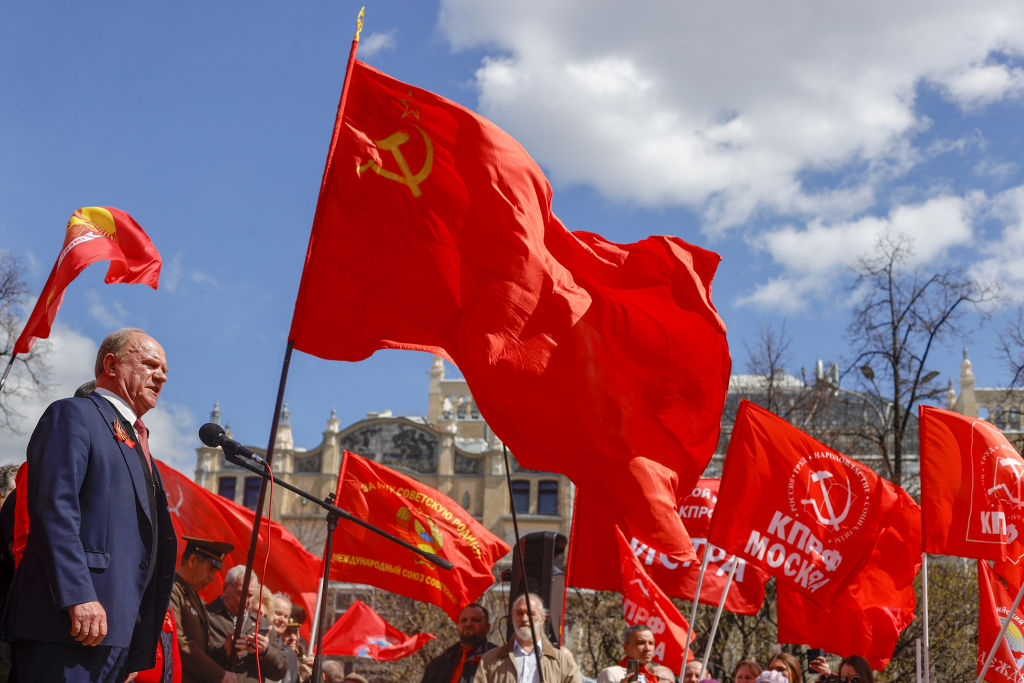
Gennady Zyuganov, the leader of Communist Party of the Russian Federation (KPRF) addresses the crowd on International Workers’ Day in Moscow on May 1, 2022. (Photo by Sefa Karacan/Anadolu Agency via Getty Images)
With the death of the populist clown Vladimir Zhirinovsky this April, seventy-eight-year-old Gennady Zyuganov became Russia’s longest-serving party leader — and also its oldest. Zyuganov has held a near unshakeable grip on the Communist Party of the Russian Federation (KPRF) since its foundation in 1993. The KPRF itself is a mainstay of post-Soviet Russian politics, indeed in a manner entirely unanticipated upon the collapse of state socialism; it has held first or second place in every Russian parliament (Duma) since 1995, and been runner-up in every presidential election since the first in 1996.
It is true that the party’s zenith is long behind it. From 1995 to 1999, the KPRF (with allies) had a near parliamentary majority, could claim up to half of Russia’s eighty-nine governors as its own (it now has just three), and briefly entered a left-wing government, which tried to impeach then president Boris Yeltsin. Most notably, Zyuganov pushed Yeltsin to a second round in the (significantly fraudulent) 1996 presidential elections, the only time the incumbent hasn’t sealed victory in the first round. However, since 1999, the party has run an ever more distant second to Vladimir Putin and his United Russia “Party of Power.”
Nevertheless, the KPRF is far from irrelevant. In the last (September 2021) Duma elections, it took 18.9 percent of the vote and fifty-seven of four hundred fifty seats. Although United Russia maintained its “supermajority” (over three hundred seats, enough to make constitutional changes) and de facto the election changed little, the KPRF’s “real” performance was perhaps as high as 30 percent, not so far behind the Party of Power.