Farmworkers in Florida Are Protesting Modern-Day Slavery
This week, Florida farmworkers with the Coalition of Immokalee Workers are marching to protest horrific working conditions including forced labor. In an interview, a CIW worker describes these conditions and how workers are organizing to change them.
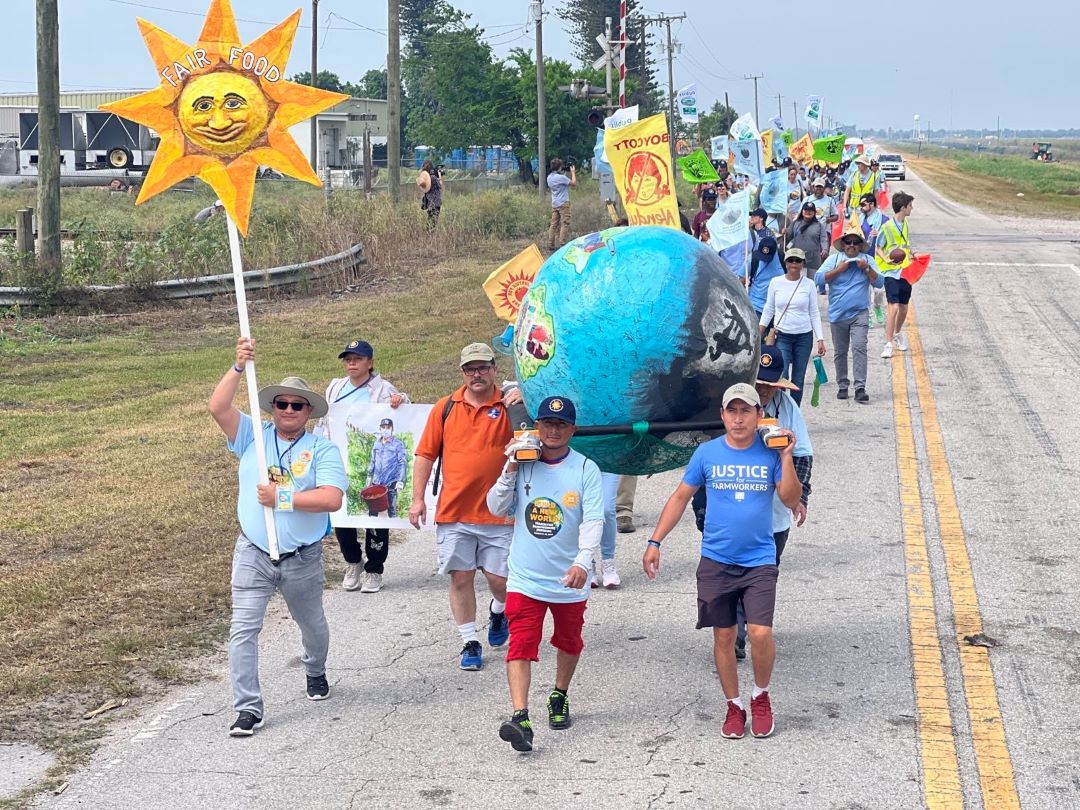
Farmworkers with the Coalition of Immokalee Workers begin their march on March 14, 2023, in Pahokee, Florida, in protest of forced labor. (Coalition of Immokalee Workers / Twitter)
In December of 2016, the Coalition of Immokalee Workers (CIW), based out of Immokalee, Florida, received a phone call from two men who had just escaped captivity near the town of Pahokee by hiding in the trunk of a car. The two men were migrant farmworkers, working on H-2A visas, who had been harvesting watermelons for Bladimir Moreno, owner of the farm labor contracting business Los Villatoros Harvesting LLC — a business that, in reality, was little more than a modern-day slave camp. “They told of being held against their will on a labor camp surrounded by barbed wire,” the CIW notes, “working and living under constant surveillance, and earning extremely low pay.”
On Dec. 29, 2022, after a lengthy investigation and subsequent trial, a US District Court judge sentenced Moreno to 118 months in prison for leading a federal racketeering and forced labor conspiracy between 2015–2017, spanning multiple states. “According to court documents,” Kristin Leigh Lore reports, Moreno owned, operated and managed LVH — a farm labor contracting company that brought large numbers of temporary, seasonal Mexican workers into the U.S. on H-2A agricultural visas — as a criminal enterprise. According to the Justice Department, Moreno compelled victims to work in Florida, Kentucky, Indiana, Georgia and North Carolina, and he also engaged in a pattern of racketeering activity that included visa fraud and fraud in foreign labor contracting. . . . Once the immigrants arrived in the U.S., Moreno and his co-conspirators coerced over a dozen of them into providing long hours of physically demanding agricultural labor, six to seven days a week, for unreasonably little pay, according to the Justice Department, which said Moreno and his co-conspirators used various forms of coercion, including tactics such as:
Imposing debts on the workers.
Confiscating their passports.
Subjecting them to crowded, unsanitary and degrading living conditions.
Harboring them in the U.S. after their visas had expired.
Threatening them with arrest and deportation if they failed to comply with demands.
The horrors uncovered at Moreno’s operation — horrors that involved the enslavement, abuse, and exploitation of flesh-and-blood human beings right here, in the United States, all around us — are not some remnant of a grim, bygone past. They are a stark reminder of the dual realities that exist side by side across the landscape of American labor: one world where working people are at least recognized as human beings with the bare minimum of rights, and another world, a submerged world, where workers who are no less human are treated as cattle, or worse.