For Chobani’s Fair Trade Certification to Live Up to Its Promises, We’ll Need Organized Labor
Greek yogurt juggernaut Chobani touts its fair trade certification as proof that it treats its workers well. But fair trade certification glosses over the fundamentally unequal and exploitative power dynamics of bosses over workers, at Chobani and workplaces everywhere.
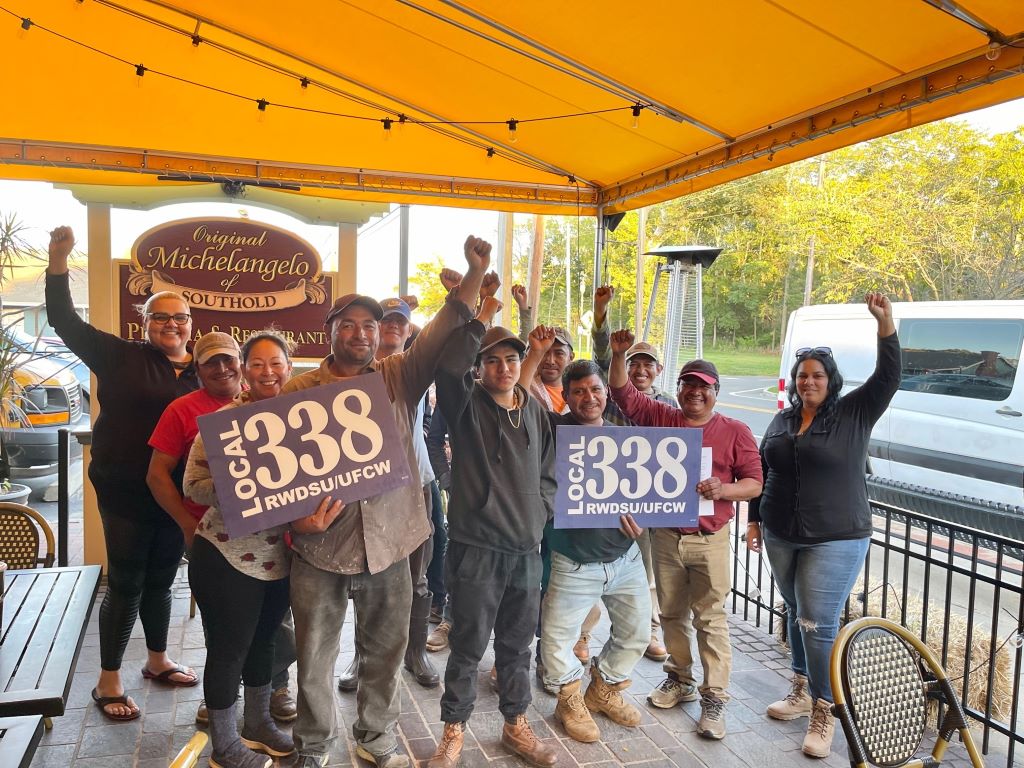
Members of the newly formed Local 338, RWDSU/UFCW, at Pindar Vineyards in Peconic, New York. (Local 338 RWDSU/UFCW)
In May 2021, the New York–based yogurt giant, Chobani, announced its new fair trade certification for dairy farms through Fair Trade USA (FTUSA). Thus far, seven of the state’s farms have agreed to recognize the new accreditation. Elsewhere in New York, farmworkers on the Long Island Pindar Vineyards made history by officially joining a union: Local 338 of the Retail, Wholesale and Department Store Union/United Food and Commercial Workers (RWDSU/UFCW), under the banner of Agricultural Workers United.
Farmworkers across the country experience poor working conditions, and dairy work is particularly dangerous. In 2015, there were over 6,700 injuries on US dairy farms. In 2018, the Bureau of Labor Statistics reported that the on-the-job fatality rate in agriculture was nearly seven times the national average.
Both the Chobani FTUSA certification and the Agricultural Workers United union organizing efforts have the labor conditions of workers in mind, but the two organizations are working within very different frameworks. FTUSA recognizes farmworkers as one group among many stakeholders — farmers, dairy cooperatives, dairy brands, and other supply chain actors. By contrast, farmworkers are the sole focus of Local 338’s campaign — the bargaining unit is composed of the workers themselves.