Peace in Ukraine Isn’t Coming Soon
Vladimir Putin invaded Ukraine one year ago today hoping to capture it in a few days — then spent the last year turning its southeast into a bloodbath. Even if the current military stalemate is broken, the divides created by the war won’t heal soon.
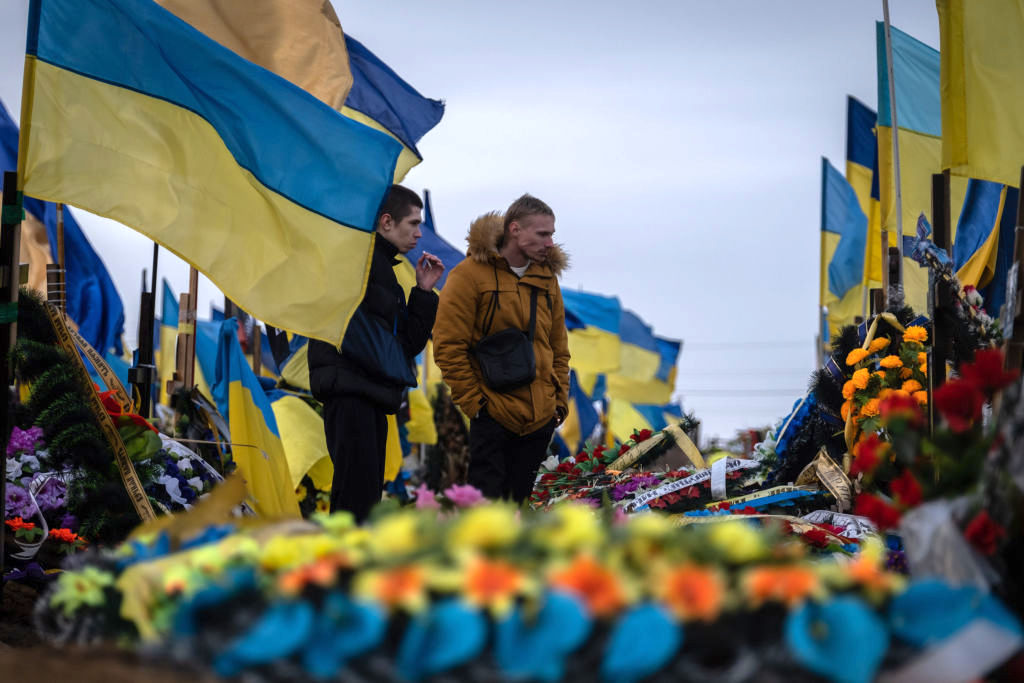
Two Ukrainian men visit the grave of a Ukrainian soldier at the cemetery of fallen soldiers in Kharkiv, Ukraine, on February 20, 2023. (Andres Gutierrez / Anadolu Agency via Getty Images)
War is bad. Almost every single human being agrees with this general principle. Aside from a handful of absolute pacifists, everyone also agrees that there are exceptions to this rule. If war is bad, defensive war is surely a regrettable necessity; if oppression is bad, revolutionary wars of liberation are practically obligatory. But if defensive wars are universally regarded as legitimate, it is practically impossible to find an aggressive interstate war that has not been presented as defensive in some form. Adolf Hitler’s declaration of war against Poland cited its refusal to accept a peaceful settlement, even as the bullets were flying. It can easily be understood that Hitler was not really trying for peace.
A claim of preventive war, like that employed by Japan in its 1941 attack on Pearl Harbor, by the United States in its 2003 invasion of Iraq, or Russia in its 2022 invasion of Ukraine, is one way of avoiding this problem. Any aggression can be justified by the claim that it was launched to forestall a future act of aggression by the target; if the war is successful, the aggressor can claim the preventive war worked; if not, defeat retrospectively confirms the need for a preemptive strike. Preventive war has a bad reputation, for obvious reasons, but it is easy to imagine circumstances in which it may be justified: the use of this argument by a Native American calling for an uprising to drive out settlers before they have the chance to exterminate the local population is easier to credit than its use by Kaiser Wilhelm II.
Another type of war that falls into a similar gray area is proxy war, or other conflicts in which one or both sides are supported by allies who keep their own hands relatively clean. After all, shipping a few containers is hardly an act of violence, yet facilitating a war effort by a country that would otherwise be quickly defeated tends to extend and intensify a conflict. For instance, the United States supplied weapons to anti-Soviet insurgents in Afghanistan, which undoubtedly had the effect of deepening and prolonging the conflict, even if not necessarily determining its final outcome.