El Salvador’s Historic Metal Mining Ban Is in Danger
Following its failed crypto scheme, authoritarian president Nayib Bukele’s cash-strapped government is making moves to reverse El Salvador’s metal mining ban. Its reintroduction would be a disaster for the nation’s already contaminated water supply.
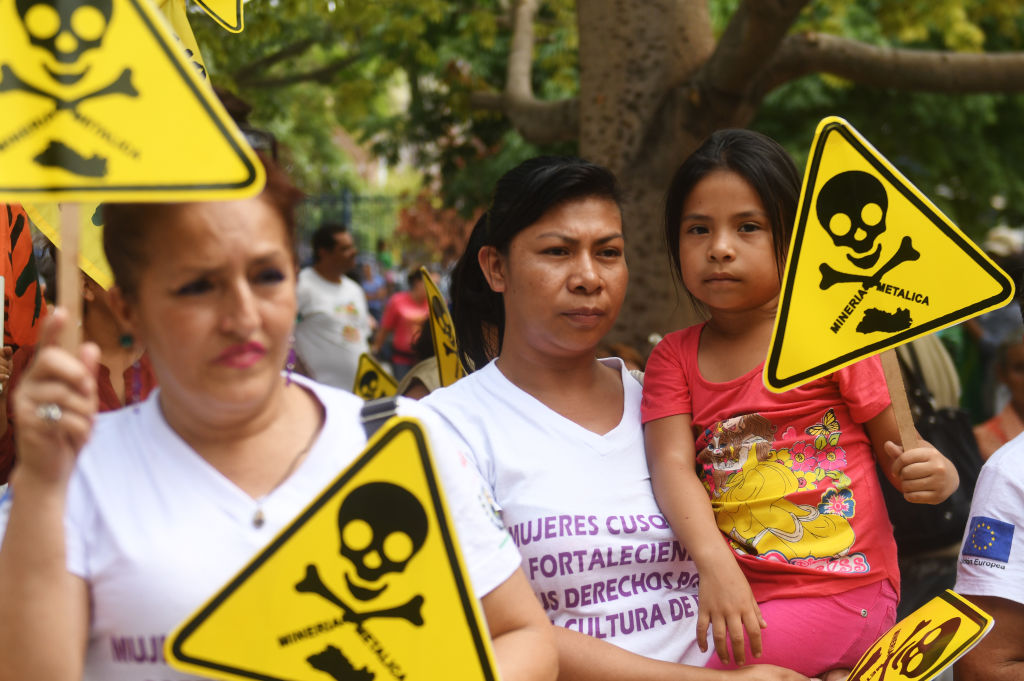
Salvadorans participate in a protest against mining outside the Legislative Assembly in San Salvador on March 29, 2017. (Marvin Recinos / AFP via Getty Images)
Unlike many Latin American countries that court extractive investments from transnational companies, El Salvador has no metal mining industry. This is unique in the region, the result of years of organizing by social groups, environmental organizations, and the Catholic Church. Under President Nayib Bukele, however, this mining prohibition is facing new threats.
On January 11, the Salvadoran government ordered the arrest of five prominent anti-mining activists and water defenders: Miguel Ángel Gámez, Alejandro Laínez García, Pedro Antonio Rivas Laínez, Antonio Pacheco, and Saúl Agustín Rivas Ortega. These figures, who all played a role in lobbying for the 2017 mining ban, are accused of “illicit associations” and committing a murder during the country’s twelve-year civil war (1980–1992). In the context of Bukele’s increasing openness toward mining, however, some in El Salvador and around the world are questioning the true motives behind the arrests. Furthermore, the five organizers are being prosecuted by a specialized war-crimes team set up by Bukele, raising worries that the ruling may be dictated from above for political purposes.
The genesis of the war-crimes team itself points to a deeper injustice in Salvadoran society. Although the UN attributes 85 percent of the crimes committed during the civil war to the US-backed military, no military member has been prosecuted there. This had led people in Santa Marta, a community with a strong anti-mining legacy, to decry the attorney general’s double standards, as there are dozens of cases that have been started by survivors of military massacres that have not gone to trial. Three specific cases are those of the Lempa massacre (forty-three killed, 189 disappeared), the Los Planes massacre (twenty-seven killed), and the Santa Cruz massacre (up to one hundred killed). Additionally, Bukele refuses to open military archives related to the El Mozote massacre, in which the US-trained army murdered around one thousand civilians in and around the village of El Mozote, even though courts have ordered him to do so.