If America Had Fair Laws, 60 Million Workers Would Join a Union Tomorrow
According to the latest data, the ranks of unionized workers grew by 200,000 between 2021 and 2022. If the United States’ unionization rules in place weren’t so biased toward bosses, tens of millions more workers indicate they would have joined a union, too.
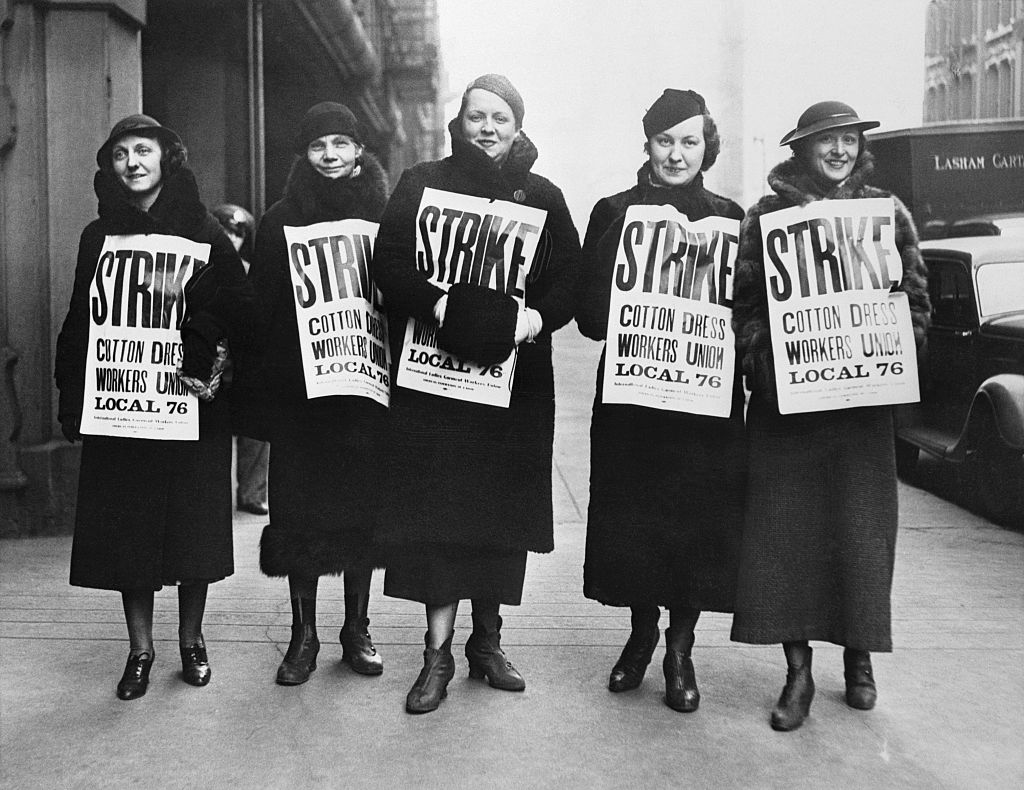
The International Ladies’ Garment Workers’ Union on strike for higher wages. (Getty Images)
According to data newly published by the Bureau of Labor Statistics and the National Labor Relations Board, the number of American workers belonging to unions rose over the past year. Amid the general trajectory of decline that has defined the last several decades of American labor organizing, the total number of unionized workers across the country rose by roughly 200,000 — with especially large increases visible in Alabama (40,000), Maryland (40,000), Ohio (52,000), Texas (72,000), and California (99,000). Between October 2021 and September 2022, the number of petitions to the National Labor Relations Board for union elections jumped by an astonishing 53 percent.
Driving the increase was a wave of unionization among workers of color, 231,000 more of whom now belong to unions (the number of white workers belonging to unions actually decreasing by 31,000). While 88,000 of new union jobs were added in the public sector, successful organizing in industries like entertainment, transport, and warehousing added 112,000 new union jobs in the private sector.
But in their analysis of the data, researchers at the Economic Policy Institute (EPI) explain why the new data, taken as a whole, are less than encouraging. For one thing, the economy added nonunion jobs at a greater rate than unionized ones, so the overall share of workers with union membership actually declined very slightly from 11.6 percent to 11.3 percent. Also, the raw numbers, though not insubstantial, were driven in part by unusually strong job growth that won’t necessarily persist into the coming years. Still, seen in relation to other developments such as the fifty-year high in public support for unions registered by Gallup in 2021, the data offers some evidence that a nascent fightback against the long-term decline of unionized work has begun.