Turkey Is Starving the Rojava Revolution
For a decade, the autonomous administration in northeast Syria has provided an alternative to dictatorship and Islamist terror. Yet still today Erdoğan’s Turkey is working to stop the revolution — including by cutting off its water and energy supplies.
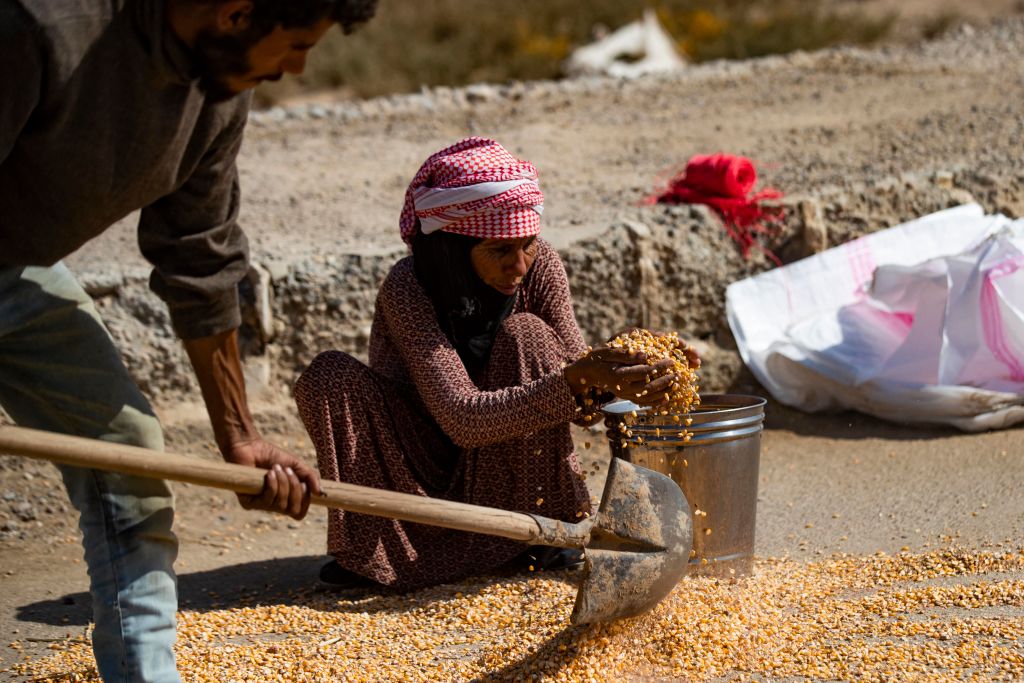
Syrian farmers take part in the corn harvest in the northern city of Raqqa, on October 16, 2022. (Delil Souleiman / AFP via Getty Images)
“We spend most of our waking life on trying to meet our basic needs,” said K. as we sat in the dark in her yard one hot August night. Households in Qamişlo — one of the largest Kurdish-majority cities in the de facto autonomous North East Syria (NES), commonly known by its Kurdish name Rojava — get on average six to eight hours of electricity per day. But K.’s neighborhood had been without power for almost a month. With no electricity or water, people like her were defenseless this summer as temperatures reached as high as 122 degrees.
K.’s family had to flee to the arid Qamişlo when their hometown Serê Kaniyê, located right on the Syria-Turkey border, was invaded and occupied by Turkey and allied Syrian militias in 2019. Leaving behind all their belongings and property has not been easy. K. — who works with the Autonomous Administration of North East Syria (AANES), the unrecognized government of the region — and her family are now struggling to make ends meet. Runaway depreciation of the Syrian lira and an embargo that have plagued NES since the beginning of the Syrian civil war in 2011 have made securing basic necessities such as food, electricity, and rent an ongoing challenge.
Yet while these hardships have become the norm, the Autonomous Administration, which has governed around one third of the country — and a population of about five million — since 2012, has managed to provide its people with greater safety and economic security than experienced by those in other parts of Syria. More than that, it has pursued nothing short of a social revolution, putting into practice a radical political vision developed by Abdullah Öcalan, the ideological leader of the Kurdish liberation movement in Turkey and Syria.