The Anti-Modern Marxism of Alasdair MacIntyre
Over seven decades, the philosopher Alasdair MacIntyre has advanced one of the most radical critiques of capitalist modernity. But in opposing modernity, he has denied a key insight of Marxism: socialism must develop, not reject, capitalism’s dynamism.
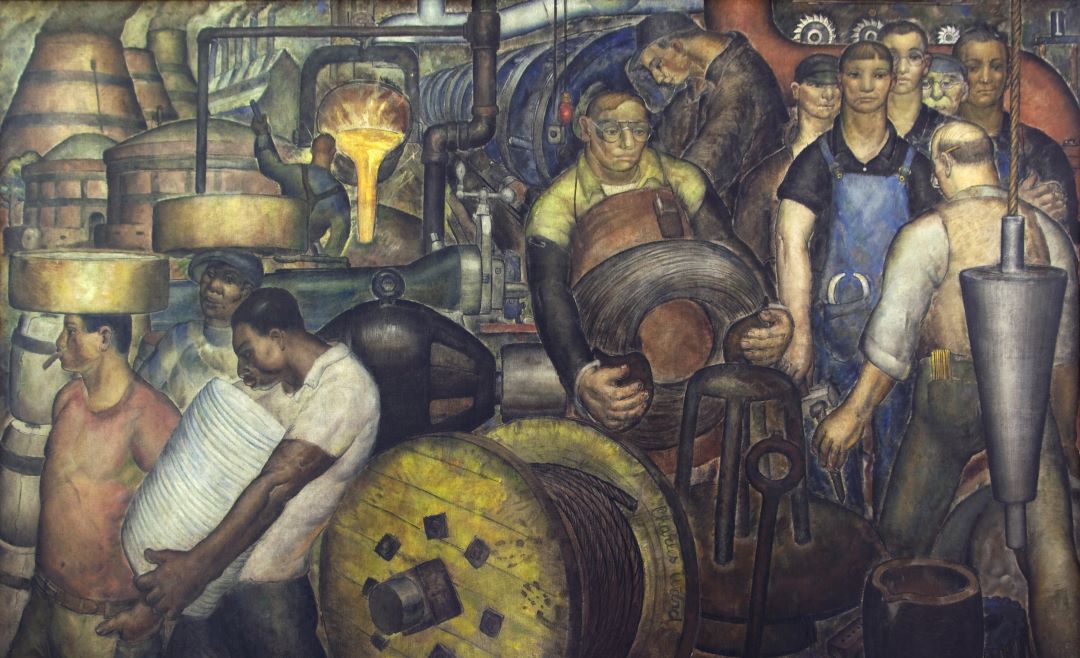
The WPA mural New Deal by Charles Wells, from the Clarkson S. Fisher Federal Building and US Courthouse, Trenton, New Jersey, circa 1935. (VCG Wilson / Corbis via Getty Images)
For the average European, America is both horrifying and alluring in the same way that for the average socialist, modernity is both horrifying and alluring. The United States is, as the philosopher Jean Baudrillard remarked during a tour of the country at the height of the Reagan era, “a world completely rotten with wealth, power, senility, indifference, puritanism and mental hygiene, poverty and waste, technological futility and aimless violence.” But, sitting in a Manhattan bar or racing toward a vanishing point on an endless empty freeway, it is hard to shake the feeling that among this mess there is “something of the dawning of the universe.”
Steeped in the writings of the medieval theologian Thomas Aquinas and Karl Marx, the philosopher and member of the New Left Alasdair MacIntyre’s thinking has been torn between two impulses. These are an old-world concern with community and belonging, threatened by industrial modernity, and a Marxist commitment to progress. Born in Glasgow in 1929, MacIntyre’s most significant writings were published well after any serious thinker could uncritically hold onto the idea of progress.
The Britain of his formative years was a nation in terminal decline; the Soviet Union was, for the Trotskyist MacIntyre, not a socialist country; and the United States’ use of nuclear weapons in Hiroshima and Nagasaki had guaranteed that future wars would be existential threats not just for the belligerents but humanity as a whole.