For Percy Bysshe Shelley, Literature Was the Spark of the Revolution
After the 1819 Peterloo Massacre, the young radical poet Percy Bysshe Shelley proclaimed he was deserting “the odorous gardens of literature” for “the great sandy desert of politics.” Instead, he infused literature with revolutionary political ideas.
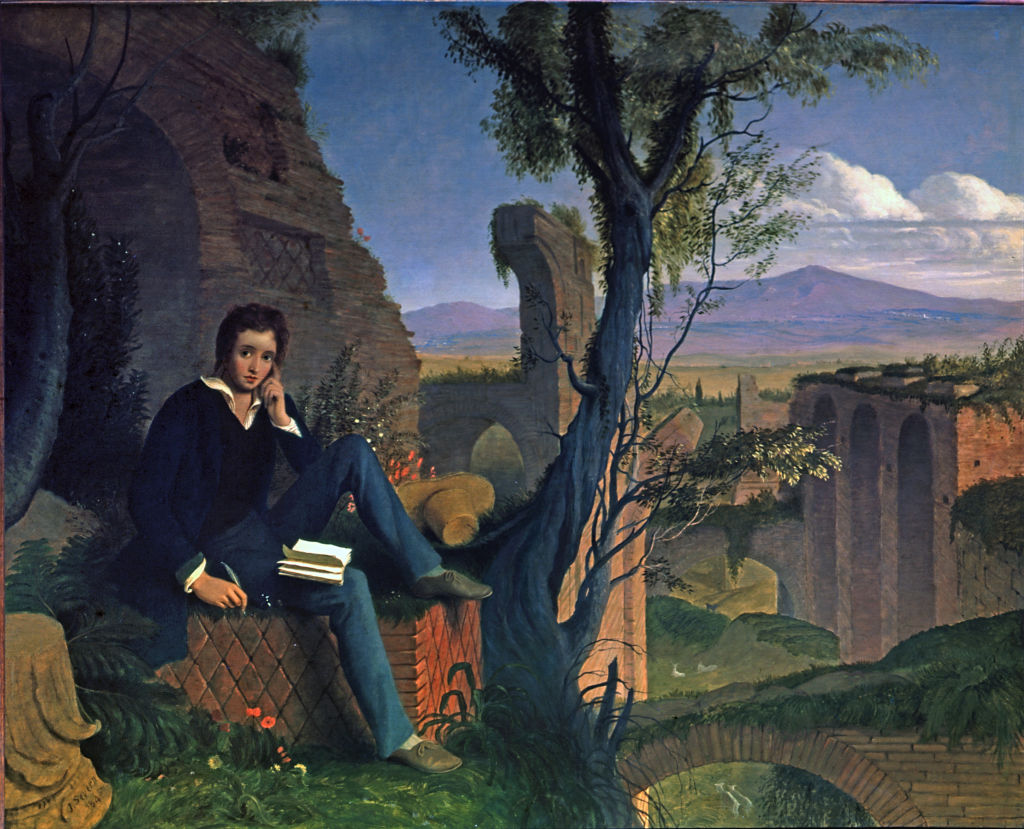
Painting portrait of the poet Percy Bysshe Shelley at the Baths of Caracalla, depicted writing Prometheus Unbound in a posthumous picture by Joseph Severn, Rome, Italy, 1845. (Fototeca Gilardi / Getty Images)
Literary reputations are fickle things. Consensus surrounding a particular author often rests on the prevailing orthodoxy of a given era’s politics and its corresponding tastes. Radical styles are often easier to assimilate than radical ideas, and writers whose politics crowd their canon tend to go in and out of popularity depending on the intellectual fashions of the period.
Few authors have fluctuated in popularity as much as Percy Bysshe Shelley, who died two hundred years ago this summer, and it should come as no surprise that where he is most derided, the source of alienation is almost invariably the radicalness of his politics.
He is most unpopular, predictably, among those we would consider to be conservatives or reactionaries. High Victorians like Thomas Carlyle and Matthew Arnold found him immature. T. S. Eliot, whose right-wing politics couldn’t have been further from Shelley, had a strange disdain for the poet and the man, calling Shelley’s ideas “repellent.” When Shelley’s reputation improved in the ’60s and ’70s, his politics were largely normalized or glossed over — an omission that led an aggrieved Paul Foot to write Red Shelley in 1981, a book that sought to reassert Shelley’s radicalism and place him (a bit uncomfortably) in a tradition of revolutionary socialism leading up to Marx.