Italy’s Communists Found Fleeting Hope in Mikhail Gorbachev
Mikhail Gorbachev’s ascent stirred enthusiasm among Italy’s Communists, who had long dreamed of reform in Moscow. The Soviet leader was inspired by the Italians’ more democratic, pluralistic approach to Communism. His failure would doom Eurocommunism, as well.
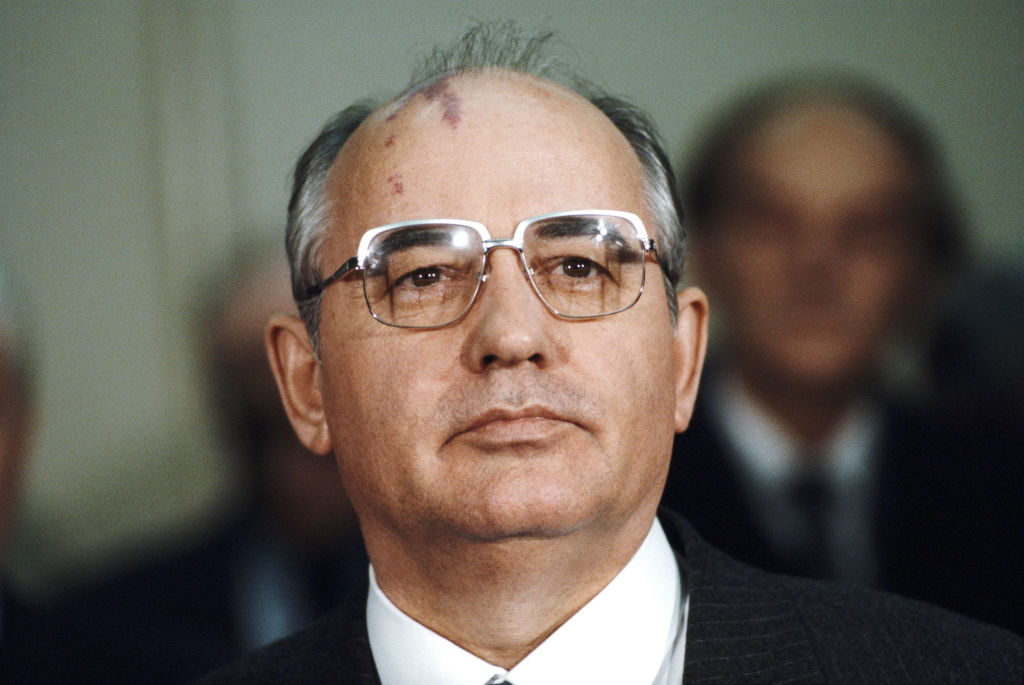
Mikhail Gorbachev was impressed by the pluralistic, democratic trends in Italian communism. (Bryn Colton / Getty Images)
In the 1970s, Italian Communist Party (PCI) leader Enrico Berlinguer became known throughout the world for proposing a pluralist, democratic communism much unlike the Soviet one. When he died suddenly in June 1984, his funeral showed the esteem he had earned: some 2 million people came to express their grief, but also their appreciation of his ideas of an alternative society based on human solidarity. A huge mass of ordinary citizens descended on Rome from all over Italy, but so, too, political figures from around the world. And at the head of the Soviet delegation was a young leader already mounting a sharp political rise: Mikhail Gorbachev.
Face-to-Face
The two men had first met in 1972, when Gorbachev, then the second-ranking Soviet Communist leader, was in Turin with his wife, Raisa, as guests at the Festa nazionale de l’Unità (a traditional annual mass gathering of Italian Communists). Gorbachev asked the city’s PCI leader, Adalberto Minucci, with whom he had become friends, if he could personally meet Berlinguer and have a face-to-face conversation with him. “Because” — he explained, according to Berlinguer biographer Chiara Valentini — “I was very impressed, on a human level, by the courage he showed in Moscow in 1969. In his speech he said things that until then had never been heard uttered in public.” The two men met and spoke for almost an hour. According to Minucci, Berlinguer showed interest and sympathy for this young Russian Communist so different from the norm.
Berlinguer’s relations with Communists in the Soviet Union had almost always been contentious, especially after the 1968 invasion of Czechoslovakia. Already then, he had proposed that the PCI not only radically distance itself from the invasion (as did much of the party’s leadership) but from the Soviet Union per se. Berlinguer strongly distrusted the USSR’s ability to reform and become more democratic. In June 1969, newly elected as the PCI’s deputy leader (he would become its secretary — i.e., main leader — three years later), Berlinguer had attended the Third International Conference of Communist Parties in Moscow. His critical speech had resonated throughout the world: for the first time since the great debates of the 1920s, and in an international forum of communists, a Communist party had advanced an alternative proposal to the Soviet one, reiterating its condemnation of the Prague invasion. This position had evidently impressed Gorbachev.