The Korean War Is All but Forgotten Today. It Shouldn’t Be.
Ever since the end of the Korean War, the US has tried its best to make Americans forget it. But for Koreans, the war never really ended. The new season of the podcast Blowback aims to excavate the realities of US brutality during and after the war.
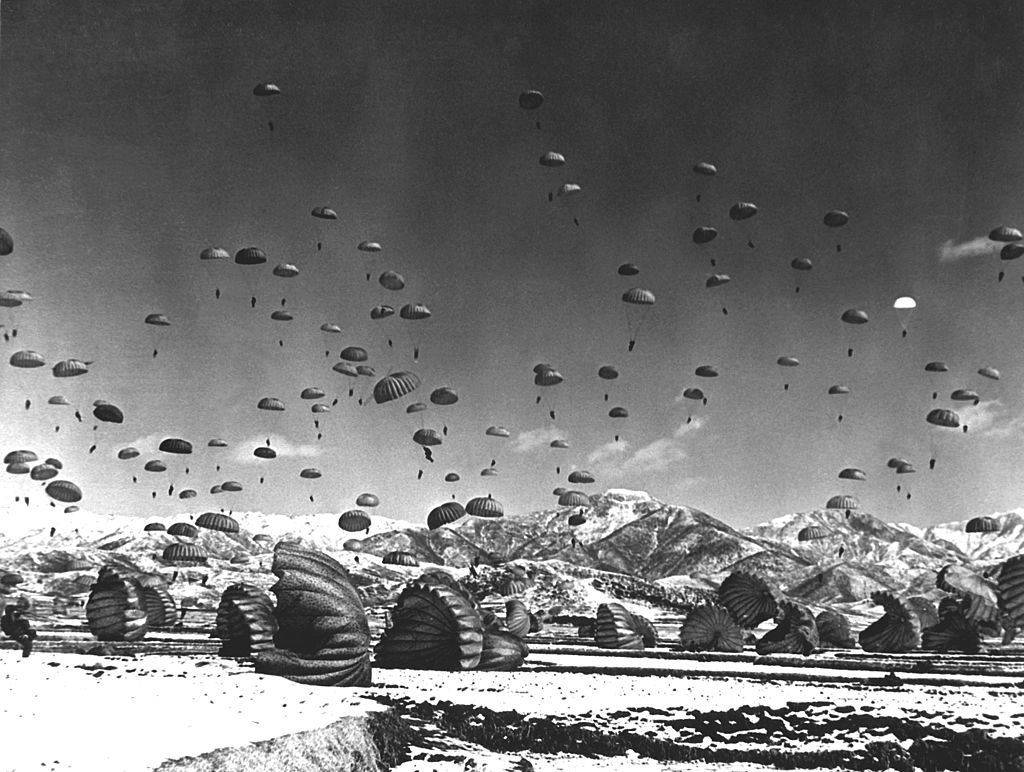
US and UN soldiers parachute down during the Korean War, 1951. (Interim Archives / Getty Images)
The one thing people tend to know about the Korean War is that they don’t know much about it. On the rare occasions it is mentioned, it’s typically described as a “forgotten war” — a term that has become something of a self-fulfilling prophecy for the conflict. Yet the third season of Blowback, a podcast about the history of American imperialism, makes a compelling case that, alongside the events which preceded it, the Korean War is far more significant than is typically credited.
To Noah Kulwin, who cohosts Blowback with Brendan James, this cliché of the conflict as a forgotten war is “used to consign what America actually did as something so minor as to not be worthy of our attention.” If the conflict itself has been turned into a historical footnote, however, its legacy has never been more prominent: in the past few years, satires of South Korean hypercapitalism like Parasite and Squid Game have exploded in popularity across the globe, while North Korea’s status as the West’s favorite bogeyman remains potent. As Blowback explores, the Korean War set the stage for the Cold War, ushered in the development of the US national security state, and helped to create the playbook which still characterizes America’s foreign policy to this day.
The title Blowback, which co-opts a CIA term used to describe the unintended consequences of a covert operation, is tongue-in-cheek. “We’re trying to illustrate how American imperialism has functioned by design, rather than being a series of misguided fuckups,” Kulwin tells me. “Using that perspective shift, we then consider the intentions of the people carrying out these policies, the interests they had, and the kinds of social histories which have generally been neglected.”