Capital’s Muddy Waters
For decades, capitalists have tried and mostly failed to privatize water supplies all around the world. But when they have succeeded, the result has been toxic health hazards and total disaster.
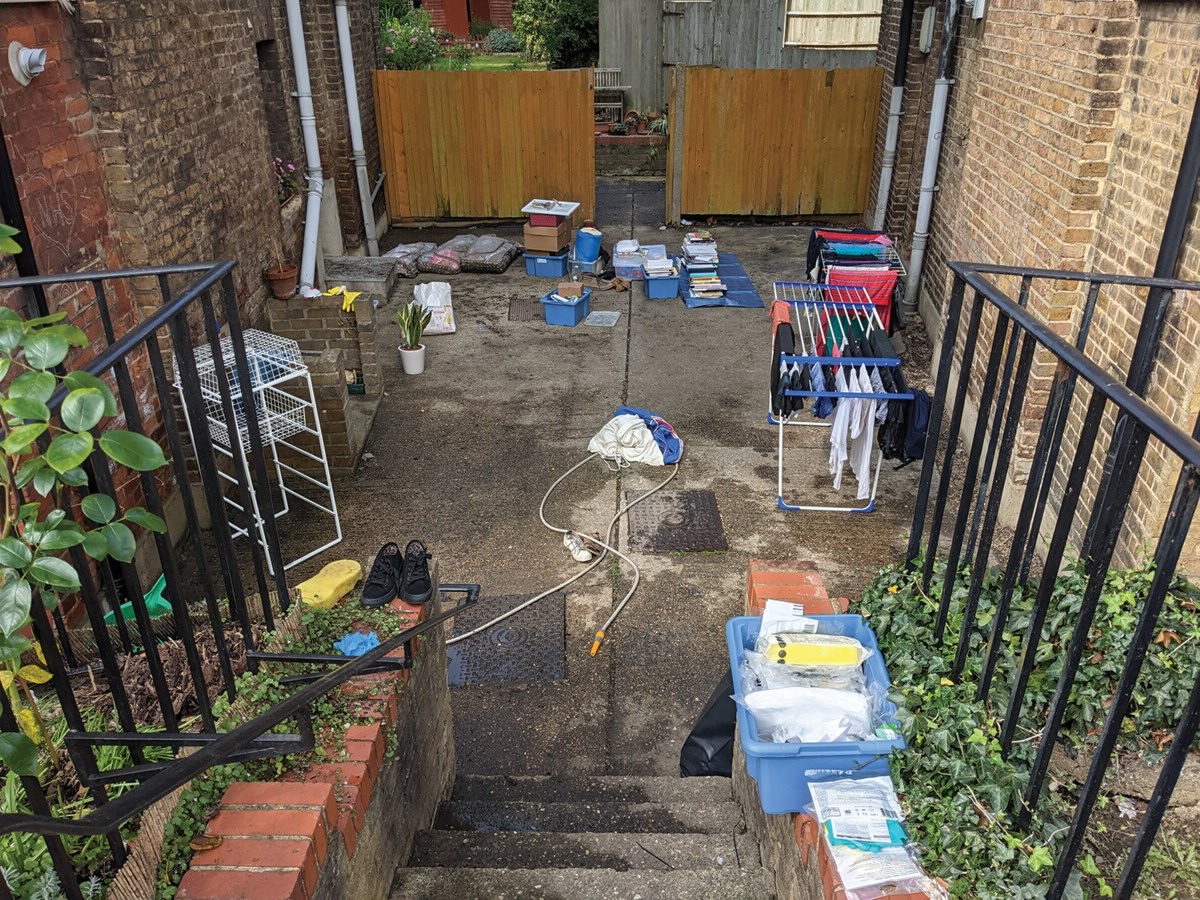
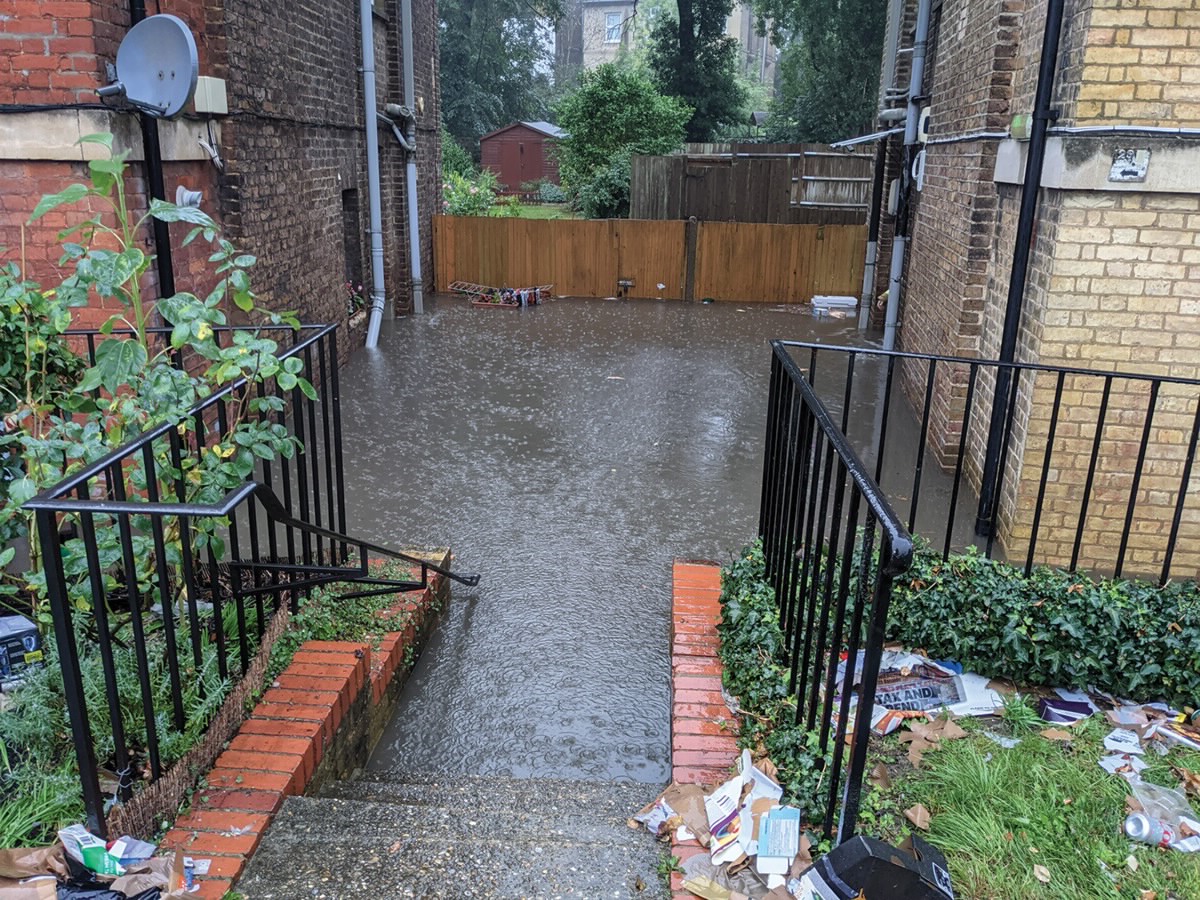
At 7:00 am one rainy morning last September in London, David Benqué heard and smelled sewage gushing through his apartment windows. David recounted to me how he quickly woke his partner, Claire, and their two children. He grabbed their five-year-old while Claire gathered their three-year-old along with the children’s favorite teddy bears, and the family waded through the already waist-high toxic flood.
By the time Claire got to the door, the flow of sewage was too strong for her and the toddler to move through the gushing current, so David stood in his flooded courtyard, yelling to the firefighters on the scene to help get them out. Within twenty minutes the entire apartment, along with two adjoining apartments and the courtyard outside, were filled with raw sewage.
The family spent several weeks staying at their landlord’s apartment until they found new housing. Nearly everything they owned was destroyed, and the only home their children had known was rendered uninhabitable for the foreseeable future. They’ve since spent tens of thousands of dollars on housing, supplies, and the removal of their destroyed belongings. Their young children are still traumatized by the “poo water” that destroyed everything they knew in a matter of a minutes, frequently playing “flood” with their new PLAYMOBIL home by repeatedly taking out all the furniture and wiping it down.
The children, David explained, “struggled with the fact that this was so random. They’d say, ‘This doesn’t happen.’ It was just like any other morning, and then shit was everywhere. Suddenly their home was destroyed.”
Now months have gone by, and Thames Water, the company responsible for water and sewage in his area, has refused any responsibility for the collapse in the brick sewer that caused the toxic flooding. In fact, Thames Water requested that the family sign a waiver absolving the company of any responsibility for the damage. (David and his partner refused.)
Yet decades of neglect by Thames Water and the other private monopolies that supply water and treat sewage in Britain have made such breakages inevitable. Indeed, sewage pollution has been a consistent and grotesque problem in the UK for years. In 2017, Thames Water was fined a record £20 million for large leaks of over a billion liters of raw sewage into its namesake River Thames. So much sewage had built up in the river that residents of Little Marlow, a town on its north bank, had taken to calling their stretch of the river “crappuccino.”
In 2020, water companies reported approximately 400,000 sewage spills at thousands of storm overflow pipes across the country, for a cumulative 3.1 million hours’ worth of untreated sewage flowing into English rivers. Dumping sewage, Ash Smith from Windrush Against Sewage Pollution explained, is a regular and essentially self-regulated aspect of operation for water companies. The companies are evaluated on the performance of their treatment plants, but they can only handle a small amount of wastewater. “The answer has been to dump untreated sewage” before it arrives to the plant, said Smith.
In the past few months, repeated sewage leaks and government inaction have fueled public anger, leading to the biggest wave of protests since the water industry was privatized more than thirty years ago. Cat Hobbs, the founder of the British organization We Own It, told me that the UK water industry currently boasts a 32 percent profit margin. These water companies, Hobbs explained, “would rather pollute our rivers and seas, get a slap on the wrist [a nominal fine], and carry on with business as usual than actually put the public and the environment first.”
Failed Promises of Privatization
The push to privatize state-owned services has been part and parcel of a neoliberal agenda for decades. From 1979 to 1990, Margaret Thatcher’s government deregulated industry and finance, muzzled militant labor unions, cut taxes, and sold British telecommunications, gas, electric utilities, rail and bus lines, seaports, airlines, and water infrastructure into private hands.
In the water sector, the industry promised much-needed investment in a system that had been consistently underfunded in the preceding decade. Private companies, the argument went, would be more directly accountable to customers and shareholders than government bureaucrats had been to their citizens. In 1989, ten regional water agencies were delivered debt-free to private companies that promised to provide increased investment and efficiency.
But although the industry saw an initial uptick of investment in the infrastructure to meet European water quality requirements, spending has steadily eroded ever since. Recent research by the Financial Times shows that “total capital expenditure by the 10 biggest water and sewage monopolies had declined by 15 per cent since the 1990s — from £5.7bn to £4.8bn a year.” In fact, the notorious polluter Thames Water is the only water company that claims to have increased spending, though not enough to keep pace with population growth.
Across the UK, customers’ water bills have risen by about a third since 1989. Meanwhile, the companies have accumulated £53 billion worth of debt and paid out £72 billion in dividends to shareholders. In the cases where substantial investment has occurred, it’s been funded through increased fees for water users.
“When there’s a big project, like the Thames ‘Super Sewer’ [Tideway Tunnel], the public has to pay,” explained Hobbs.
All of the investment is coming from the public, through our bills. What they’re doing is a financialized scam: They use this guaranteed income to take on a load of debt, to extract a huge amount of dividends for their shareholders, and to use these vehicles to generate profits. The outcome is that we pay more than we should, they extract more than they should, and then they just literally pour crap into our rivers.
Globally, only state governments in the UK and Chile sold off their water systems wholesale — transferring pipes, facilities, and all other assets to private entities. But apart from these extreme examples, in many parts of the world, states have held on to water infrastructure but contracted out the management of their systems through public-private partnerships (PPPs), usually for twenty or thirty years at a time, or pursued some combination of asset sales and PPPs.
And it’s not just a handful of governments either. International financial institutions led by the World Bank have also pushed privatization schemes. In her book Water for All, which chronicles the struggle for water access in Cochabamba, Bolivia, historian Sarah T. Hines explains how the World Bank conditioned loans to developing countries for water infrastructure projects on sectoral reforms. These reforms “would enable the government and lenders to exert greater control over water sources, infrastructure, rates, and governance,” thus making water utilities more attractive to investors. They “aimed to facilitate privatization, private sector management of water provision, and commercialization, and treated water as a commodity with an economic value rather than as a social good or right.”
To this day, the World Bank’s private sector arm, the International Finance Corporation (IFC), is the world’s largest funder of water projects. According to the World Bank, with their assistance, more than 260 contracts have been awarded to private companies to manage urban water and sanitation utilities in the developing world since 1990.
In Argentina, for instance, one of the world’s largest water privatization programs was enacted as part of the country’s neoliberal turn in the 1990s. Under the administration of President Carlos Menem, the government aimed to reduce budgetary expenses and raise capital by selling off state-owned enterprises. In its effort to privatize the water system of Greater Buenos Aires, the Menem government repeatedly hiked water rates to make the company more attractive to potential bidders.
The state retained ownership of existing water infrastructure but let the private sector take money from residents through higher water bills in return for maintaining and expanding service. Aguas Argentinas SA (AASA), a multinational consortium led by two French companies, Suez and Vivendi, won a thirty-year concession in 1993. (The runner-up bidder was a consortium led by Thames Water.) Although initially promising to reduce water rates, AASA — with the help of the World Bank — raised rates in return for a pledge to increase investment in the system.
Water connection fees rose 84 percent, and charges went up 42 percent for sewage. At the same time, investments in infrastructure amounted to less than half of what was required by the contract, indefinitely delaying a major wastewater treatment plan and sewage project that the company had been obligated to build in the first five years of the concession. As a report by the North American Congress on Latin America (NACLA) notes, in this way, “AASA went from registering deficits to reaping astounding profits in its second year of operation, taking in $350 million with $50 million in net profits.”
During the contract, water quality decreased, with contaminants in the water found at levels deemed unacceptable by sanitation authorities; technical failures caused service outages; and cesspools of sewage overflowed in poor neighborhoods. AASA expanded profitable water services rather than dole out the more expensive investments necessary to develop sewage and drainage services.
A 2001 report from the research network Municipal Services Project found that, as a result of lack of sewage investment, “over 95% of the city’s sewage continues to be dumped directly into the Río de la Plata and households with new water services are often forced to dump their sewage into makeshift septic tanks, cesspools or directly onto streets and open fields.”
Basements, the report notes, have begun to flood; building foundations have been compromised; and waterborne diseases have become a greater concern.
Do as I Say, Not as I Do
Surprisingly, in the arch-capitalist United States, public water systems were never really delivered into private hands. While systems were first developed by private companies during the rapid industrialization of the nineteenth century, some notable and spectacular failures led city and state authorities to municipalize water infrastructure and supply by the mid-to-late 1800s. New York City’s water system, for instance, was built by the Manhattan Company, the predecessor of JPMorgan Chase. The Manhattan Company’s waterworks ran on twenty-one miles of leaky wooden pipes, and customers complained about undrinkable water. In the years that followed, New York battled multiple outbreaks of yellow fever and cholera and an average of twenty major fires per year — the city’s ability to fight fires having been massively hampered by limited water supply. The city finally took over water services after a cholera outbreak that killed more than three thousand people.
Nationally, successive administrations have been more interested in pushing privatization schemes on other countries than they have in drinking their own Kool-Aid. Although private companies are still aggressively going after water systems, particularly in states with legislation in place that easily facilitates takeovers, most Americans today get their water from publicly owned and managed water authorities.
Thus, while Margaret Thatcher was carving up as much of the UK’s public infrastructure as she could get away with, Ronald Reagan preferred austerity measures in the United States. Federal funding for water systems, which peaked in the late 1970s, was cut dramatically in the 1980s; since 1977, it has fallen by 78 percent in real terms. Bill Clinton furthered the process that Reagan set in motion in the 1990s with “full-cost pricing” — the idea that the full cost of water services should be reflected in their rates.
As Mary Grant from Food & Water Watch explained to me, cities were caught in a bind. They could either jack up rates to fund services, which led to shutoffs and poor people losing their homes over unpaid water bills in places like Detroit, or they could simply neglect their system and end up with poisoned water. As she put it, “It creates a two-tiered system. If you’re wealthy and you can afford to pay for your infrastructure, then you can have high-quality water. But if you’re poor, then you’re stuck with toxic water, broken sewer systems, and sewage backing up into homes.”
And it could get worse. In a handful of states, like Pennsylvania and New Jersey, water companies like American Water and Aqua America have successfully lobbied for fair market value (FMV) legislation that makes it easier for them to acquire water systems. Companies use FMV to offer wildly inflated values to buy out the water systems — an offer cash-strapped municipalities can’t refuse — then use that valuation to justify big rate hikes. “It’s basically like payday lending,” explained David McMahon from Neighbors Opposing Privatization Efforts (NOPE). “Built into the rate is a guaranteed 10.9 percent return for shareholders. It’s just like printing money.”
Much of the reason these companies haven’t gotten very far yet can be chalked up to organized resistance. Local organizations like NOPE and Save Chester Water Authority (SAVE CWA) in Pennsylvania have been organizing petition drives, public comments, door knocking, and rallies. In some cases, they’ve been able to override their city councils’ privatization schemes.
Throughout their public canvassing, Kofi Osei from NOPE told me that he hasn’t met a single person who wants to privatize. “You’ll get conservatives who say, ‘I paid my money into this, why is the government doing this with my money?’ And you’ll get progressive people who care about the environment and say, ‘If we want to prioritize the environment, we need to own this infrastructure.’” Catherine Miller, from SAVE CWA, too, said that the volunteers organizing against the takeover of the water authority come from a variety of political backgrounds. “On election day, I had a Trump supporter and a super progressive environmentalist staffing a SAVE CWA table together.”
The durability of public water in the United States may be a holdover from the Progressive Era, but populist sentiment on both left and right has consistently opposed privatization. According to Grant, there is “ongoing sentiment across the board, no matter if I’m talking to a Tea Party conservative in Florida or anyone across the political spectrum in the United States. People feel deeply connected to water and that it needs to be in public and local control.” The movement for public water in Florida, for instance, “was led by Tea Party conservatives and retirees. They were successful, and they scared the company out of the state.”
A Resilient Resource of the Commons?
Environmental geographer Karen Bakker characterizes water as an “uncooperative commodity.” It is highly localized in nature, with deep histories of community-controlled management in many parts of the world, and at the same time a “flow resource,” in constant motion through the hydraulic cycle, which makes it difficult to establish private property rights. As Hines put it to me: “Water is always in motion. Whereas you can take over a plot of land and arm people to protect it, it’s much harder to do that with water. You have to let it renew itself by letting it flow.”
Water is also a non-substitutable resource that is critical for life and carries with it symbolic and spiritual connections to communities. In the case of Cochabamba, as Hines recounted, “Whereas people might feel like they have a right to the proceeds with other natural resources like oil or gas, most Bolivians don’t touch oil or gas or have a role in its extraction. But everyone needs water; everyone uses water.”
Water has thus proven to be a highly risky and oftentimes unprofitable venture — particularly when supplying the poor. Most companies have shifted to focus on water delivery in advanced economies where they can be guaranteed an acceptable return on investment with fewer political risks. To the extent that corporations are still attempting to take over public water assets in poor countries, they are doing so if they can secure heavy subsidization through international financial institutions like the World Bank, along with contracts that absolve them of responsibility to provide services in cases of “exceptional circumstances” like natural disasters.
Even with the World Bank “sweetening the pot for the private sector,” director of the Municipal Services Project David McDonald told me, “the private sector really isn’t biting” the way they did in the past. “Either because they can’t make enough money or because of political volatility . . . it’s bad for their branding if they have to leave a country with their tails between their legs.”
High-profile cancellations of contracts in Atlanta, Buenos Aires, Jakarta, La Paz, and Manila “seem to bear out the hypothesis that water presents difficult, and perhaps intractable, problems for private sector management,” Bakker wrote.
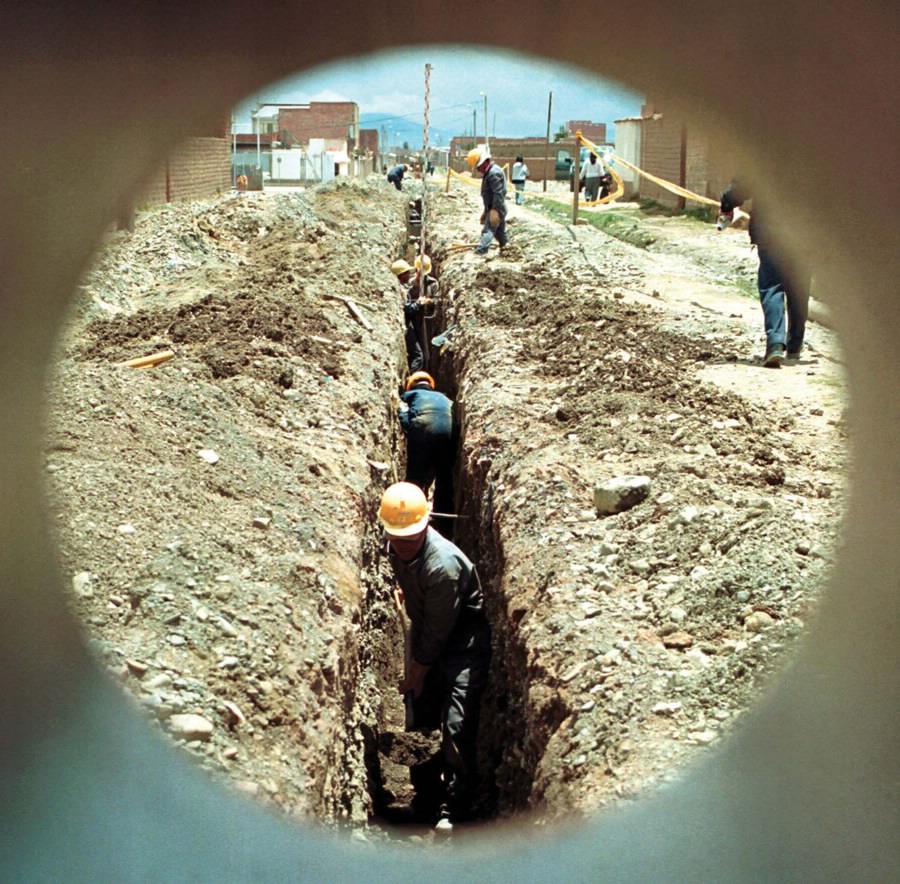
Between December 1999 and April 2000, neighborhood organizations, peasants, unions, committees of water users, and irrigators in Cochabamba organized tens of thousands of people against the privatization of the city’s water supply system. The proposal being considered was a forty-year concession to a Bechtel-led consortium, Aguas del Tunari, for water provision. The struggle came to a head in April 2000, when a hundred thousand protesters shut down the city, occupied the Aguas del Tunari offices, and replaced their corporate placard with one that read “Aguas del Pueblo.”
The government was forced to back down, and the victory proved to be a major flash point against the neoliberal world order. Just as Thatcher’s carve-up of state resources marked the opening shots of the push to privatize everything, the Water War of Cochabamba signaled a pendulum shift in the other direction. The following two decades have seen over three hundred cases of water remunicipalization, including Buenos Aires in 2007 and other cities throughout Latin America, Africa, the United States, and Europe.
The Transnational Institute (TNI) is a research and advocacy organization that tracks global remunicipalizations and works on deprivatization of services. When I spoke to Satoko Kishimoto, coordinator of TNI’s public alternatives program, she agreed that the appetite among companies for privatization in low-income countries is not what it used to be. Contracts of the scale pushed through in Buenos Aires, Jakarta, and Manila in the 1990s “probably won’t happen anymore. It’s too risky for companies.” Still, she warned that “worldwide, privatization is still very strong,” pointing out that more than ten countries in Africa are under immediate pressure by the World Bank to embark on public-private partnerships, as well as observing a shift toward increased privatization in the Middle East and states like China, Japan, India, and Indonesia.
The World Bank, for its part, has shifted its emphasis toward corporatization and transforming public water utilities to prioritize cost recovery over equity or sustainability. As McDonald put it, “The neoliberal era has taken corporatization as an institutional tool and infused it with marketized sensibilities, which has utterly transformed the water sector.”
Further, the question of what replaces private sector participation depends on what kind of infrastructure the state has in place. The remunicipalization efforts throughout France have been quite successful, even installing carbonated water fountains around Paris — “socialism with a sparkle,” as Hobbs calls it. The Parisian model incorporates democratic, accountable mechanisms that include community and worker representatives.
But when the water system of Cameroon came back into public hands, the country was left with much fewer resources to invest in the maintenance and expansion of its infrastructure. And like many private companies that have been written out of water management, Camerounaise des Eaux has since demanded compensation from the Cameroonian government for financial losses.
In the next decade, hundreds of water service contracts around the world will come up for renewal, just as the demands on global water supplies increase due to pressures from a warming climate. We can’t anticipate all of the complicated factors that will determine whether and where the private sector or the public commons will win out. But for David Benqué, the London resident whose family dealt with Thames Water’s neglect, the question is simple: “How is a company allowed to make so much profit off our infrastructure and then not have any responsibility for it when it fails?”