To Plan the Green Transition, We Need to Democratize the State
France’s election campaign has seen growing calls for greater ecological planning. But if the green transition is not to impose austerity by other means, it has to be planned by working people themselves.
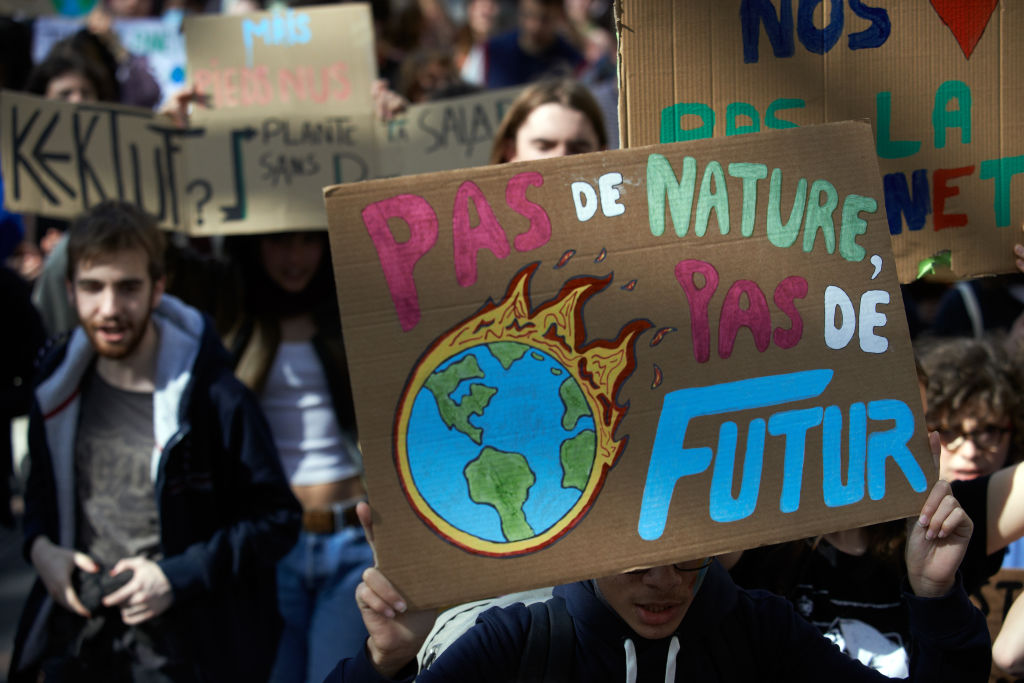
A protester holds a sign that says “No nature, no future” in Toulouse, France on March 25, 2022. (Alain Pitton / NurPhoto via Getty Images)
A fleet of delivery workers weave their electric-propelled bikes between the cyclists along a boulevard divided by a new tramline. Small electric cars drift along uncongested highways, dotted every few kilometers by charging stations. While public transport dominates, the few motorists in their own cars can glimpse the farms that provide flexitarian groceries to towns and biofuels to the remaining airports servicing long-haul flights. Revitalized villages teem with life, after a decades-long boom in agricultural employment. After settling into their well-insulated home, with solar panels donning its roof, a family of erstwhile city-dwellers saunter down to the riverbanks, with cargo vessels coasting by.
These are a few of the everyday-life scenes that the Shift Project, a Paris-based think tank specialized in the energy transition, lets us imagine in its Plan for the Transformation of the French Economy. The world envisaged here is set in 2050, more than a quarter-century after this month’s presidential election. In this timeline, the winner on April 24 kicks off a legislative marathon that came to define the 2022–27 presidential term — the years when the environmental crisis finally emerged as the central focus of French political life.
The world described in the Plan could hardly be a further cry from our own societies, buckling under the sway of petro-power. But it is all the more valuable for it: here is a detailed picture of life in an industrialized society, after the energy transition. What classics of environmental argument, such as William Morris’s 1890 book News from Nowhere, or Ernest Callenbach’s Ecotopia describe through the moralizing power of the novel, the Shift Project’s Plan provides in a brief panorama written in the more sober language of social science.
Back to the Plan
The thirty years of future history told in the Plan also rely on past precedent. Here, old institutions such as the Planning Commission, a relic of postwar France, are dusted off and tasked with coordinating between government ministries, and the myriad of private businesses and associations mobilized toward slashing the use of fossil fuels. Newer bodies, such as the Citizen Convention on the Climate, an assembly of randomly selected citizens that drafted climate-related proposals in 2019 and 2020, here serve as models for the deliberative bodies that would later define collective priorities and needs. This would allow a green revolution to take over France, achieving carbon neutrality, remaking daily life around smaller circuits of consumption, work, and play — making us all happier and healthier.
The Plan puts to rest many of the debates and silver-bullet solutions that usually trip up the ecological debate. “Sustainable development,” for example, assumes that the gamut of renewable sources will be able to fully compensate for the flexibility and abundance of carbon sources, and pick up for growing energy demand. But the intensive amounts of energy needed to extract the metals for solar panels, turbines, and batteries — and the finite nature of those resources — argues against the claim that renewables will be able to fill the gap in the energy mix left by fossil sources. The mass production of biofuels likewise conflicts with our other major spatial needs: biodiversity, but also agricultural production and the earth’s ability to digest and stock carbon.
Nuclear power, the Shift Project argues, is an indispensable short- and medium-term solution, cushioning the drastic drop off in carbon energy sources that will need to define the next decade. But the resources and time needed to set up new reactors — to say nothing of difficulties in supply, transportation, safety, and disposal — means that nuclear power won’t realistically be able to fully compensate for what needs to be a sudden drop in petrol and gas consumption.
Then there’s the question of time. Adapting to a world with lower energy consumption may end up being forced upon a society like France’s, even before the disastrous effects of global warming make themselves fully felt. The end of “easy oil,” the earth’s most accessible petrol stocks, was passed in 2008, the International Energy Agency alerted in 2018. Before the Russian invasion, this was one of the main causes of rising energy prices and inflation, for example.
While veering away from “degrowth” romanticism about spontaneous communities, the Plan argues that we need to prepare our societies not only for the end of fossil fuels, but for declining energy consumption more broadly. It is still difficult to truly wrap our heads around this prospect — one that presents an unprecedented divergence from two centuries of such consumption constantly expanding. The report is worthy most of all as a display of the fact that, technically speaking, this is possible. It just so happens that ecological “sobriety” has a lot in common with what some might call a free and truly modern life.
Green Rule
Some form of “ecological planning” is a natural fit for the environmental debate in France, drawing on a tradition of state-centric economic management that straddles the left-right political divide. There is an emerging consensus, shared by Emmanuel Macron, the three candidates of the right, and Communist Party candidate Fabien Roussel, that France needs to double down on nuclear power — among developed economies, France draws the highest share of its electricity from nuclear plants. In recent months, the president has made a series of high-profile statements paving the way for a new generation of reactors.
But there is a risk then that “ecological planning” might be little more than a rubber stamp for a new eco-statism that might ride roughshod over critics of nuclear power. Although he pledges to break from nuclear energy, Jean-Luc Mélenchon has long been the leading advocate of ecological planning, a component of his project since the early 2010s. His program calls for the downscaling of productive processes, industrial re-localization, and a surge in agricultural production to be guided by a “green rule” included in the French constitution, outlawing extractive activity that violates natural limits. A “council on ecological planning” will be the main executor of the green transition, sitting atop a pyramid structure of bodies tasked to draft policy and laws, from commune-level committees to departmental assemblies up though the national parliament.
Swimming with the political tides, Macron vaunted his own “will to plan” on March 17. The tenor of his first term, however, says otherwise. The important policy proposals made by the Citizen Convention of the Climate included strict regulations of advertising, moratoriums on constructions outside previously developed space, new taxation, and near-bans on domestic air travel.
What could have been an excellent jumping-off point for ecological planning resulted, however, in the lackluster Climate and Resilience Law passed in 2021. Roundly criticized by environmental NGOs, the government’s landmark piece of environmental legislation was in fact a series of minimal, toothless regulations driven by the philosophy that a “voluntarist” policy that changes in individual behavior was the best way to reduce emissions. It goes without saying that anything even remotely resembling the Shift Project’s rosy scenario is unimaginable if that vision holds sway for another five years.
Energy Wars
A major case for ecological planning is that we already do it — or at least a twisted form of it. The economic fallout of Russia’s invasion of Ukraine is a cruel reminder of the scope of global energy governance. Gas is still flowing from Russia to Western Europe, but enormous amounts of financing and resources are slated to be directed toward weaning the European Union off Russian oil and gas imports by 2027.
The talk is of new pipelines from the Sahara up through Southern Spain, oil and natural gas terminals dotting the Atlantic and North Sea Costs, and revived coal mining. These are billed as short-term solutions, necessary to facilitate the disconnect from Russian oil and gas imports. They risk, however, further locking in fossil fuel consumption, even as European countries have committed themselves to a 55 percent cut in emissions by 2030, relative to 1990 levels.
Without again indulging in early-pandemic-era optimism about what people then liked to call “the world after” COVID-19, political environmentalism needs to seize the Russian crisis before the petrol industry’s well-honed mastery of shock politics again confirms itself. The Shift Project report came out in early February, a humble attempt to pierce a 2022 election dominated by the Right’s cultural anxieties. But with the politics of energy thrust again into the center stage of French and European politics, it ought to serve as a roadmap for fending off the oil majors’ efforts to situate themselves as key players in securing European autonomy.
To do that, however, ecology needs to be political. For better or worse, the Shift Project’s Plan is focused entirely on the technical side of reducing fossil fuel emissions, and the areas of life that will need to be restructured in a lower energy future. Perhaps for that reason, the plan entirely skips the question of political conflict. It’s all well and good to augur the re-localization of supply chains, the scaling down of industrial production, and the reassignment of hundreds of thousands of French workers to the agricultural sector.
But short of a moral revolution — one of the unmentioned conditions of this plan — “planning” will have to mean command of, or the existence of, political institutions that enable a democratic majority to actually govern itself. This brushes up directly against one of the main disclaimers of the Shift Project: that the transition conceived in the report is consistent with, and can indeed assume, the persistence of existing political institutions. In France this means the Fifth Republic, cannibalized by executive power and a truncated parliament. To judge by its track record since 1958, it’s as good a tool as any to amplify the power and influence of what Henrik Ibsen’s 1882 play An Enemy of The People called the “compact majority.”
“Optimism is never far from naivety, nor entrepreneurship from recklessness,” Jean-Marc Jancovici concedes in the Plan’s introduction. “Only time will tell whether the work you hold in your hands was a welcome initiative because it made a positive difference in the course of history, or whether it was the most culpable form of naivety, because we wasted our time devising inapplicable solutions.”
One antidote to this would be to not skirt around a number of major problems; the well-organized and engrained interests that stand between us and what now looks like the highly optimistic scenario of a two-degree future temperature rise; how those interests perpetuate their power; and the specific social groups that we need to peel off from them. It is in the nature of utopian literature to prioritize the description of a possible other world. The hope is that from here to there, others will take care of the muddy work of altering the political balance of power.
For France’s populist left, today grouped around Mélenchon, a crucial corollary to ecological planning is the immediate calling, weeks after the 2022 election, of a constituent assembly to draw up the constitution of a new republic. An ecological revolution by 2027 — so meticulously described in the Shift Project’s Plan — is unimaginable without such a political counterpart, giving people the power to take their own destiny in hand.