Boycotting Russian Dissidents Is Only Helping Vladimir Putin
Anti-Russian boycotts in the West are hitting even outspoken opponents of Vladmir Putin’s war. Collective punishment is deeply unfair — and only hardens Putin’s grip over Russians.
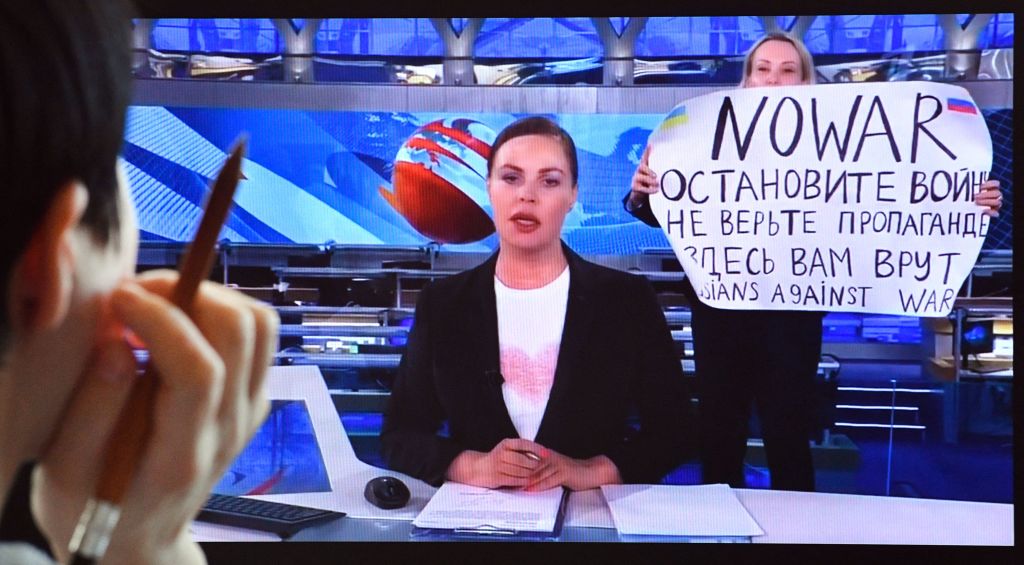
A woman looks at a computer screen, watching dissenting Russian Channel One employee Marina Ovsyannikova interrupting Russia’s most-watched evening news broadcast, holding up a poster that reads “No War” and condemning Russia’s military action in Ukraine in Moscow on March 15, 2022. (AFP via Getty Images)
My birth certificate reads: “Mother: Tatar; Father: Russian.” For reasons involving alcohol abuse, my father played no role in my life, and I was raised entirely by my mother’s side of the family. When I was little, I used to think my great-grandmother wasn’t very intelligent, as she spoke Russian in a strange way and exclusively used the male gender. Only later did I realize that Russian wasn’t her first language; it was Tatar. Only later did my mother tell me about the discrimination our family faced as an ethnic minority in Russia and her own experiences of being referred to as a “filthy Asian” — too narrow-eyed, too skinny, too dark.
When she signed up for a dating firm to find a husband in the West, it was recommended she dye her hair blonde before taking professional photographs for the online profile. Only later did I understand why my own Tatar identity was hushed, in favor of emphasizing that I am Russian.
On the day that Vladimir Putin invaded Ukraine, I returned from demonstrating at the Russian consulate and the United Nations and posted a story on my Instagram. I described my struggle with Russian identity, my effort to assimilate to Dutch culture when my mother and I immigrated to the Netherlands, how I felt that I could only come out as lesbian once I denounced my Russianness, how I’ve felt ashamed of being Russian for most of my life. This changed when I started to engage with queer culture in Russia, allowing myself to imagine an alternative future for the country. But that hope shattered all over again when Putin invaded Ukraine — leaving nothing but an overwhelming sense of shame. I was aware that this post risked “making it all about me,” but I also felt that the personal was my only entryway into the political. Not only am I far from an expert in foreign policy — and amazed by how easily others pretend to be — but I believe that that the violent suppression of queer voices, within the wider gagging of any opposition, has been one of Putin’s most successful strategies for stabilizing his rule.